BREAKING: Democrats Shut Down GOP Plan That Could Let Officials See Your Mail-In Vote — Here’s What They Tried to Slip In
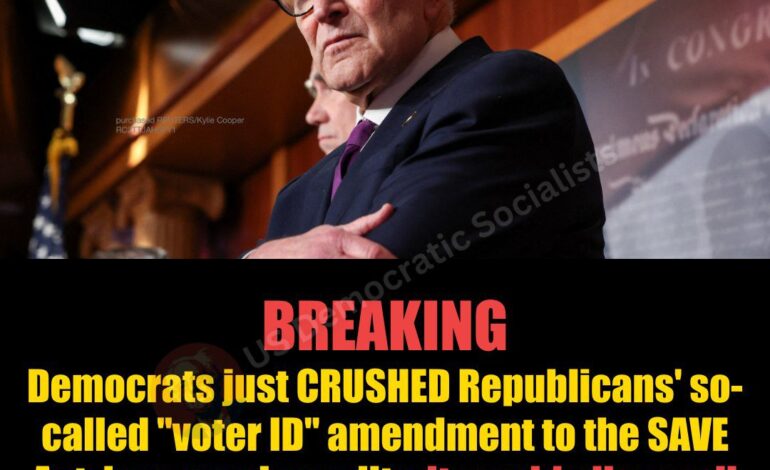

Senate Democrats Block GOP Voter ID Amendment: What the Mail-Ballot Privacy Fight Is Really About
| Quick Answer On March 26, 2026, the Senate voted 53-47 to defeat a Republican amendment offered by Sen. Jon Husted (R-OH) that would have required photo ID for all federal elections, including a photocopy of ID placed inside mail-in ballot envelopes. Senate Democrats and Sen. Schumer argued this would allow election officials to open envelopes and see how voters voted, destroying ballot secrecy. Republicans called it a clean, common-sense voter ID requirement. The vote fell short of the 60-vote threshold needed to overcome the filibuster. |
Introduction: A Voter ID Vote That Is Not Quite What It Seems
On March 26, 2026, the United States Senate held a vote on a voter ID amendment. The outcome: 53 in favor, 47 opposed. Not a single Democrat voted yes. The amendment failed — it needed 60 votes.
Simple enough, right? Except this vote is about far more than voter ID. It is about one of the most fundamental principles in American democracy: the secret ballot. And it is about a broader elections bill — the SAVE America Act — that has consumed the Senate for two weeks and ignited a fierce national debate about who gets to vote, how they get to vote, and who decides.
This article explains the amendment in plain language, presents both parties’ arguments fairly, examines the mail-ballot secrecy concern at the center of the controversy, and provides the full factual context you need to form your own opinion.
What Was the Husted Voter ID Amendment?
Sen. Jon Husted (R-OH), a former Ohio Secretary of State, offered an amendment to the SAVE America Act on March 26, 2026. The amendment would have created a national photo ID requirement for all federal elections.
Here is what the amendment would have required, in plain terms:
- In-person voters: Show a valid government-issued photo ID before casting a ballot.
- Mail-in / absentee voters: Include a photocopy of a valid photo ID inside the envelope with their ballot.
Valid ID forms listed in the amendment included: a state-issued driver’s license or ID card, a U.S. passport, a military ID, or a tribal ID.
Overseas military members, some elderly Americans, and some disabled voters would be exempt from the mail-in ID requirement.
What Is the SAVE America Act?
The Safeguard American Voter Eligibility (SAVE) America Act is the broader elections bill the Senate has been debating since mid-March 2026. It goes well beyond photo ID. Its major provisions include:
- Requiring documented proof of U.S. citizenship — such as a birth certificate or passport — to register to vote in federal elections.
- Requiring photo ID to cast a ballot in person.
- Requiring a photocopy of photo ID to be included with mail-in ballots.
- Mandating a process for cleaning up state voter rolls.
- Allowing private citizens to sue election officials at polling places.
Democrats have called the SAVE Act dead on arrival. Sen. Schumer called it Jim Crow 2.0, arguing it would eliminate online voter registration, make mail registration impossible, and result in massive purges of legitimate voters.
Republicans argue it is a common-sense set of measures to secure federal elections. House Speaker Mike Johnson said there is broad public support for voter ID and citizenship verification.
| SAVE Act Provision | In the Bill? | Current Status |
| Photo ID at polls | Yes | Yes (existing law in 23 states) |
| Photo ID copy with mail ballot | Yes | New national requirement |
| Proof of citizenship to register | Yes | No current federal requirement |
| Voter roll purge process | Yes | State-level only currently |
| Private citizen lawsuits vs. poll workers | Yes | Not currently permitted federally |
The Mail-Ballot Privacy Problem: How It Actually Works
This is the heart of the controversy. And it is worth slowing down to understand the mechanics clearly.
When you vote by mail today, here is what normally happens: You receive a ballot in a sealed envelope. You mark your choices privately. You seal the ballot back in a return envelope. Election officials verify your identity through the signature on the outside of the envelope — comparing it to the signature on file from when you registered to vote.
Under the Husted amendment, the process would change in a critical way: you would also have to place a photocopy of your photo ID inside the envelope with your ballot.
Voting rights attorney Marc Elias explained the concern: if a voter accidentally puts the ballot in the wrong envelope, or the ID in the wrong envelope, ballots could be discarded entirely. He called the mail-in ID requirement an end run around mail voting — making it logistically difficult even if not technically prohibited.
Republicans and Sen. Husted dispute this framing. Husted argued the amendment contains no prohibition on absentee voting and no mechanism for throwing out ballots based on how someone voted. He said election officials have professional obligations and that the amendment simply adds an identity verification step.
This is a genuine dispute about how the law would operate in practice. Both sides are making good-faith arguments about a real procedural question — with significant implications for tens of millions of mail voters.
Democrats’ Case Against the Amendment
Senate Democrats offered several distinct arguments against the Husted amendment. Here is each one:
1. It Would Destroy Ballot Secrecy
This was Schumer’s primary argument. He said placing an ID copy inside a ballot envelope would allow election officials to open the envelope and know exactly how you voted. The sacred secrecy of the ballot, he said, would be undone. Whether or not officials would misuse that information, the structural protection of secret voting would be gone.
2. It Is the Strictest Voter ID Law in America
Schumer argued the amendment would impose a stricter standard than any state currently has — stricter than Texas, stricter than Florida, stricter than any red state. He said it would override every existing state voter ID system and replace them with a one-size-fits-all federal mandate that is more restrictive than what any state currently requires.
3. It Would Block Valid Forms of ID
Sen. Alex Padilla (D-CA) argued the amendment would block common forms of identification that many Americans carry, including veteran IDs, student IDs, and tribal IDs that do not have expiration dates. He noted that President Trump himself votes by mail in Florida — and asked whether the amendment was good enough for the president but not for other Americans.
4. It Would Suppress Mail Voting Overall
Padilla said the amendment would impose new requirements on the tens of millions of Americans who choose or rely on voting by mail. He called it a new and unnecessary obstacle. Elias echoed this: requiring a photocopy of ID both when requesting a mail ballot and when returning it was doubling up requirements in a way designed to make mail voting very, very hard.
5. It Is a Political Cover for the Broader SAVE Act
Schumer argued the amendment was a political maneuver — cobbled together to provide cover for the broader SAVE Act, which he characterized as the real voter suppression measure. He said 99% of the SAVE Act has nothing to do with voter ID, and that the amendment was designed to distract from the bill’s more sweeping provisions.
Republicans’ Case For the Amendment
Republicans made a strong and consistent case for the amendment. Here is their argument:
1. Photo ID Is Common Sense and Broadly Supported
Husted called the amendment clean, simple, and straightforward. He noted that Americans show photo ID to rent a car, board a plane, and start a new job. He argued voting — a foundational act of citizenship — warrants at least the same verification. A Pew Research poll found 83% of Americans support photo ID requirements to vote, including 71% of Democratic voters.
2. Democrats Said They Support Voter ID — Then Voted No
Senate Majority Leader John Thune pointed out that Schumer himself had said on March 15 that Democrats are not opposed to photo ID. Thune said the amendment was a test of that claim. Husted said he was taking Democrats at their word and giving them the chance to show it. The 47-0 Democratic vote against the amendment contradicted those prior statements — a point Republicans hammered immediately.
3. Thirty-Six States Already Require Voter ID
As of early 2026, 36 states already have voter ID requirements. Of those, 23 require photo ID specifically. Nine states with Democratic senators have their own voter ID laws. Republicans argued the amendment simply created a national floor consistent with what most states already do.
4. The Amendment Contained No New Absentee Voting Restrictions
Husted specifically stated there are no additional restrictions, no tricks, no games, and no prohibition on absentee voting in his amendment. Republicans argued Democrats were manufacturing a privacy concern about mail ballots that the amendment did not actually create.
What the Vote Revealed: A Credibility Problem for Both Sides
The 53-47 vote exposed a tension that is uncomfortable for both parties.
For Democrats: Schumer said on March 15 that Democrats support voter ID and pointed to their own Freedom to Vote Act as proof. Sen. Cory Booker told CNN he would support a clean voter ID bill. Then zero Democrats voted for the Husted amendment. Republicans immediately — and fairly — called this a contradiction.
For Republicans: The SAVE America Act goes well beyond photo ID. It would require proof of citizenship to register to vote — a requirement that would affect an estimated 3.8 million Americans who lack citizenship documents, according to the Brennan Center. Republicans framed the standalone amendment as simple and clean, but their broader bill is far more sweeping. The amendment vote was deliberately structured to put Democrats in a difficult position — and Republicans acknowledged as much.
What Is the Secret Ballot — and Why Does It Matter?
The secret ballot is one of the oldest and most important protections in democratic elections. It means that your vote is known only to you. No employer, landlord, family member, political party, or government official can find out how you voted.
The United States adopted the secret ballot widely in the late 1800s. Before that, voting was often done publicly — by voice or by show of hands — which made voters vulnerable to coercion, intimidation, and retaliation.
| Why Ballot Secrecy Matters Today
Ballot secrecy is not just a historical relic. It protects workers from employers who want to know how they voted. It protects people in abusive relationships. It protects voters in communities where political pressure is intense. When secrecy erodes — even in theory — the willingness of vulnerable people to vote freely can erode with it. |
The concern Democrats raised is structural, not conspiratorial. If the amendment passed and created a mechanism by which a voter’s identity and their vote could be connected at the moment of opening an envelope, that structure would exist — regardless of whether any individual official intended to misuse it.
What Voter ID Laws Already Exist in America?
The debate over the Husted amendment happens in the context of a complex existing patchwork of state voter ID laws. Here is the current landscape:
| Metric | Number / Data |
| States with photo ID required | 23 |
| States with ID required (non-photo accepted) | 13 |
| States with no ID requirement | 14 + D.C. |
| States that have Democratic senators and voter ID laws | 9 |
| Americans who voted by mail in 2024 | Approximately 1 in 3 |
| Americans without valid government photo ID (est.) | 11% of voting-age citizens (ACLU) |
| Americans without proof of citizenship documents (est.) | 3.8 million (Brennan Center, 2023) |
The patchwork of existing state laws is exactly why Republicans argue a national floor makes sense — and why Democrats argue a one-size-fits-all federal mandate would disrupt systems that already work.
What Polls Say About Voter ID
Polling on voter ID is some of the most consistent in American politics — and it does not align neatly with partisan positions in Congress.
- 83% of Americans support requiring photo ID to vote — Pew Research Center (August 2025)
- 83% of Americans support proof of citizenship for first-time voter registration — Gallup (October 2024)
- 71% of Democratic voters support showing government-issued photo ID to vote — Pew Research
- A majority of Black voters support voter ID requirements in multiple surveys, though they express concern about implementation and ID accessibility
These numbers are why Republicans have made voter ID a central political issue. They are also why Democrats who oppose specific voter ID measures face a communication challenge — they must explain why they voted against a measure most Americans say they support, in terms that make sense to those same Americans.
Democrats’ answer, in this case, centers on the mail-ballot privacy problem and the broader context of the SAVE Act. Whether that answer is persuasive is something voters can judge for themselves.
Key Quotes From the Senate Floor
Sen. Chuck Schumer (D-NY), Senate Minority Leader
Sen. Jon Husted (R-OH), Amendment Sponsor
| Husted on the Amendment
“We’re going to take them at their word and offer an opportunity to turn those words into action. The Senate will take a roll call vote on a clean, simple, straightforward amendment of mine to require a photo ID to vote in American elections. There are no additional restrictions, no tricks, no games, no prohibition on absentee voting. The types of IDs that are sitting in wallets right now, that the American people use on a regular basis.” — Sen. Jon Husted, March 26, 2026 |
Senate Majority Leader John Thune (R-SD)
| Thune on Democratic Inconsistency
“That is one on which the Democrats have said — Sen. Schumer himself — that ‘we are not opposed to photo ID.’ Well, let’s test that proposition. Let’s actually have a vote on it and see where the Democrats are.” — Sen. John Thune, March 26, 2026 |
Sen. Alex Padilla (D-CA)
| Padilla on Mail Voters
“This so-called voter ID amendment would impose new requirements on the tens of millions of Americans who choose or rely on voting by mail. President Trump voted by mail in Florida. Is it good enough for the president, but not good enough for us? Secure enough for the president, but not secure enough for the American people?” — Sen. Alex Padilla, March 26, 2026 |
People Also Ask: Key Questions Answered
What did the Senate vote on March 26, 2026?
The Senate voted 53-47 on an amendment sponsored by Sen. Jon Husted (R-OH) to require photo ID for all federal elections, including a photocopy of ID inside mail-in ballot envelopes. The amendment failed because it needed 60 votes to overcome the filibuster. No Democrats voted for it.
Why did Democrats block the voter ID amendment?
Democrats argued the amendment had a hidden problem: requiring a photocopy of ID inside a mail-in ballot envelope would allow election officials to open the envelope and see both who you are and how you voted at the same moment, destroying ballot secrecy. They also argued it was the strictest voter ID law in the country and would block common forms of ID.
What is the SAVE America Act?
The Safeguard American Voter Eligibility (SAVE) America Act is a Republican elections bill requiring proof of citizenship to register to vote, photo ID at the polls, and a photocopy of photo ID with mail-in ballots. Democrats have called it voter suppression. Republicans call it election security. The bill does not currently have the 60 votes needed to pass the Senate.
Is requiring ID to vote legal?
Yes. Voter ID laws are constitutional under current Supreme Court precedent. As of 2026, 36 states already have voter ID requirements. The debate is not about legality but about what forms of ID should be accepted, whether the requirements are too strict, and whether they disproportionately burden certain groups of voters.
Did Schumer say Democrats support voter ID?
Yes. On March 15, 2026, Schumer told reporters that Democrats support voter ID and pointed to their own Freedom to Vote Act as evidence. He said Democrats are not opposed to photo ID. When the Husted amendment came to a vote 11 days later, no Democrat supported it. Republicans called this a direct contradiction.
What is the secret ballot and why does it matter?
The secret ballot means your vote is known only to you. It is one of democracy’s oldest and most important protections, preventing coercion, intimidation, and retaliation. Schumer argued the Husted amendment would break the mechanical separation between a voter’s identity and their vote choices that makes ballot secrecy work.
How many Americans vote by mail?
Approximately one in three Americans voted by mail in the 2024 presidential election. Mail-in voting has grown significantly since 2020, when the COVID-19 pandemic led many states to expand absentee ballot access. Any requirement affecting mail ballots therefore affects a large and growing portion of the American electorate.
Discover more from MatterDigest
Subscribe to get the latest posts sent to your email.