Congressional Clash Over Trump Jr. Subpoena Exposes Deep Partisan Divide
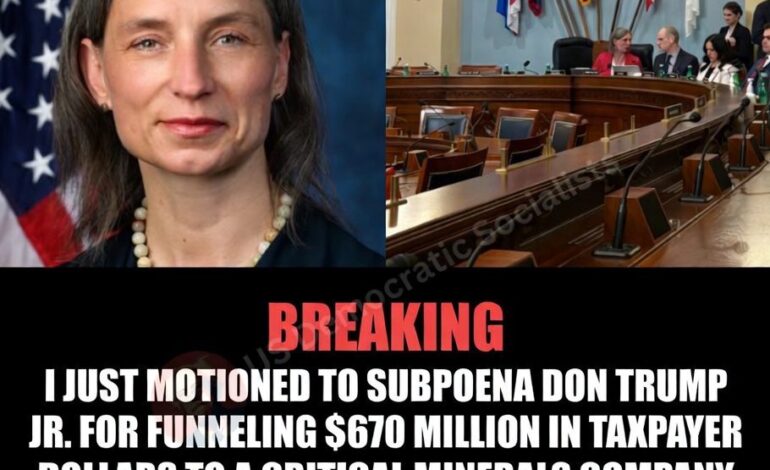

In a dramatic showdown on Capitol Hill, Representative Maxine Dexter made it unmistakably clear: the wait for Republican oversight is over. Speaking forcefully during a House hearing, Dexter demanded answers regarding allegations that Donald Trump Jr. may have profited illegally from his father’s presidency. “We are done waiting for Republicans to fulfill their responsibility to conduct oversight,” Dexter declared. “Donald Trump Jr. must be made to answer whether he illegally profited from his father’s presidency.”
This moment marked the latest in a growing tension between Democratic lawmakers seeking accountability and Republican members determined to block such inquiries. Dexter’s push to subpoena Trump Jr., alongside key Pentagon officials tied to the controversial deals, was met almost immediately with procedural roadblocks.
Republicans Move to Block Subpoena
The hearing quickly devolved into a partisan battle. Paul Gosar, serving as committee chairman, called a recess and then orchestrated a vote to table the subpoena. The motion passed with a 5-2 vote, effectively halting efforts to compel testimony from Trump Jr. or Pentagon officials.
Moments later, Lauren Boebert moved to adjourn the hearing entirely, drawing immediate criticism from Democratic colleagues who viewed the move as a deliberate attempt to bury accountability. With these maneuvers, the committee effectively shelved the investigation—for now—raising questions about the future of congressional oversight in a deeply divided Washington.
Democrats Push Back: Accountability Is Non-Negotiable
Despite the procedural setbacks, Democratic representatives did not retreat. Representative Jared Huffman warned Republican colleagues that attempts to dodge accountability would not succeed indefinitely. “You can try these moves, for now,” Huffman said. “But you cannot dodge accountability. You cannot hide.”
Democrats argue that the public has a right to know whether Trump Jr. leveraged his father’s position for personal gain, especially in deals involving Pentagon officials. The case underscores ongoing concerns about conflicts of interest and the ethics of political families profiting from public office—a topic that has fueled debate since the Trump administration.
The Broader Context
This clash is part of a larger pattern in Congress, where oversight efforts frequently meet partisan resistance. For Democrats, subpoenas are essential tools to investigate potential misconduct and maintain transparency in government. For Republicans on the committee, resisting subpoenas is framed as protecting executive authority or preventing politically motivated investigations.
The public, however, sees a stark contrast. While Democrats emphasize accountability and transparency, the GOP’s procedural maneuvers give the impression that political protection is taking precedence over public scrutiny. This dynamic has intensified scrutiny over Trump Jr.’s activities, particularly deals tied to defense contracts and lobbying, which critics say raise serious ethical questions.
Subpoenas and Oversight: Tools of Accountability
Subpoenas serve as one of Congress’s most powerful oversight tools. They compel individuals, including private citizens and government officials, to provide testimony or produce documents. In this instance, the subpoena would have forced Trump Jr. and Pentagon officials to testify about the nature of deals made during his father’s presidency, shedding light on potential conflicts of interest.
The tabling of the subpoena and the adjournment of the hearing illustrate how political control can dramatically influence oversight efforts. While Democrats framed the request as an urgent ethical inquiry, Republicans leveraged procedural rules to stymie the investigation—a tactic that has been increasingly common in closely divided committees.
Political Fallout
The partisan confrontation is likely to have lasting implications. Democratic lawmakers have signaled that they will continue to pursue oversight through other channels, including follow-up subpoenas, investigations by other committees, and public hearings. Meanwhile, Republican resistance reinforces the growing perception among some voters that accountability mechanisms are being undermined by partisan politics.
Analysts say this standoff also reflects the broader tension between governance and political loyalty. For critics of Trump Jr. and his allies, the GOP’s maneuvers are emblematic of a political culture where family connections and partisan loyalty can override ethical concerns.
What Comes Next?
While the subpoena may be temporarily blocked, Democrats are expected to explore alternative strategies. These could include issuing revised subpoenas, seeking compliance through court orders, or leveraging public pressure to compel testimony.
Huffman’s warning resonates as a reminder that political maneuvers may delay—but cannot indefinitely prevent—questions about ethics and accountability. The public’s interest in understanding whether Trump Jr. profited from his father’s presidency ensures that the issue will remain a central focus of congressional oversight debates in the months ahead.
Conclusion
The clash over Trump Jr.’s subpoena illustrates the increasingly polarized landscape of congressional oversight. Procedural tactics may provide temporary relief for those resisting accountability, but the broader push for transparency and ethical governance is far from over.
As Dexter, Huffman, and other Democratic representatives have emphasized, questions about profiting from political office are not just partisan politics—they are questions at the heart of democratic accountability. While Republicans managed to table the subpoena for now, the debate over oversight, ethics, and transparency in government is far from finished.
This hearing was a reminder that in American politics, accountability can be delayed—but it cannot be erased.
Discover more from MatterDigest
Subscribe to get the latest posts sent to your email.