Fox host accuses Americans against Trump’s war of not supporting troops
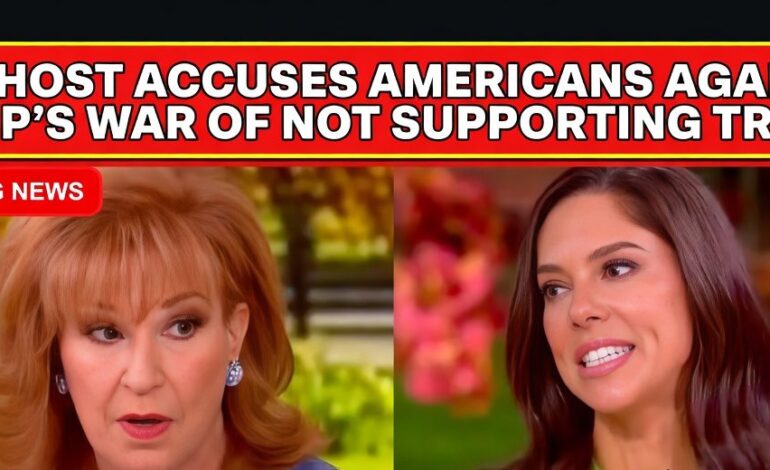

The heated exchange between Abby Huntsman and Joy Behar has reignited a long-standing and deeply emotional debate in American politics: what it really means to “support the troops”—and whether questioning military action, particularly under leaders like Donald Trump, is being unfairly framed as unpatriotic.
This moment, which unfolded during a tense on-air discussion, wasn’t just another cable TV clash. It tapped into broader public frustration over U.S. foreign policy, the legacy of past conflicts, and the political rhetoric often used to silence dissent. At its core, the exchange highlighted a crucial distinction that many Americans feel is deliberately blurred: the difference between supporting service members and endorsing the wars they are sent to fight.
A Clash of Perspectives
The discussion began with Huntsman attempting to praise the U.S. military’s role in Iran, emphasizing what she described as their “incredible” accomplishments. However, when pressed by Behar to explain specifically what had been achieved, Huntsman struggled to provide a clear answer.
Behar’s repeated questioning—“What have they accomplished?”—cut to the heart of the issue. It wasn’t a dismissal of the military itself, but a demand for accountability regarding policy decisions and measurable outcomes. Huntsman’s responses shifted toward broader, more generalized praise of the military, rather than addressing the specifics of the Iran situation.
This pivot is a familiar one in political discourse. When concrete justifications for military action are difficult to articulate, the conversation often moves toward honoring troops, invoking patriotism, and framing criticism as disrespect.
Behar, however, refused to let that framing stand.
Supporting Troops vs. Supporting War
One of the most striking moments came when Behar firmly pushed back against any implication that questioning military action equates to opposing the troops themselves. She referenced her own family’s military service, underscoring that criticism of a specific conflict does not diminish respect for those who serve.
This distinction is not new—but it remains highly contentious.
Since the early 2000s, particularly following the Iraq War, critics of U.S. military interventions have often faced accusations of being “anti-military” or “un-American.” Yet many veterans, military families, and policy analysts have argued the opposite: that true support for troops includes questioning the missions that put them in harm’s way.
The argument goes like this: supporting troops means ensuring they are not deployed unnecessarily, without clear objectives, or into conflicts lacking a defined endgame. It means demanding transparency, strategy, and accountability from political leaders.
Behar’s stance reflects this perspective—one shared by a growing segment of the American public.
The Iran Question
The specific focus of the debate—U.S. actions in Iran—adds another layer of complexity. Under the Trump administration, tensions with Iran escalated significantly, particularly after the U.S. withdrew from the Joint Comprehensive Plan of Action, an agreement negotiated under Barack Obama.
Supporters of the withdrawal argued that the deal was flawed and insufficient to curb Iran’s long-term ambitions. Critics, however, maintained that it was effectively containing Iran’s nuclear program and that abandoning it risked destabilizing the region.
Behar’s pointed remark—“Obama had a deal in place with it”—reflects this criticism. From her perspective, the U.S. moved away from a functioning diplomatic framework without presenting a clear alternative strategy.
When Huntsman attempted to frame deterrence—“whether it’s for another year, whether it’s for 10 years”—as a success, it highlighted the ambiguity surrounding the administration’s goals. Deterrence, by nature, is difficult to measure. It relies on hypotheticals: what didn’t happen, rather than what did.
That ambiguity is precisely what Behar was challenging.
The “Intelligence” Debate
Another notable moment came when Huntsman suggested that the public might not fully understand the situation due to a lack of access to intelligence. Behar’s sharp retort—questioning the use of the word “intelligence” in relation to Trump—drew applause and underscored a broader skepticism toward the administration’s credibility.
This skepticism is rooted in past controversies, including disputed intelligence claims that led to military action. The shadow of the Iraq War looms large here, where intelligence about weapons of mass destruction was later proven inaccurate.
For many Americans, this history reinforces the need for scrutiny and skepticism when governments justify military operations. Blind trust, they argue, is not patriotism—it’s negligence.
Media Framing and Political Narratives
The exchange also reflects how different media ecosystems frame national security issues.
On networks like Fox News, the emphasis is often on strength, patriotism, and unwavering support for military action. Criticism of policy can sometimes be framed as undermining national unity or morale.
On programs like The View, there is generally more space for skepticism, debate, and critique of government decisions.
These contrasting narratives contribute to a polarized information environment, where viewers may receive fundamentally different interpretations of the same events.
Huntsman’s framing—that questioning military accomplishments risks diminishing the troops—fits within one narrative. Behar’s insistence on separating policy critique from troop support fits within another.
The Emotional Weight of War
It’s important to recognize that debates like this are not purely intellectual—they are deeply emotional.
War involves life-and-death decisions. It affects soldiers, families, and entire regions. For many Americans, especially those with military connections, these discussions are personal.
This emotional weight can make it difficult to maintain nuance. Accusations of disloyalty or disrespect can quickly escalate tensions, shutting down meaningful dialogue.
Behar’s forceful response—“DO NOT make it sound like that”—reflects frustration with a narrative she sees as both unfair and manipulative. It’s a rejection of what critics call a “false binary”: either you support the war, or you don’t support the troops.
A Broader Cultural Shift
In recent years, there has been a noticeable shift in public attitudes toward military intervention. After decades of conflict in Iraq and Afghanistan, many Americans are increasingly wary of prolonged overseas engagements.
Polling has shown growing support for diplomatic solutions and skepticism toward open-ended military commitments. This shift cuts across political lines, though it manifests differently depending on ideological perspectives.
Behar’s position aligns with this trend—questioning not the military itself, but the policies that govern its use.
The Role of Accountability
At the heart of this debate is the concept of accountability.
Democracies rely on informed citizens who are willing to question their leaders. This includes asking difficult questions about war: Why are we involved? What are the objectives? How will success be measured? What is the exit strategy?
When Huntsman struggled to articulate specific accomplishments, it underscored a key concern: if proponents of a policy cannot clearly explain its outcomes, how can the public evaluate its effectiveness?
Behar’s persistence in asking the same question—“What have they accomplished?”—was an attempt to hold that line of accountability.
Why This Moment Resonated
The exchange quickly gained traction because it captured a broader frustration felt by many viewers.
For some, it was a rare instance of someone pushing back against a familiar narrative. For others, it reinforced concerns about how media discussions can conflate patriotism with policy support.
The applause that followed Behar’s remarks wasn’t just about the moment—it was about what it প্রতিনিধed: a demand for clarity, honesty, and a more nuanced conversation about war.
Conclusion: A Necessary Conversation
The confrontation between Abby Huntsman and Joy Behar serves as a microcosm of a much larger debate—one that has shaped American politics for decades and continues to evolve.
It raises fundamental questions:
-
Can citizens question military action without being labeled unpatriotic?
-
What does it truly mean to support the troops?
-
How should governments justify and communicate their decisions to go to war?
There are no easy answers. But one thing is clear: avoiding these questions is not an option.
As Behar’s insistence demonstrated, accountability requires persistence. It requires pushing past slogans and generalities to demand specifics.
And perhaps most importantly, it requires recognizing that supporting those who serve and questioning the missions they are sent on are not contradictory—they are, for many, inseparable.
In a democracy, that distinction isn’t just important. It’s essential.
Discover more from MatterDigest
Subscribe to get the latest posts sent to your email.