Astronauts Spotted a Strange Tentacled Object on the ISS… The Truth Left Everyone Speechless
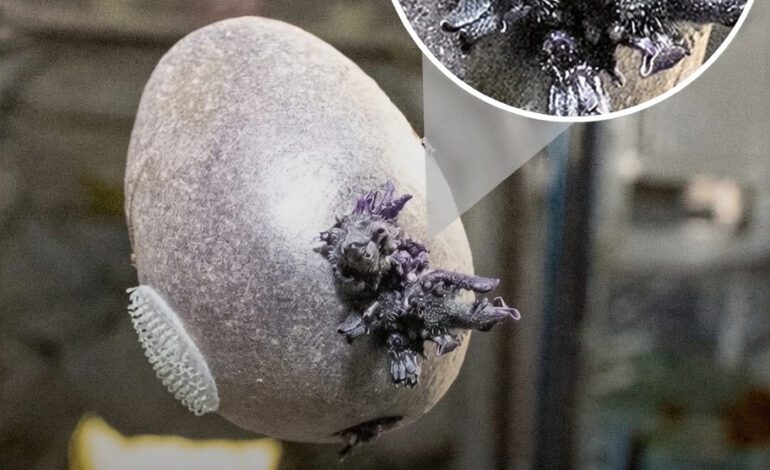

Tentacled Mystery Object Found Aboard ISS Spawns Terror — But the Truth Is Even Weirder
QUICK ANSWER
A viral photo showing a purple, egg-shaped object covered in dark tentacles aboard the International Space Station turned out to be a sprouting purple potato. NASA astronaut Don Pettit grew the spud during Expedition 72 (September 2024 – April 2025) as part of a personal space garden project. He nicknamed it Spudnik-1, a nod to the Soviet Sputnik satellite. While users begged astronauts to “kill it with fire,” the object was perfectly harmless — just a humble potato doing what potatoes do.
Picture this. You’re scrolling through social media late at night. An image stops you dead in your tracks. It shows a purple, egg-shaped object covered in writhing dark tendrils floating inside the International Space Station. Your stomach drops.
The comments section is losing its collective mind. “Kill it with fire,” one user screams. “Bro I genuinely thought this was some kind of egg hatching,” writes another. Someone compares it to the poster of the 1979 sci-fi horror classic Alien. Someone else references the shape-shifting monster from the video game Prey.
That’s exactly what happened in March 2026 when a photo shared by NASA astronaut Don Pettit went viral — and sent the internet into full panic mode.
The truth? It was a potato.
But the real story is far more fascinating than either the alien panic or the punchline suggests. It’s a story about ingenuity in orbit, the future of space food, and what happens when plants go rogue in microgravity. Read on.
Table of Contents
- 1. The Photo That Broke the Internet
- 2. Who Is Don Pettit, the Astronaut Behind Spudnik-1?
- 3. What Exactly Was the Tentacled Object? (Answered)
- 4. Why Does a Potato Look So Terrifying in Space?
- 5. Spudnik-1: Growing Potatoes in Microgravity
- 6. The Science of Space Gardening
- 7. Why Is Growing Food in Space So Important?
- 8. People Also Ask: Your Questions Answered
- 9. What Foods Have Been Grown on the ISS?
- 10. Key Takeaways
The Photo That Broke the Internet
NASA astronaut Don Pettit posted a close-up photograph on Instagram showing a small, purple-black object nestled in what appeared to be some kind of improvised growing chamber. The object was covered in pale, root-like tendrils sprouting outward in every direction. It looked alive. It looked angry. It looked like it was about to hatch.
The image immediately spread across X (formerly Twitter), Reddit, and other platforms. Users compared it to creatures from science fiction horror. References flew in from Alien, The Thing, and Prey. One commenter said it looked like “a mimic hatching out of an egg.” Others were more direct: “kill it with fire,” they begged.
What made the image so unsettling? A few things worked together:
- The deep purple-black color looked organic and alien.
- The tendrils radiated outward with no clear pattern, mimicking living limbs.
- The ISS background gave the photo an eerie, zero-gravity quality.
- Without scale reference, the object could have been any size.
Pettit quickly cleared things up, but not before the post had already gone massively viral.
Who Is Don Pettit, the Astronaut Behind Spudnik-1?
Don Pettit is not your average NASA astronaut. At 70 years old, he is NASA’s oldest active astronaut to fly in space. He is a chemical engineer with a deep passion for science communication, astrophotography, and — as we now know — space gardening.
Pettit flew during Expedition 72, which ran from September 23, 2024 to April 18, 2025. During his off-duty hours on the ISS, he set up what he called an “improved grow light terrarium” — a small, improvised growing station where he cultivated plants as a personal hobby.
He told his followers that his inspiration came from Andy Weir’s celebrated novel and film, The Martian. In that story, astronaut Mark Watney famously grows potatoes on Mars to survive. Pettit apparently took that to heart.
What Exactly Was the Tentacled Object? (Answered)
Let’s be clear: the tentacled mystery object aboard the ISS was a purple potato in early stages of sprouting.
Specifically, it was a purple variety of potato — which already has a striking dark pigmentation — that had begun developing sprouts, also known as “eyes.” In microgravity, these sprouts grow outward in all directions rather than just upward, creating the tentacled, alien-like appearance that terrified the internet.
Pettit anchored the potato using a small piece of Velcro hook to keep it in place inside his terrarium. That small detail was visible in the photo, but most users were too busy screaming about the tentacles to notice.
He named his potato Spudnik-1 — a clever portmanteau of “spud” (slang for potato) and Sputnik (the iconic Soviet satellite). The name immediately charmed the very same people who had been demanding its fiery destruction moments before.
Why Does a Potato Look So Terrifying in Space?
Microgravity Changes Everything
On Earth, plants have a built-in compass: gravity. Roots grow down, stems grow up. It’s called gravitropism, and it gives plants their familiar, recognizable shapes.
In microgravity aboard the ISS, that compass disappears. Roots and sprouts grow in every direction at once — outward, sideways, backwards — creating bizarre, chaotic shapes that look nothing like what we expect from plants.
Pettit confirmed this himself when asked about it. He said: “The roots would grow in all directions absent gravity, and all plants I have ever grown in space have grown far slower than they would have on Earth.”
Purple Potatoes Look Especially Alien
Standard potatoes have a brownish, familiar look. Purple varieties — which contain anthocyanins, natural pigments found in blueberries and red cabbage — have a dramatically darker, more intense coloration. Combined with the tentacled sprouts, the result was something that looked less like a vegetable and more like a creature from the deep ocean.
Spudnik-1: Growing Potatoes in Microgravity
Pettit’s potato experiment was not an official NASA mission. He grew Spudnik-1 during his personal off-duty time, which he noted is a tradition aboard the ISS. Astronauts have long used their limited free hours to pursue hobbies, creative projects, and personal scientific curiosities.
He chose potatoes because of their impressive nutritional efficiency. As he explained to curious followers, potatoes are “one of the most efficient plants based on edible nutrition to total plant mass.” That makes them an ideal candidate for growing in space, where every gram of cargo counts.
The terrarium setup was improvised but clever: a small grow-light chamber with Velcro to anchor plants in the absence of gravity. Simple, lightweight, and effective.
The Science of Space Gardening
Plants in space behave in genuinely strange ways. Understanding that behavior is a major area of scientific research on the ISS. Here’s what scientists have learned:
Growth is significantly slower in space.
Pettit noted that every plant he’s grown in orbit has grown more slowly than its Earth-based counterpart. Scientists believe this is likely stress-induced — the plant’s systems are working overtime to adapt to an alien environment.
Roots lose their direction.
Without gravity to guide them, roots sprawl outward in all directions. This is beautiful to observe, but it presents practical challenges for growing food efficiently.
Water behaves differently.
On Earth, gravity pulls water down through soil. In microgravity, water clings to surfaces and forms droplets that can suffocate roots. Specialized watering systems are needed to grow plants successfully.
Light becomes the new “up.”
In the absence of gravitational cues, plants rely more heavily on light to orient themselves. This is called phototropism, and it partly explains why Pettit’s grow-light terrarium could work at all.
Why Is Growing Food in Space So Important?
This isn’t just a fun science experiment. Growing food in space could be critical to human survival on long-duration missions. Here’s why it matters:
| Challenge | Why Space Food Is the Answer |
| Resupply missions are expensive | Cargo costs thousands of dollars per kilogram to launch |
| Long missions (Moon, Mars) make resupply impossible | Astronauts would need to grow their own food on-site |
| Packaged food degrades over time | Fresh produce provides better nutrition and crew morale |
| Psychological wellbeing in isolation | Tending plants reduces stress and improves mental health |
NASA and other space agencies are actively researching space agriculture. Finnish startup Solar Foods, for example, is working with the European Space Agency (ESA) on a “space food” project that could even manufacture nutrients from astronaut waste products aboard the ISS — a concept that sounds unpleasant but could be revolutionary for long-haul space travel.
A 2025 study also found that potatoes could potentially be grown on the Moon using human waste and compost from Earth. Spudnik-1’s legacy might extend further than its creator ever imagined.
People Also Ask: Your Questions Answered
What was the tentacled object found on the ISS?
It was a purple sprouting potato grown by NASA astronaut Don Pettit during Expedition 72. The potato’s dark pigmentation and multi-directional sprouts (which grow outward in all directions in microgravity) gave it an alien, tentacled appearance. Pettit named it Spudnik-1.
Who is Don Pettit?
Don Pettit is a chemical engineer and NASA’s oldest astronaut to serve in active spaceflight. He is known for his astrophotography and passion for science communication. He flew during Expedition 72 aboard the ISS from September 2024 to April 2025.
Why do plants grow differently in space?
Plants use gravity (gravitropism) to direct root growth downward and stem growth upward. In the microgravity environment of the ISS, this directional cue disappears. Roots and sprouts grow in all directions at once, and growth is significantly slower overall, likely due to physiological stress.
Can potatoes grow in space?
Yes. Potatoes have been successfully sprouted and grown on the ISS. Scientists are also exploring whether potatoes could be cultivated on the Moon using compost and organic waste from Earth.
What is Spudnik-1?
Spudnik-1 is the nickname Don Pettit gave to his orbiting purple potato — a wordplay on ‘spud’ (potato) and ‘Sputnik’ (the Soviet satellite). It became a viral internet sensation in March 2026.
What Foods Have Been Successfully Grown on the ISS?
Spudnik-1 is not alone. Over the years, NASA astronauts and international crew members have successfully grown a variety of plants on the station. Here’s a quick rundown:
- Lettuce — one of the first crops successfully grown and eaten by astronauts
- Chinese cabbage
- Mizuna mustard
- Red Russian kale
- Zinnia flowers (grown as a morale-boosting experiment)
- Purple potatoes (Spudnik-1, by Don Pettit)
NASA’s Veggie program (and subsequent APEX and Plant Habitat experiments) have been dedicated to understanding how plants behave in space and how to make food production practical for future long-duration missions.
Key Takeaways
- The viral “tentacled object” aboard the ISS was a purple sprouting potato, not an alien.
- NASA astronaut Don Pettit, 70, grew the potato during Expedition 72 as a personal hobby project.
- He named it Spudnik-1 — a nod to both ‘spud’ and the Soviet satellite Sputnik.
- In microgravity, plant sprouts grow in all directions because gravity no longer guides them, creating alien-looking shapes.
- Growing food in space is critically important for future lunar and Mars missions.
- The internet’s panic was completely understandable — and completely wrong.
The next time you open a bag of purple potatoes, take a moment. Picture one of those humble spuds floating in orbit, sprouts exploding outward in zero gravity, anchored by a scrap of Velcro inside a makeshift terrarium 250 miles above the Earth.
Don Pettit didn’t just grow a potato. He sparked a global conversation about space agriculture, the psychology of fear, and the creative spirit of astronauts who spend their off-duty hours tinkering with gardens among the stars.
Spudnik-1 was never a threat. It was a small act of hope — a tiny reminder that life finds a way, even in space.
Discover more from MatterDigest
Subscribe to get the latest posts sent to your email.