“Moments After the $450M Verdict… Matthew McConaughey Speaks Out—and the Internet Erupts”
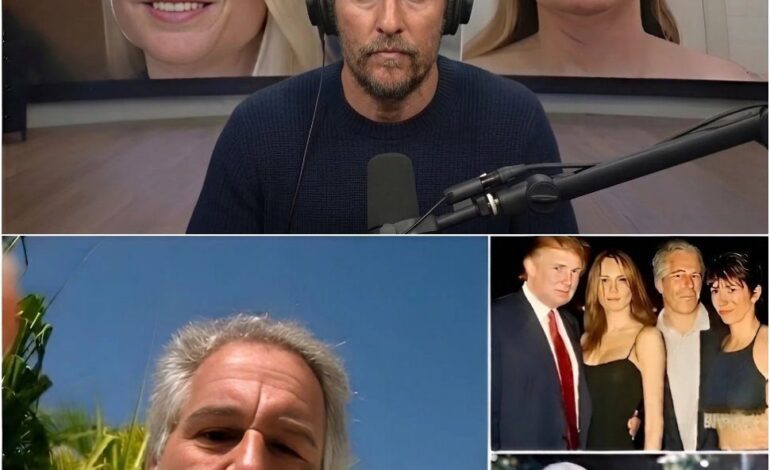

Two separate stories collided this week to create one of the most talked-about news cycles in recent American history. First, a staggering $450 million fraud verdict landed against Donald Trump — one of the most consequential legal rulings ever handed down against a sitting or former U.S. president. Second, actor and cultural figure Matthew McConaughey launched a viral livestream that ignited a worldwide conversation about power, accountability, and the things that powerful people would rather keep quiet. Together, these two events sparked a level of public discussion that has not been seen in quite some time.
The $450 Million Fraud Verdict Against Trump: What It Means
The fraud verdict against Donald Trump represents one of the largest financial judgments ever issued in a case involving a major political figure in the United States. The ruling, which came after a lengthy legal process, found that Trump had engaged in a pattern of financial deception that caused significant harm. The court determined that the conduct in question was not a mistake or a gray area — it was deliberate fraud carried out over an extended period of time.
The $450 million figure is not arbitrary. It reflects the court’s assessment of the total damage caused by the fraudulent behavior, including the financial gains that came directly from deceiving lenders, insurance companies, and business partners. Courts in fraud cases like this one do not simply punish bad behavior — they require that those found responsible pay back what they wrongly obtained, plus additional penalties designed to discourage the same behavior in the future.
For Trump, this verdict is not just a financial blow. It is a legal and reputational earthquake. Being found liable for fraud at this scale — with a judgment this large — is the kind of ruling that follows a person and an organization for decades. It raises serious questions about the business practices that built his financial empire and about what standards of honesty the American legal system actually holds powerful people to.
The case had been closely watched by legal experts, political observers, and members of the public who wanted to know whether the court system would treat a former president the same way it would treat anyone else. The answer, at least in this court and on this day, appeared to be yes. The verdict was swift and unambiguous. There was no softening of the language, no partial finding, and no suggestion that Trump’s political profile had influenced the outcome in his favor.
How Trump Responded to the $450 Million Ruling
Donald Trump and his legal team responded to the verdict quickly and forcefully. As has become standard in cases involving Trump and the courts, he rejected the ruling entirely — calling it politically motivated, unfair, and a weaponization of the legal system against him. His team announced plans to appeal, arguing that the judgment was excessive and that the case itself was driven by political enemies rather than genuine legal concerns.
Trump’s supporters rallied around him online and in public statements. Many echoed his framing of the verdict as an attack on a political figure rather than a legitimate legal outcome. Conservative media figures argued that the case set a dangerous precedent — that courts were being used to damage political opponents rather than pursue real justice.
Critics and legal experts pushed back hard on that framing. They pointed out that the case had proceeded through the normal legal process, that Trump had the opportunity to present his full defense, and that the court’s ruling was based on evidence — not politics. Several attorneys noted that the size of the judgment, while enormous, was consistent with what courts typically award in cases involving fraud of this scale and duration.
The appeal process is expected to take months, possibly years. In the meantime, the verdict stands — and the question of how Trump will manage a $450 million legal liability while pursuing his political ambitions is one that analysts, journalists, and voters will be watching very closely.
Who Is Matthew McConaughey and Why Did His Livestream Go Viral?
Matthew McConaughey is one of the most well-known actors in Hollywood. He won the Academy Award for Best Actor in 2014 for his role in Dallas Buyers Club and has been a major box office draw for more than three decades. But in recent years, McConaughey has stepped beyond acting to become a more public voice on cultural and political questions — and his livestream this week was the most prominent example of that shift yet.
The livestream was not a typical celebrity moment. McConaughey did not announce a new film or promote a product. He sat down in front of a camera and spoke — directly, plainly, and at length — about the things he believes Americans are not talking about honestly enough. He talked about power. He talked about silence. He talked about what happens when the people at the top of society make decisions that the rest of the country has to live with — and about the unspoken rules that keep those decisions hidden from public view.
The stream drew massive viewership within hours of going live. Clips spread rapidly across social media platforms including X, YouTube, TikTok, and Instagram. People who had never paid particular attention to McConaughey’s public statements found themselves watching, rewinding, and sharing what he was saying. The reason was simple: he was speaking in plain language about things that a lot of people feel but rarely hear stated so directly from someone with his level of public profile.
By the time the livestream ended, it had become one of the most-discussed media events of the week — and in the context of the Trump fraud verdict breaking on the same news cycle, the timing could not have felt more pointed.
What McConaughey Actually Said: The Key Messages From the Livestream
McConaughey’s livestream covered several interconnected themes. At its core, it was a meditation on accountability — on who gets held responsible in America and who does not, and on the gap between the rules that apply to ordinary people and the rules that seem to apply to those with wealth, power, and connections.
He spoke about the way silence functions as a tool of control. When powerful institutions — whether they are corporations, political parties, government agencies, or media organizations — do not want something discussed, the easiest way to suppress it is not censorship but indifference. If the people at the top simply refuse to acknowledge something, the conversation never gains enough momentum to become a threat. McConaughey argued that this kind of engineered silence is one of the most effective and underappreciated forms of power in the modern world.
He also talked about what he called the difference between public truth and private truth. Public truth is what powerful people say in front of cameras, in press releases, and in official statements. Private truth is what they actually know and believe — and often what they discuss among themselves when no cameras are present. McConaughey argued that the gap between these two truths has grown so wide in recent years that it has started to erode trust in every major institution, from government to media to business.
Perhaps most powerfully, he talked about ordinary people — the millions of Americans who are not famous, not wealthy, and not politically connected, but who are paying very close attention. He said these people are smarter than the powerful give them credit for. They see the gaps. They notice the contradictions. They know when they are being talked at rather than talked to. And he suggested that the growing frustration in American public life is not irrational anger — it is a rational response to a system that consistently rewards dishonesty and punishes transparency.
Why These Two Stories Landed at the Same Time — And Why That Matters
The timing of the Trump fraud verdict and McConaughey’s livestream was not planned — at least not as far as anyone knows. But the fact that they happened within the same news cycle gave each story added weight and context that neither would have had on its own.
The fraud verdict raised the question of whether powerful people are truly held accountable in America. McConaughey’s livestream raised the same question from a different angle — less legal, more cultural. Together, they created a moment where millions of people were simultaneously thinking about accountability, power, and honesty in public life. That kind of convergence does not happen often, and when it does, it tends to produce conversations that last longer and cut deeper than the individual events that sparked them.
Social media analysts noted that the two stories fed each other in real time. People watching McConaughey’s stream would see a notification about the Trump verdict. People reading about the verdict would stumble onto clips from the livestream. The result was a feedback loop of public attention that amplified both stories far beyond what they might have achieved separately.
Political observers on both left and right noted that the combination was uncomfortable for those who prefer to keep certain questions off the table. When a major legal ruling and a viral cultural moment both point in the same direction — toward questions about who has power, who gets away with what, and what the public is not being told — it becomes harder to change the subject.
The Legal Landscape: What the Fraud Verdict Changes
From a purely legal standpoint, the $450 million verdict against Trump is significant for several reasons beyond the dollar amount. It establishes a formal court record — a finding of fact by a judge — that Trump engaged in fraud. That record does not disappear because of an appeal. It exists, it is public, and it can be referenced in future legal proceedings, investigations, and political debates.
Legal experts noted that the verdict may also have implications for other ongoing cases and investigations involving Trump and his business organization. When a court formally finds that a pattern of fraudulent behavior existed, it can inform how other courts, prosecutors, and regulators approach related questions. It does not automatically determine the outcome of other cases, but it adds weight to the body of evidence that exists in the public record.
For the banking and financial institutions involved in the case — those that were deceived by fraudulent asset valuations — the verdict provides a measure of legal vindication. It confirms what their own internal reviews had eventually concluded: that the numbers they were given did not reflect reality, and that the misrepresentation was intentional.
Perhaps most importantly for the broader public, the verdict reinforces a principle that American courts are supposed to uphold regardless of who is standing before them: that fraud has consequences, that the law applies to everyone, and that the scale of your wealth or the height of your political profile does not exempt you from accountability.
McConaughey’s Livestream and the New Role of Celebrities in Public Discourse
One of the most interesting aspects of McConaughey’s livestream was what it said about the changing role of celebrities in public conversation. For most of the 20th century, the relationship between fame and politics was relatively simple: celebrities endorsed candidates, attended fundraisers, and occasionally spoke out on specific issues. What they almost never did was sit down and engage seriously with deep structural questions about how power works in society.
That has changed significantly in the past decade — and McConaughey’s livestream represents one of the more thoughtful examples of this shift. He was not stumping for a candidate or promoting a cause. He was thinking out loud, in public, about questions that do not have easy answers. That approach is unusual enough among celebrities to draw attention on its own. Combined with his genuine communication skills and his willingness to challenge people across the political spectrum, it made for a livestream that felt genuinely different from most celebrity political commentary.
Critics of celebrity political engagement argue that fame does not equal expertise, and that having a large audience does not mean you have anything particularly useful to contribute to complex political and social debates. That is a fair point. But it misses something important: in an era where trust in traditional institutions — media, government, academia — is at historic lows, people are increasingly turning to sources they find personally credible. For a significant portion of the public, McConaughey’s plain-spoken, non-partisan approach carries more credibility than a panel of experts or a cable news debate.
Whether that is a healthy development for democratic discourse is a legitimate question. But it is the reality of the media environment in 2026, and McConaughey’s viral livestream is a perfect illustration of how that environment works.
What the Public Is Saying: Reaction to Both Stories
Public reaction to both the Trump fraud verdict and McConaughey’s livestream was intense and immediate. Polls taken in the days following the verdict showed that a majority of Americans — including a notable percentage of Republicans — believed the legal system had functioned appropriately in holding Trump accountable. That finding surprised some political observers who had expected more partisan division in the public response.
McConaughey’s livestream generated millions of views and hundreds of thousands of comments across platforms. The most common themes in the public response were relief and recognition — people saying they felt relieved to hear someone with a large platform talking about things they had been thinking about privately, and recognition that what he described matched their own experience of how power and silence work in American life.
Some commentators pushed back on both stories. Trump allies continued to insist the verdict was politically motivated. Critics of McConaughey argued that his analysis, while engaging, lacked specific policy proposals and risked generating emotion without producing action. These are legitimate criticisms that deserve to be part of the broader conversation.
But the sheer scale of the public reaction to both events suggests that something important was touched. People are hungry for honesty about how power works, who gets protected from its consequences, and what ordinary citizens can actually do about it. Both stories, in very different ways, spoke directly to that hunger.
Looking Ahead: What These Events Mean for American Politics and Culture
The convergence of a landmark fraud verdict and a viral cultural moment raises questions that will not be resolved in a single news cycle. They point toward deeper tensions in American life — about accountability, about honesty, about who the rules actually apply to — that have been building for years and are unlikely to ease anytime soon.
For Trump, the path forward involves appeals, legal strategy, and the ongoing effort to maintain political viability in the face of mounting legal and financial pressure. How he navigates the $450 million verdict while pursuing his political goals will be one of the defining stories of the coming months.
For McConaughey, the livestream appears to have marked a new chapter in his public life — one defined less by acting and more by the kind of cultural commentary that his audience clearly wants to hear. Whether he builds on that moment or steps back from it remains to be seen.
For the rest of America — the millions of people who watched the verdict coverage and shared the livestream clips — the week served as a reminder that the questions at the center of public life right now are not small or simple. They are questions about justice, about truth, about power, and about what kind of country the United States is actually going to be. And those are questions worth sitting with — and talking about honestly — for as long as it takes to answer them.
Discover more from MatterDigest
Subscribe to get the latest posts sent to your email.