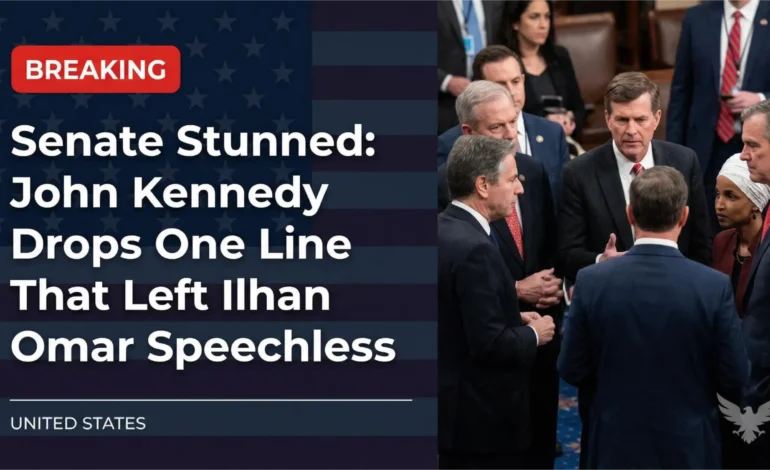
Senate Stunned: John Kennedy Drops One Line That Left Ilhan Omar Speechless

The Senate Bomb That Wasn’t: How a Viral Political Story Fooled Millions
Picture the scene: the United States Senate chamber, usually a theatre of grinding procedural tedium, suddenly crackles to life. A Southern senator rises from his seat. Every eye turns. The air thickens. And then — an accusation so explosive, so electrifying, that the internet claims 107 million people watched it unfold in real time.
There’s just one problem: it never happened.
The Story That Set the Internet on Fire
The narrative tearing across social media platforms is gripping, cinematic, and ruthlessly engineered for maximum outrage. It stars Senator John Neely Kennedy of Louisiana — drawling, blunt, a man who once compared a colleague’s argument to “a screen door on a submarine” — and Representative Ilhan Omar of Minnesota, one of the most polarising figures in modern American politics.
According to the viral account, Kennedy rose without warning during a routine border-security vote and detonated a political grenade. He purportedly brandished a recording — the so-called “Omar File” — containing a statement attributed to Omar that suggested a divided loyalty between the United States and Somalia. The chamber, the story breathlessly reports, descended into stunned silence. Alexandria Ocasio-Cortez allegedly turned white. Chuck Schumer reportedly buried his face in his hands.
The story spread like wildfire. The hashtags trended. The outrage metrics spiked. And millions of people clicked, shared, and argued over what they were certain was a moment of historic reckoning.
The Reality Check: Where Is the Evidence?
Here is where the story collapses under its own weight.
Not a single credible news outlet — not the Washington Post, not Reuters, not even the aggressively partisan outlets on either side of the aisle — has reported this event. C-SPAN, which cameras every second of Senate floor activity with the tireless neutrality of a surveillance drone, has no footage. There is no official Senate record, no Congressional transcript, no contemporaneous witness account from any of the hundreds of staff, journalists, and aides who fill the Capitol building on any given working day.
And those viewing figures? The claim of 107 million live viewers would place this alleged Senate moment above the viewership of presidential inaugurations, Super Bowls, and major global sporting finals. It is, statistically, not just implausible — it is absurd.
The Anatomy of a Perfect Lie
What makes this particular piece of viral fiction so dangerous is how artfully it is constructed. The story doesn’t stumble out of the gate with wild conspiracy. It opens with calm, procedural normalcy — a routine Senate vote, the kind of thing that makes even political junkies reach for their phones out of boredom. Then, like a thriller novelist who knows exactly when to detonate his plot twist, the author introduces the disruption.
The silence. The shock. The decisive rhetorical blow delivered in a memorable closing line.
Kennedy’s alleged phrase — sharp, colourful, morally loaded — lands like a final verdict from a hanging judge. It is engineered to feel unanswerable. It is designed not to inform, but to inflame.
And it includes a built-in immunisation against scepticism: Omar’s office allegedly dismisses the quote as “a selectively edited fabrication” — a phrase so perfectly calibrated to mirror real-world political denials that it paradoxically adds a layer of false credibility to the whole construction.
Why We Believe — and Why That Matters
The viral success of this story is not a mystery. It is a masterclass in exploiting the deepest fault lines of modern political psychology.
Confirmation Bias: The Engine of Viral Misinformation
Human beings are not rational information processors. We are, when it comes to political information, fundamentally tribal. We do not read stories about our political opponents and ask “Is this true?” We ask “Does this feel true?” And when a story confirms what we already suspect or fear about a political rival, our critical faculties go offline and our share buttons light up.
The story about Kennedy and Omar is engineered to target this vulnerability with surgical precision. For those already suspicious of Omar’s politics, the narrative simply confirms what they believe they already know. For those who distrust Kennedy, it becomes proof of Republican bad faith. Everyone finds exactly what they’re looking for.
The Attention Economy’s Dirty Secret
Digital platforms do not reward accuracy. They reward engagement. Outrage drives clicks. Moral indignation drives shares. A calm, fact-checked article explaining why a Senate confrontation never happened will always lose the engagement war against a breathless account that makes your blood pressure spike.
This is not an accident. It is a feature. The same algorithmic machinery that surfaces cat videos and cooking tutorials also surfaces political fabrications — not because the platforms are malicious, but because all of it generates the same valuable commodity: your attention.
The Real Damage: What Fabricated Stories Actually Do
It would be comforting to dismiss stories like this as harmless entertainment for the politically obsessed. They are not. The ethical and social damage from unverified political narratives is significant, lasting, and often irreversible.
Reputations Under Fire
Real people — Kennedy, Omar, Ocasio-Cortez, Schumer — have their names attached to fabricated events they did not participate in. The correction, if it comes at all, rarely travels as far or as fast as the original lie. In the calculus of public perception, the damage is asymmetric and permanent.
Institutional Trust in Freefall
When a fabricated Senate confrontation goes viral, it contributes to a broader, corrosive narrative: that democratic institutions are secret battlegrounds for power struggles happening just out of public view. Every viral lie about Congress makes it slightly harder for citizens to trust what the Senate actually does. Over time, that erosion of trust becomes one of the most serious threats to democratic governance.
The Polarisation Spiral
Each successful piece of viral political fiction widens the gap between partisan information bubbles. The people who believed the Kennedy-Omar story and the people who furiously debunked it are not operating in the same information environment. They are not even arguing about the same event. They are living in parallel political realities — and that gap, once opened, is extraordinarily difficult to close.
The Uncomfortable Truth About Viral Stories
There is a deeper, more troubling dimension to this story’s popularity. It does not persist purely because people are gullible. It persists because it speaks to something real: a profound dissatisfaction with the grinding, unglamorous reality of political life.
Many people feel politically abandoned, talked over, and patronised by institutions that seem distant and opaque. When a story arrives offering a rare moment of clarity — a hero, a villain, a confrontation, a reckoning — it fills an emotional void that mainstream political communication has failed to address.
That emotional resonance does not make the story true. But it does make it understandable. And understanding why people believe these narratives is the necessary first step toward building something better.
How to Survive the Information War: A Practical Guide
The good news is that the tools to resist viral misinformation are neither complicated nor expensive. They require only a few seconds of deliberate thought before you click share.
Ask the Three Questions
Before accepting any dramatic political story as true, ask yourself three things: Where did this originate? Who else has independently confirmed it? What evidence, beyond the story itself, supports the claims being made? If those questions lead to silence or vague answers, the most reasonable conclusion is not that a hidden truth has been revealed. It is that the story was built for impact, not accuracy.
Follow the Verification Chain
For any event involving the U.S. Senate, C-SPAN footage is publicly available. Official Congressional records are publicly accessible. If an event as dramatic as the one described in this story had actually taken place, the evidence trail would be wide, deep, and impossible to hide. When that trail simply does not exist, the absence of evidence is itself the most powerful piece of evidence available.
Sit With Your Discomfort
Perhaps most importantly: learn to sit with the discomfort of not knowing. The impulse to share a story before verifying it often comes from a desire to be first — to be the person who spotted the important thing and passed it along. Resisting that impulse, pausing to ask whether a story is real before amplifying it, is one of the most genuinely patriotic acts available to a citizen in the digital age.
A Mirror, Not a Window
Ultimately, the viral “Senate moment” described across social media is not a window into the hidden workings of American politics. It is a mirror. It reflects back the anxieties, the tribal loyalties, and the narrative hunger of the audiences who consumed and shared it.
In a media environment where perception spreads faster than reality, and where storytelling routinely shapes belief more powerfully than evidence, the viral Senate confrontation that never happened may ultimately tell us more about ourselves than any confrontation that did.
Whether one finds it persuasive, troubling, or merely entertaining, its true significance lies in what it exposes: how information flows, how trust is formed and broken, and how easily both can be manipulated in the modern age.
Discover more from MatterDigest
Subscribe to get the latest posts sent to your email.