She Married a River — and Three Years Later, She Says the Love Is Stronger Than Ever
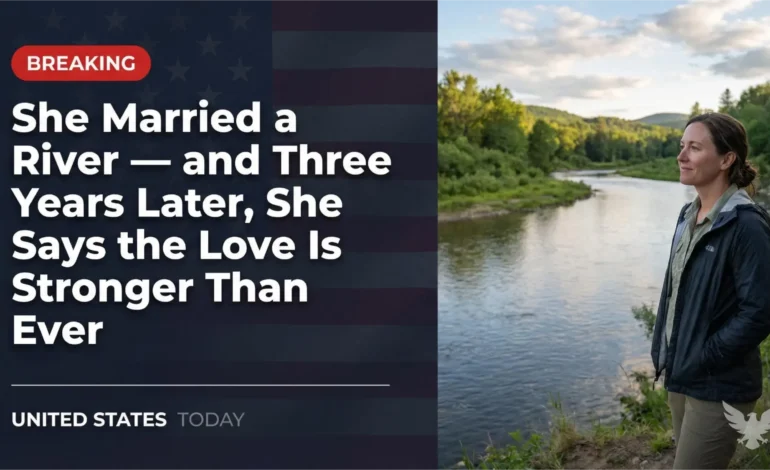

When Meg Avon walked down the aisle to wed the River Avon in Bristol, most people laughed. But behind the unusual wedding was a serious message about water pollution, environmental law, and why one young woman believes rivers deserve the same rights as people.
A Love Story Unlike Any Other
Most anniversary stories go something like this: two people meet, fall in love, get married, and a few years later they are still together, building a life side by side. Meg Avon’s story follows a similar path — except that her partner is not a person. Her partner is a river.
On June 17, 2023, Meg — who was born Megan Ruth Trump — made history in the city of Bristol, England, when she married the River Avon in a ceremony that she describes as “joyful.” She wore a wreath of ferns on her head and carried a bouquet made from riverside plants. Witnesses cheered. Cameras clicked. And Meg, then 26 years old, officially became Mrs. Meg Avon.
Now, three years later, Meg is celebrating her third wedding anniversary. And she is clear about one thing: the romance is very much still alive.
“I am still finding time to swim in the river every week,” she says, with the kind of warmth most people reserve for talking about a beloved partner. “Even in the winter when it has been particularly wet, which always feels riskier! But I am committed, and every experience I have in the water is lush.”
To some people, what Meg is doing might sound strange — even a little funny. But spend more than five minutes listening to her talk, and it becomes clear that there is real purpose and passion behind everything she does. This is not a publicity stunt. It is not a joke. It is a carefully thought-out act of environmental activism — one that has captured the attention of thousands of people across the UK and beyond.
Why Would Anyone Marry a River?
To understand why Meg made this unusual choice, you need to understand the water crisis that has been building in the United Kingdom for years.
England’s rivers are in serious trouble. Raw sewage is being pumped into waterways on a regular basis by water companies that are under pressure to manage overflowing sewage systems. According to environmental watchdogs, there were tens of thousands of sewage overflow events across England in recent years. Rivers that were once clean enough to swim in are now rated as unsafe. Fish populations have declined. Wildlife has suffered. And the people who love swimming outdoors — open water swimmers like Meg — have been told again and again that the water they swim in is polluted.
Meg is one of those people. She is a passionate open water swimmer who has been swimming in the River Avon for years. She is also a researcher, writer, and environmental activist. When she looked at the state of the river she loves — the pollution, the sewage, the lack of legal protection — she felt she had to do something.
And what she decided to do was get married.
“We all understand marriage because it’s about love and law — the governing forces!” Meg explains. “A lot of the law feels incomprehensible and hard to reach and understand for a big majority of the population, so having a story that makes it relatable is so powerful.”
In other words, Meg used marriage as a way to tell a complex environmental story in a simple, human way. And it worked. The wedding made headlines. It got people talking. It made water pollution into something people could feel — not just a dry statistic in a government report, but a story about love, commitment, and the fight to protect something precious.
The Wedding Day: Ferns, Friends, and a River
The ceremony took place on the banks of the River Avon on a warm June afternoon in 2023. Meg wore a fern wreath woven into her hair and carried a bouquet of wild plants gathered from near the water’s edge. Friends and supporters gathered to witness the moment. There was music, laughter, and what Meg describes as a real sense of celebration.
Of course, in the eyes of the law, the marriage is not legally recognised. You cannot legally marry a river in England — or anywhere else in the world, for that matter. Current law treats rivers as objects, not as living entities with rights. A person cannot enter into a legal contract with an object.
But Meg is comfortable with that — for now. The ceremony was a symbolic act, a blessing and a promise. It was her way of declaring publicly that she loves this river, that she is committed to protecting it, and that she refuses to stand by while it is treated with neglect and disrespect.
When she changed her last name to Avon after the wedding, that commitment became even more visible. Every time someone reads her name or asks about it, there is a conversation to be had about the river and the crisis threatening it.
Keeping the Romance Alive: Swimming Through Winter
Three years into this unusual relationship, Meg has no intention of letting things grow stale. She keeps what she calls her “romance” with the river alive through regular swimming — at least once a week, no matter the season.
This is no small commitment. Open water swimming in an English river during winter is not for the faint-hearted. Water temperatures can drop to near-freezing levels. The current can be strong after heavy rainfall. And, of course, there is the ever-present concern about water quality — the very problem Meg has been campaigning against.
But Meg goes anyway. She says that getting into the water — even when it is cold, even when conditions are far from perfect — is one of the most powerful ways she stays connected to the river and to the cause she has built her life around.
“Getting in the water is one of the quickest and easiest ways to completely immerse yourself in nature,” she says. “Which is what young people need now more than ever before, with the rise of technology.”
She has also been exploring new spots along the river — swimming at different points along its length, discovering parts of the Avon she had never visited before. Through these swimming adventures, she has also been meeting people: artists, environmentalists, community members who care just as deeply about the river as she does.
“I’ve even been finding new ways to connect with the river — from swimming in various spots along the stretch to meeting people from various art and environmental communities at different points,” she says.
The Crisis That Started It All: Sewage in England’s Waterways
To fully appreciate what Meg is fighting for, it helps to understand just how bad the water pollution problem in England has become.
England’s rivers have been under threat for many years, but the issue came to widespread public attention when reports revealed that water companies were regularly releasing untreated or partially treated sewage into rivers and coastal waters. These releases — called storm overflows — are supposed to happen only in extreme weather events when the sewage system is overwhelmed. But data has shown they have been happening far more often than that.
The result is water that is often unsafe for swimming, fishing, or even contact. Rivers that once supported thriving wildlife are now suffering. People who love swimming outdoors are being warned to stay out of the water they have enjoyed for decades.
Channel 4’s recent documentary “Dirty Business” has shone an even brighter spotlight on the issue, exploring how England’s sewage crisis developed and who is responsible. Meg says it has been encouraging to see the public response to that film.
“It really is lovely to see the recognition,” she says. “People still really connect with our local story and how much it influences the wider national story.”
For the River Avon specifically, the situation is grim. Meg is part of a campaign group called Conham Bathers, which has been trying to get the River Avon awarded “designated bathing water status” — a legal classification that would require authorities to monitor and improve water quality more closely. But so far, the river has been unable to qualify because its water quality is simply too poor.
“I’m not surprised by the water quality results,” Meg says. “I think a lot of people are angry and upset still, and it is important to make people aware of what’s going on.”
Beauty in the Broken: Finding Hope in Dirty Water
What is remarkable about Meg is that, even while fighting hard against the pollution of the river she loves, she has not lost her sense of wonder for it. She still sees beauty in the water. She still finds moments of real joy when she is in it.
“It really is sad, but I still see so much beauty,” she says. “The water doesn’t feel disgusting and awful every day. On the days when the water is clearer, it makes me hopeful that the river can be like that every day.”
This ability to hold two things at once — grief for the damage being done to the river, and hope for what it could one day become — is part of what makes Meg such a compelling voice in the campaign for clean water. She is not just angry. She is also deeply in love. And love, she believes, is more powerful than anger when it comes to making lasting change.
“It’s important to keep raising awareness of how people can use that fear and outrage into something that is motivating and not off-putting!” she says.
This is a key part of her message. Environmental campaigns can sometimes feel overwhelming or deeply depressing. The problems are big. The solutions are slow. The people responsible for the damage often seem untouchable. Meg wants to offer a different approach — one rooted in love, connection, and the simple act of getting into the water and feeling it for yourself.
The Big Ambition: Giving the River Its Own Rights
Beyond cleaner water and better monitoring, Meg and the Conham Bathers campaign group have an even bigger goal in mind: they want the River Avon to be granted “personhood rights.”
This might sound like an outlandish idea, but it is not without precedent. In 2017, New Zealand’s Whanganui River was granted legal personhood, making it the first river in the world to be recognised as a legal person under the law. The move came after decades of campaigning by the indigenous Maori people, who consider the river to be an ancestor. By granting the river personhood, the New Zealand government gave it the same legal rights as a human being — meaning it could be represented in court and its interests could be defended legally.
Since then, other rivers and natural bodies of water around the world have been given similar legal recognition in countries including Ecuador, Colombia, and Bangladesh. The movement to give nature legal rights — known as the Rights of Nature movement — is growing globally.
Meg is passionate about bringing this concept to England and applying it to the River Avon.
“I don’t believe the river is an object,” she says firmly. “I think it is an actual entity that deserves rights like any other living thing.”
She acknowledges that English law currently views the river as an object — something that can be owned, used, and yes, polluted, with limited consequences. But she believes that is wrong, and she believes it can change.
If the river were ever granted personhood status in England, Meg says it would open up a whole new world of legal possibilities. The river could be represented in environmental court cases. Companies that polluted it could be sued in a new and more powerful way. And, as an added bonus, Meg and her river could officially renew their vows — and be “legally” married at last.
“Though in legal terms, the river is still viewed as an object and not a subject with rights — so you can’t legally marry an object,” she notes with a smile. That is exactly what she is working to change.
What Conham Bathers Is Fighting For
Meg is not fighting this battle alone. The Conham Bathers is a community group made up of open water swimmers, environmental activists, artists, and ordinary residents of Bristol who love the River Avon and want to see it protected.
The group has been pushing on several fronts. Their original campaign goal was to secure designated bathing water status for the stretch of river they swim in most often — a section near Conham, on the outskirts of Bristol. This status would legally require authorities to regularly test the water quality and make the results public. It would also put pressure on regulators to take action when pollution levels are too high.
But the application has been blocked, and the reason is painfully ironic: the river fails to qualify for bathing water status because the water is not clean enough. In other words, the very problem they are trying to fix is the same reason they cannot get the legal tool they need to fix it.
Despite this setback, the group has not given up. They continue to monitor and report on water quality, organise swimming events, and campaign loudly for change. They have attracted media coverage, built partnerships with other environmental groups, and helped to make Bristol’s water pollution problem a talking point far beyond the city itself.
Marriage as Activism: Does It Work?
There is a genuine question worth asking here: does this kind of creative activism actually make a difference? Does marrying a river change anything?
Meg believes it does — and the evidence supports her. When she got married in June 2023, her story spread around the world. It was covered by news outlets in the UK, Europe, the United States, and beyond. It brought new attention to a crisis that many people were not aware of. It gave journalists and social media users a story they wanted to share — because it was unusual, emotional, and human.
Traditional environmental campaigns can struggle to break through the noise of modern media. Reports and statistics, no matter how alarming, often fail to move people to action. But a story about a woman who loves a river so much she married it? That gets people talking.
Three years on, Meg’s wedding is still bringing new people into the campaign. When she swims in the river and posts about it, when she gives interviews on anniversaries like this one, the story finds new audiences. People who had never heard of the sewage crisis in English rivers learn about it through her. People who had never thought about river rights suddenly find themselves curious.
In that sense, the marriage has been a remarkable success.
A Message for Young People: Get Into the Water
One of the threads that runs through everything Meg does is a desire to connect young people with nature — specifically with water.
She is deeply aware of how much time young people now spend in front of screens, separated from the natural world. She is not judgmental about this — she understands the pull of technology and the way it shapes modern life. But she is convinced that getting outdoors, and particularly getting into the water, offers something that no screen can replace.
“Getting in the water is one of the quickest and easiest ways to completely immerse yourself in nature, which is what young people need now more than ever before,” she says. “With the rise of technology, there’s never been a more important time to feel the world around you — not just see it on a screen.”
When young people swim in a river, she argues, they start to care about it. They feel the temperature of the water. They notice when it is murky or smells wrong. They experience firsthand what pollution means — not as an abstract idea, but as something real that affects them directly. And once you care about something, you are more likely to fight for it.
What Comes Next for Meg and Her River
As she celebrates her third anniversary, Meg is clear-eyed about both how far the campaign has come and how much work remains to be done.
The water in the River Avon is still not clean enough for bathing water designation. The legal framework that would allow rivers to have their own rights does not yet exist in England. The companies responsible for sewage overflows have not yet been held fully accountable for the damage they have caused.
But Meg is not discouraged. She keeps swimming. She keeps writing. She keeps talking to anyone who will listen about the river she loves and the future she believes is possible for it.
And she keeps dreaming of the day when the River Avon is recognised not just as a body of water running through a city, but as a living entity with its own legal rights — and when she and her river can finally make their marriage official.
Until then, she will be there every week, stepping into the cold current, feeling the pull of the water around her, and doing what she has always done: loving her river, out loud, for all the world to see.
— End of Report —
This is an independently written feature report based on publicly available news coverage. All quotes and facts are drawn from published sources.
Discover more from MatterDigest
Subscribe to get the latest posts sent to your email.