Delta Just Took Away Congress’ Favorite Perk Until They End the DHS Shutdown — You Won’t Believe Which One

Flying Without a Safety Net:
How the DHS Shutdown Is Grounding TSA Workers, Enraging Airlines, and Making Every American’s Trip Through the Airport a Lot More Painful
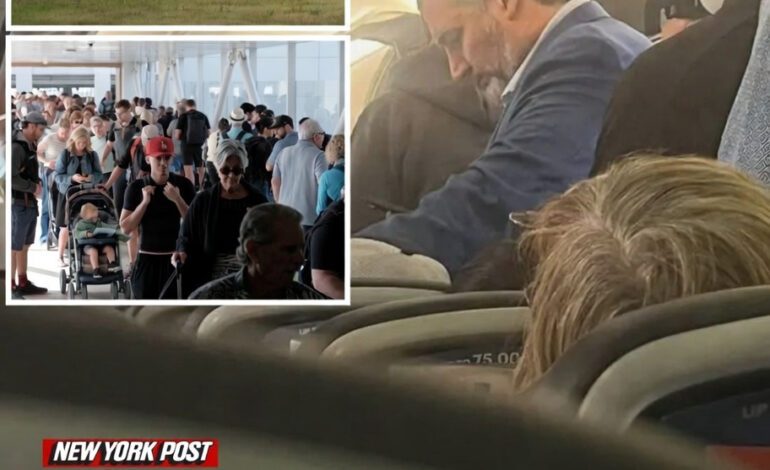
Picture this: you arrive at the airport two hours before your flight — what you thought was plenty of time — only to find a security line that stretches out the front doors, snakes across the sidewalk, and disappears around the corner of the building. The line moves slowly. TSA agents look exhausted. Some lanes are closed. And when you finally get through and sprint to your gate, you learn your flight has been delayed anyway — partly because the aviation system as a whole is running on fumes.
This is not a hypothetical nightmare. It is the reality that millions of American travelers have been living through since late February 2026, when the Department of Homeland Security entered a partial government shutdown — and kept going deeper into crisis with each passing week.
Now, a major American airline has had enough. Delta Air Lines — one of the country’s largest and most influential carriers — has taken the extraordinary step of punishing members of Congress directly by stripping away a set of special travel privileges that lawmakers had quietly enjoyed for years. The message from Delta’s leadership is loud, clear, and deliberately uncomfortable: fix this, or lose your perks.
It is a remarkable moment in American political and corporate history — a private company drawing a direct line between Congressional inaction and real-world consequences, and then making lawmakers feel those consequences personally. And it is only one part of a much larger story about what happens when Washington’s political battles spill out of the Capitol building and into the lives of ordinary people just trying to catch a flight.
What Is the DHS Shutdown — And How Did We Get Here?
To understand the current crisis, it helps to know a little bit about how the federal government’s funding works — and how it can break down.
The United States government is not funded in one single budget. Instead, different departments and agencies receive their own funding through separate pieces of legislation that Congress must pass — and the President must sign — in order for those agencies to keep operating. When Congress fails to pass funding for a particular department, that department faces what is called a government shutdown: it runs out of money, and most of its employees either stop working or continue working without being paid while they wait for Congress to act.
On February 28, 2026, the Department of Homeland Security — the massive federal agency responsible for everything from border security and immigration enforcement to disaster response and airport security — entered a partial shutdown. Congress had failed to pass a funding bill for DHS, and the department’s money ran out.
DHS is a huge operation. It employs hundreds of thousands of people across dozens of agencies. Among the most visible and most immediately affected by this shutdown has been the Transportation Security Administration — the TSA — the agency responsible for screening passengers and baggage at every commercial airport in the United States.
TSA employees are considered essential workers. That means they are required to keep showing up and doing their jobs even during a government shutdown — even if they are not receiving full paychecks. It is a situation that, when you stop and think about it, is genuinely extraordinary: the federal government is legally requiring trained security professionals to come to work every day, screen millions of passengers, and protect the safety of the entire air travel system — without paying them fully for doing so.
TSA workers received their last full paycheck on February 14. They then received a partial paycheck on February 28 — the very day the shutdown began — and missed their next scheduled pay period on March 13 entirely. As of late March, the next pay period is approaching with no guarantee that workers will receive what they are owed.
The Human Cost: Workers Walking Out
It should not surprise anyone that asking people to work without pay leads to problems. Human beings have bills. They have rent and mortgages, car payments, grocery bills, and childcare costs. When those checks stop coming — or arrive smaller than expected — people have to make decisions. And for a growing number of TSA workers, the decision they have made is to stop showing up.
Before the partial shutdown began, the TSA’s call-out rate — meaning the percentage of scheduled employees who failed to show up for their shifts — hovered around 2 percent. That is a normal, manageable level of absenteeism for any large organization. Then the shutdown hit. Then the paychecks stopped arriving on time and in full. And the call-out rate jumped to more than 10 percent.
A five-fold increase in absenteeism means that on any given day, roughly one in ten scheduled TSA workers is not at their post. That translates directly into fewer open security lanes, longer lines, slower screening times, and a system that is struggling to process the same volume of passengers with significantly fewer people doing the work.
But call-outs are only part of the problem. Close to 400 TSA workers have resigned outright since the partial shutdown began. These are not people calling in sick or taking a personal day — these are trained, experienced security professionals who have permanently left federal employment. Finding, hiring, and training replacements takes months. The skills and institutional knowledge those workers took with them when they walked out the door cannot be instantly replaced.
The acting Deputy TSA Administrator, Adam Stahl, has sounded increasingly urgent warnings about the situation. Beyond the immediate airport congestion, Stahl has raised the alarming possibility that several smaller regional airports could be forced to close their security checkpoints entirely if the funding lapse continues and more workers leave. A closed security checkpoint means a closed airport — which means disrupted travel, stranded passengers, and economic damage to the communities those airports serve.
Four-Hour Lines and Airports in Chaos
The effects of the staffing crisis have been most visibly on display at America’s airports — and nowhere more dramatically than in Atlanta.
Hartsfield-Jackson Atlanta International Airport is the busiest passenger airport in the world, handling tens of millions of travelers every year. It is also, not coincidentally, the home hub of Delta Air Lines. During the DHS funding lapse, Hartsfield-Jackson recorded TSA wait times of over four hours at security checkpoints. Four hours. Lines stretched not just through the terminal but physically outside the building, with passengers standing on the sidewalk in whatever weather Atlanta happened to be serving up that day.
Atlanta has not been alone. Across the country, airports have been reporting significantly elevated wait times, missed flights, and the kind of travel-day stress that pushes already-frayed travelers to their limits. Airports that normally pride themselves on efficient security operations have watched helplessly as lines grow and the capacity to manage them shrinks.
For airlines like Delta, this is not just an inconvenience — it is a direct business problem. When passengers miss their flights because the security line was four hours long, airlines deal with the fallout. Rebooking passengers, managing delays, absorbing complaints, and losing the goodwill of customers who blame the airline for what is actually a government-created problem — all of this costs money and damages reputation. Delta has made clear that it sees this situation as having reached a crisis point.
In response to the staffing shortfall, President Trump took the unusual step on Monday of deploying Immigration and Customs Enforcement agents — ICE — to airports across the country to help alleviate the pressure on TSA. The move was both practical and politically pointed: practical because it added bodies to the airport security environment, and political because it highlighted the role that the fight over ICE funding has played in creating the shutdown in the first place.
Delta Draws a Line: No More Perks for Congress
Into this environment of frustration and disruption stepped Delta Air Lines with an announcement that immediately attracted national attention.
For years — quietly, without much public discussion — Delta had been providing special services to members of Congress and their staffers when they traveled. These benefits were not advertised to the general public. They included things like personal airport escorts, access to so-called red coat services (Delta’s premium customer assistance team), and a dedicated Capitol Desk reservation line that lawmakers could call to manage their travel arrangements with more efficiency and attention than the average passenger receives.
These are the kinds of perks that make a busy person’s life significantly easier. Members of Congress travel constantly — between Washington and their home districts, to campaign events, to committee meetings in other cities. Having a dedicated desk to call, a personal escort through the airport, and priority assistance from airline staff is a meaningful convenience. And now Delta has taken it away.
In its official statement, the airline was measured but unmistakably pointed. The company explained that due to the impact on resources caused by the government shutdown, it would temporarily suspend these specialty services to members of Congress flying Delta. It added that Delta’s top priority after safety is taking care of its people and customers — and that this had become increasingly difficult given the current situation.
The Capitol Desk reservation line will remain open, the company clarified, but lawmakers will now be handled the same way as any other passenger — based on their SkyMiles membership status, just like everyone else. No more special treatment. No more escorts. No more red coats. Welcome to coach.
The message embedded in that announcement is as clear as corporate language ever gets: Congress created this problem, Congress is benefiting from services that depend on a functioning airport security system, and Congress will now experience — in at least a small and personal way — what it looks like when that system does not work properly.
The CEO Who Called Congress Inexcusable
Delta’s decision to pull congressional perks did not happen in a vacuum. It came on the heels of a forceful and very public rebuke of Congress delivered the previous week by Delta CEO Ed Bastian.
Bastian is not known for being a firebrand. He is a careful, measured executive who has led Delta through some of the most turbulent periods in the airline industry’s history, including the COVID-19 pandemic, which nearly destroyed the entire commercial aviation sector. He tends to choose his words carefully and does not typically engage in the kind of dramatic public confrontations that generate headlines.
Which is why his appearance on CNBC last Tuesday attracted so much attention. Bastian was not measured. He was angry. He described the situation facing TSA workers as inexcusable. He said it was ridiculous to watch essential security professionals being used as what he called “political chips” in a Congressional standoff that had nothing to do with them. And he said Delta was outraged.
“It’s inexcusable that our security agents, our frontline agents, that are essential to what we do, are not being paid, and it’s ridiculous to see them being used as political chips,” Bastian said. “We’re outraged.”
Bastian also signed a letter alongside other corporate executives urging Congress to find a bipartisan solution to the partial shutdown. The letter represented a coalition of business voices calling on lawmakers to stop the political standoff and restore full funding to DHS.
The fact that the CEO of Delta — a company headquartered in Atlanta, Georgia, a state represented by prominent Republican senators — was publicly attacking Congress in these terms was itself significant. This was not a left-wing advocacy group or a Democratic-aligned organization making noise. This was one of the country’s largest and most important private employers drawing a direct line between Congressional dysfunction and damage to American workers and businesses.
Why Is Congress Stuck? The ICE Fight at the Center of It All
To understand why Congress has been unable to fund DHS for over a month, you have to understand the specific political dispute at the heart of the shutdown — a fight that has nothing to do with airport security and everything to do with immigration enforcement.
Democrats in the Senate have been using the filibuster — a Senate procedural rule that effectively requires 60 votes to advance most legislation in the 100-member chamber — to block the Republican-backed DHS funding bill. But they are not blocking it simply to cause chaos or score political points. They are blocking it because they want something in return: significant reforms to how Immigration and Customs Enforcement operates.
Specifically, Democratic senators have pushed for two major changes. The first is a ban on ICE officers wearing masks during enforcement operations — a practice that critics argue makes it harder for the public to identify agents and hold them accountable for their actions. The second is a requirement for a tighter judicial warrant process before ICE can carry out certain types of arrests or searches — a change aimed at what Democrats describe as civil liberties protections.
Republicans have rejected both demands. Their argument is that these reforms would hamper ICE’s ability to carry out its law enforcement mission, compromise agent safety, and undermine the Trump administration’s broader immigration enforcement agenda. From the Republican perspective, Democrats are holding DHS funding — and by extension, TSA worker paychecks — hostage to an immigration policy agenda.
From the Democratic perspective, the situation looks different: they are trying to use the one piece of legislative leverage available to them to extract accountability reforms from an administration whose immigration enforcement policies they see as dangerous and out of control.
President Trump has been characteristically direct about where he stands. In a weekend post on his Truth Social platform, he declared that no deal should be made with what he called the “Crazy, Country Destroying, Radical Left Democrats” unless they agree to vote for a sweeping piece of Republican legislation he has labeled the “Save America Act.” He also rejected a proposal that would have funded the rest of DHS — including TSA — while leaving ICE funding to be handled separately through a different legislative process. That deal would have ended the airport security crisis without resolving the broader immigration dispute, but Trump declined to support it.
Congress Feels the Heat — But Who Is Actually Accountable?
Delta’s move to revoke congressional travel perks has been widely praised by people across the political spectrum who are frustrated with Congress’s inability to keep basic government functions running. But it has also raised a genuine question: in a political standoff this complicated, who is actually responsible for the pain being felt by TSA workers and air travelers?
Both sides have a ready answer, and both sides blame the other. Republicans point to the Senate filibuster and argue that Democrats are choosing to keep the shutdown going rather than accept a clean funding bill. Democrats counter that Republicans and the Trump administration have refused to engage in good-faith negotiation and are protecting ICE from reasonable oversight requirements.
What is indisputable is that the people actually paying the price are not members of Congress. They are TSA workers — many of them earning modest salaries, living paycheck to paycheck like most Americans — who are being required to work without full pay. They are travelers facing hours-long security lines. They are regional airports at risk of closure. They are airlines trying to run a business in an environment where the infrastructure they depend on is being deliberately starved of resources.
This is not the first time TSA workers have been put in this position. Remarkably, this is the third funding lapse that TSA employees have had to weather in just the last six months. Three times in six months, the political system has failed to do the basic work of funding the agency responsible for keeping American air travel safe. That pattern suggests a systemic problem that goes beyond any single political dispute.
Last week, the Senate unanimously passed a bill authored by Senator John Cornyn of Texas that would strip members of Congress of their ability to bypass standard TSA security lines at airports. The bill passed without a single dissenting vote — suggesting that even senators recognize the absurdity of enjoying special security privileges while the agency providing those privileges is in crisis. However, the bill has not yet passed the House of Representatives, meaning it has not yet become law.
Some lawmakers have also proposed blocking Congressional salaries until a funding deal is reached — using the same kind of personal financial pressure that TSA workers are currently experiencing as a tool to motivate action. However, that approach runs directly into a constitutional barrier: the 27th Amendment to the Constitution prohibits Congress from changing its own pay until after a new Congress has been sworn in. The amendment was designed to prevent lawmakers from voting themselves immediate raises, but it also effectively blocks efforts to cut their pay as punishment for inaction.
What a Resolution Would Require
Ending the partial shutdown requires one of two things: either both parties in the Senate reach a compromise that can clear the 60-vote threshold required to overcome the filibuster, or the political dynamics shift in a way that changes the calculation for one side or the other.
The pressure to resolve the situation is mounting from multiple directions. Corporate America is speaking up, with Delta’s move being only the most visible example of business frustration with the shutdown. Air travelers are angry and vocal. TSA workers — and the unions that represent many of them — are advocating loudly for relief. Regional airport communities are watching nervously as the threat of closure moves from theoretical to increasingly real.
At the same time, the political forces keeping the shutdown in place show no obvious signs of collapsing. Democrats believe the immigration reforms they are demanding are worth fighting for. The Trump administration believes that accepting those reforms would represent an unacceptable concession to the political left. And in Washington, where both sides often calculate that appearing strong and uncompromising is more politically valuable than appearing reasonable, those positions can be remarkably durable.
A Country Waiting in Line
There is a certain quiet symbolism in what is happening at American airports right now. Security lines that stretch out the door and into the street. TSA agents showing up to do a demanding, essential job without knowing when their next paycheck will arrive in full. Travelers missing flights, rearranging plans, and burning hours of their lives in lines that do not need to be this long.
And somewhere in all of that, a member of Congress is checking in for their flight — without a red coat escort, without a priority phone line, without any of the small conveniences that Delta quietly provided for years. For at least a few minutes, in at least this one corner of their lives, they are standing in the same line as everyone else.
Whether that experience will translate into the urgency needed to end the shutdown remains to be seen. Government shutdowns have a way of dragging on longer than almost anyone predicts, because the people with the power to end them are often the last ones to feel their effects directly.
Delta Air Lines has done its small part to close that gap. Now it is up to Congress to do its much larger part.
Discover more from MatterDigest
Subscribe to get the latest posts sent to your email.