$580 MILLION Bet Placed Minutes Before Trump’s Iran Announcement — Now People Are Asking Questions
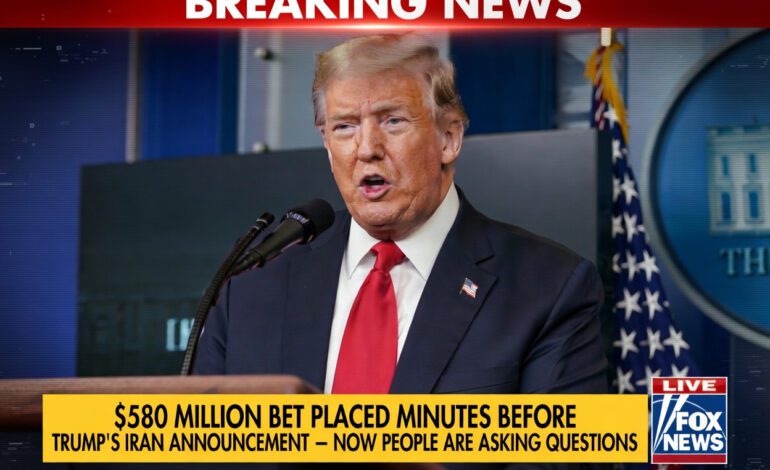

Mystery $580 Million Oil Trades Just Minutes Before Trump’s Iran Announcement Raise Questions
A sudden wave of oil trades worth more than half a billion dollars has drawn intense attention from financial analysts and market watchers around the world. The trades happened just minutes before a major announcement from former U.S. President Donald Trump about Iran, and the timing has sparked a debate across Wall Street.
According to market data reviewed by financial journalists, roughly $580 million in oil futures contracts were traded in a very small window of time early Monday morning. The burst of activity happened only about fifteen minutes before Trump posted a message signaling that the United States would pause potential military strikes on Iranian infrastructure.
When that message reached investors, the markets reacted immediately. Oil prices dropped sharply while stock futures jumped higher. For many traders, the sudden move raised an uncomfortable question: did someone know about the announcement before the public did?
The trading surge occurred between 6:49 a.m. and 6:50 a.m. Eastern Time. During that brief period, around 6,200 futures contracts tied to Brent crude and West Texas Intermediate crude were bought and sold. Futures contracts are agreements to buy or sell a commodity at a specific price on a future date, and they are widely used by investors to bet on where prices will move.
Together, those trades represented a value of roughly $580 million. The sheer size of the transactions stood out to analysts who track market activity every day. Normally, such large volumes appear gradually over time. But in this case, the trades were concentrated into an extremely tight time frame.
The spike in activity quickly caught the attention of market observers who specialize in unusual trading patterns. When markets see such a sudden surge in volume, it often signals that a large investor or institution is making a strong bet on price movement.
Only minutes later, at about 7:04 a.m., Trump posted a message on his social media platform stating that the United States had engaged in “productive conversations” with Iran. He suggested that planned attacks on Iranian infrastructure would be paused for the time being.
That message surprised many investors. In the days leading up to the announcement, tensions between the United States and Iran had been rising. Many traders believed the situation could escalate into a military confrontation that might disrupt global oil supply.
If that had happened, oil prices would likely have surged because Iran plays a key role in global energy markets. Any threat to supply in the region can quickly push crude prices higher.
Instead, the signal that tensions might ease sent oil prices sharply lower.
Within hours of the announcement, crude prices had dropped more than 10 percent. At the same time, stock futures tied to the S&P 500 began climbing as investors felt relief that a larger conflict might be avoided.
For traders who had bet on falling oil prices just minutes before the news, the move would have been extremely profitable. Even a small change in oil prices can produce large gains when futures contracts are involved.
That possibility is what has fueled so much discussion about the trades. While there is currently no proof that anyone acted on inside information, the timing alone has raised eyebrows across the financial industry.
Another detail that drew attention was the movement in stock market futures. Around the same time the oil trades appeared, trading volumes in S&P 500 futures also increased sharply.
Stock futures are often used by professional investors to react quickly to major news events. Because they trade almost around the clock, they allow traders to position themselves before the regular stock market opens.
The spike in futures activity suggested that some investors were preparing for a broader market reaction, not just a shift in oil prices. When Trump’s message was posted minutes later, the market reaction seemed to match the direction of those early trades.
Despite the suspicious timing, experts caution that unusual trading patterns do not automatically mean wrongdoing occurred. Financial markets are extremely complex, and large trades happen every day for many different reasons.
For example, hedge funds often adjust their positions based on automated trading strategies. These algorithms analyze price patterns, economic data, and geopolitical headlines to predict market movements. Sometimes they can trigger large trades within seconds.
Institutional investors also rebalance portfolios regularly. A large oil trade might be part of a broader strategy that includes multiple commodities, currencies, or stocks. Without access to detailed trading records, it is impossible to know the exact reason behind any specific transaction.
Still, the coincidence between the trading spike and the announcement has made many analysts curious. On Wall Street, timing matters. When large trades happen immediately before major market-moving news, regulators sometimes review the transactions to ensure that no confidential information was used improperly.
Government officials have so far rejected suggestions that anyone connected to the administration benefited from advance knowledge of the announcement. A spokesperson for the White House described the speculation as “baseless and irresponsible.”
According to officials, the policy decision regarding Iran was made through normal diplomatic channels and was not shared outside appropriate government circles before the public announcement.
The geopolitical background behind the situation is also important. Tensions between the United States and Iran have been rising over the past several months. Disputes over sanctions, regional conflicts, and nuclear policy have repeatedly pushed the two countries toward confrontation.
Energy markets are extremely sensitive to developments in the Middle East. The region produces a large portion of the world’s oil supply, and any threat to production or transportation routes can push prices higher.
Because of that sensitivity, traders around the world watch political developments closely. Even small signals about diplomacy or conflict can send prices moving dramatically within minutes.
The Monday announcement appeared to calm fears that a major escalation was about to occur. By signaling a pause in military plans, the message suggested that negotiations might still be possible.
However, the situation became even more confusing later the same day. Iran’s parliamentary speaker publicly denied that any negotiations with the United States had taken place. That statement sent markets into another wave of volatility as traders tried to understand what was actually happening behind the scenes.
When governments send mixed signals, markets often react strongly because investors dislike uncertainty. Oil prices bounced around throughout the day as traders adjusted their expectations about the future of U.S.–Iran relations.
The mystery surrounding the early morning trades comes at a time when participation in oil markets has been expanding rapidly. In recent weeks, retail investors have poured record amounts of money into funds linked to crude oil prices.
One of the most popular vehicles for these bets is the United States Oil Fund, commonly known by its ticker symbol USO. The fund tracks oil futures contracts and allows everyday investors to gain exposure to price movements without directly trading commodities.
According to market reports, more than $115 million flowed into this fund in just five days earlier this month. That surge reflects growing interest among smaller investors who want to profit from the dramatic swings in energy prices.
Options trading tied to oil funds has also reached record levels. Options give traders the right to buy or sell assets at specific prices in the future. They are often used to make highly leveraged bets on short-term price movements.
In addition to USO, other leveraged products linked to oil have seen heavy trading activity. One example is the ProShares Ultra Bloomberg Crude Oil ETF, known by the ticker UCO. This fund is designed to deliver amplified returns based on daily changes in oil prices.
While these products can offer large profits, they also carry significant risk. Sharp price swings can quickly erase gains, especially when leverage is involved.
The recent excitement in oil markets has led some analysts to compare the trend to past “meme stock” movements. In those episodes, large groups of retail investors used social media and online forums to coordinate aggressive trading strategies.
Although the oil market is much larger and more complex than individual stocks, the surge in speculative activity has raised concerns among regulators. When large numbers of inexperienced investors enter volatile markets, sudden price swings can become even more extreme.
At the same time, professional traders remain the dominant force in oil futures trading. Major banks, hedge funds, and commodity firms still account for most of the daily volume.
For investigators and regulators, the key question is whether the early morning trades were part of normal market activity or something more unusual. Determining that answer requires detailed data about who placed the orders and why.
Such investigations can take time because trades often pass through multiple brokers and financial institutions before reaching the market. Analysts must review transaction records, communication logs, and trading strategies to build a complete picture.
Until that process is complete, the mystery surrounding the $580 million oil trades will likely continue to attract attention.
Events like this highlight how sensitive global markets are to political decisions. A single message from a political leader can instantly change the direction of trillions of dollars in assets.
In today’s digital world, information travels faster than ever before. Traders monitor social media posts, news alerts, and government statements in real time. Algorithms can even scan text and automatically trigger trades based on keywords.
This speed makes financial markets incredibly responsive—but it also means that even small timing differences can create huge advantages for those who act first.
Whether the trades were simply lucky timing or something more significant remains an open question. What is clear is that the combination of geopolitical tension, market volatility, and massive financial stakes creates an environment where even a few minutes can make an enormous difference.
As investigations continue and new information emerges, analysts will keep watching the data closely. For now, the early morning burst of oil trades remains one of the most intriguing market mysteries of the year.
And in a world where politics and markets are increasingly intertwined, stories like this remind investors just how quickly fortunes can change.
Discover more from MatterDigest
Subscribe to get the latest posts sent to your email.