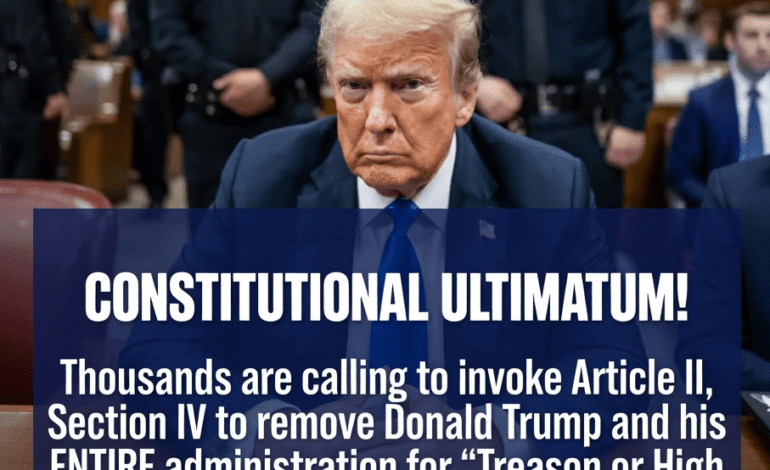
CONSTITUTIONAL ULTIMATUM: The People Invoke Article II to Remove Trump

🔴 BREAKING
WASHINGTON SHAKEN! Massive Demand to Remove Entire Trump Administration Under Constitutional Authority
The Constitutional Storm Nobody Saw Coming
Something unprecedented is happening in America right now. Across town halls, courthouses, and social media platforms, ordinary citizens are invoking a constitutional mechanism most Americans barely knew existed — and they are using it to demand the removal of President Donald Trump and his entire administration.
This isn’t protest. This isn’t politics as usual. This is a formal, constitutional ultimatum — and Washington is shaking.
So what exactly is Article II? Why are people invoking it now? And what does a constitutional removal process actually look like? Let’s break it all down in plain language — because every American deserves to understand what’s happening in their government.
|
What Is Article II of the U.S. Constitution?
Article II is the section of the U.S. Constitution that defines the executive branch. It creates the presidency, outlines presidential powers, and — critically — establishes the terms under which a president can be removed from office.
Most people know the basics: the president is elected every four years, serves as commander-in-chief, and can be impeached. But Article II goes much deeper than that.
The Core Provisions of Article II
Here’s what Article II actually covers, broken into plain language:
- Section 1 — Creates the office of the President and establishes the Electoral College system
- Section 2 — Grants the president powers as Commander-in-Chief, treaty-making authority, and the ability to appoint key officials
- Section 3 — Requires the president to ‘take care that the laws be faithfully executed’ — a crucial accountability clause
- Section 4 — States that the president, vice president, and civil officers shall be removed from office upon impeachment and conviction for treason, bribery, or other high crimes and misdemeanors
| KEY LEGAL TERM: ‘High crimes and misdemeanors’ does not mean ordinary crimes. Historically, this phrase covers serious abuses of power, violations of public trust, and corruption in office — even acts that may not be explicitly illegal under the criminal code. |
Why Article II Is Being Invoked Now
Critics of the Trump administration argue that multiple actions taken since January 2025 meet the constitutional threshold for removal. These include alleged violations of the ‘faithful execution’ clause, abuse of executive orders, and what opponents describe as deliberate obstruction of congressional oversight.
Legal scholars are divided. But the conversation is no longer fringe — it has entered mainstream political and legal discourse with remarkable speed.
What Is the ‘Constitutional Ultimatum’ Movement?
The phrase ‘Constitutional Ultimatum’ refers to an organized civic movement that formally calls on Congress to begin impeachment proceedings under Article II, Section 4. Supporters argue this is not a political preference — it is a constitutional obligation.
The movement gained enormous traction in early 2025, fueled by growing frustration with what many describe as executive overreach, dismantling of federal agencies, and actions seen as undermining democratic norms.
Who Is Behind the Demand?
The movement spans an unusually broad coalition:
- Constitutional law professors and former federal judges
- Civil rights organizations and voting rights advocates
- Former Republican officials and military leaders
- Grassroots activist networks with millions of members
- Chapters of the movement active in all 50 states
Retired federal judge J. Michael Luttig, a conservative legal icon, warned in early 2025 that certain executive actions represented ‘a clear and present danger to the constitutional order.’ His words became a rallying cry for the movement.
What Are They Specifically Demanding?
The core demands of the Constitutional Ultimatum movement are:
- Immediate impeachment hearings in the House of Representatives
- Senate trial and conviction of President Trump and key Cabinet members
- Removal of officials who facilitated unconstitutional actions
- Independent special counsel investigation into executive branch conduct
- Restoration of fired or forced-out federal employees and agency heads
What Actions Triggered This Constitutional Crisis?
To understand the constitutional argument, you need to know the specific actions that critics say crossed legal and constitutional lines. Here is a straightforward summary.
Mass Firings of Independent Agency Officials
One of the most legally contested moves of the Trump second term was the mass dismissal of officials at independent agencies — including the Federal Trade Commission (FTC), the Equal Employment Opportunity Commission (EEOC), and the National Labor Relations Board (NLRB).
Federal courts have historically ruled that officials at independent agencies can only be removed ‘for cause.’ Critics argue these mass firings violated that principle and undermined the independence of watchdog institutions.
Executive Attempts to Defund Congressional Appropriations
The administration moved to impound — or simply not spend — funds that Congress had already authorized. This is a practice banned by the Impoundment Control Act of 1974, passed after similar actions by President Nixon.
Legal experts say this is not just a policy dispute. It represents a direct assault on the separation of powers — specifically, Congress’s power of the purse.
Deployment of Federal Forces in Disputed Circumstances
The use of federal military and law enforcement assets in ways that several governors and courts contested raised serious concerns about the Insurrection Act and constitutional limits on executive power.
Retaliation Against Oversight Bodies
Multiple reports documented what critics called systematic retaliation against inspectors general, congressional investigators, and whistleblowers — all protected under federal law.
| Action | Constitutional Provision Allegedly Violated | Legal Status (as of March 2025) |
|---|---|---|
| Mass agency firings | Separation of Powers / Independent Agency Protections | Contested in multiple federal courts |
| Impounding congressional funds | Impoundment Control Act / Art. I Sec. 9 | Injunctions issued in several circuits |
| Obstruction of oversight | Article II Sec. 3 (Faithful Execution) | Congressional investigations ongoing |
| Retaliation vs. whistleblowers | Whistleblower Protection Act / 1st Amendment | DOJ Inspector General reviewing |
| Executive orders bypassing Congress | Non-delegation doctrine / Separation of Powers | Supreme Court petitions pending |
How Does the Constitutional Removal Process Actually Work?
Here’s the plain-language guide to how impeachment and removal works under the U.S. Constitution. Many Americans are surprised by how the process actually differs from what they learned in school.
Step 1: The House of Representatives Votes to Impeach
Impeachment begins in the House. A simple majority vote (218 of 435 members) is required to formally impeach the president. Importantly, this is similar to an indictment — it does not remove the president from office. It sends the case to the Senate for trial.
Step 2: The Senate Conducts a Trial
Once impeached, the Senate holds a full trial. The Chief Justice of the Supreme Court presides. Senators serve as jurors. Both sides present evidence and witnesses. The trial can take days or weeks.
Step 3: Two-Thirds Senate Vote Required for Removal
To actually remove the president, two-thirds of the Senate (67 of 100 senators) must vote to convict. This is a very high bar — and it is why no U.S. president has ever been removed through impeachment, though several have come close.
Step 4: Can Cabinet Members Also Be Removed?
Yes. Article II, Section 4 explicitly states that ‘the President, Vice President and all civil Officers of the United States’ are subject to impeachment and removal. This means Cabinet secretaries, senior agency officials, and even the Vice President can be impeached and removed.
The Constitutional Ultimatum movement specifically calls for proceedings against multiple Cabinet members — not just the president.
| PEOPLE ALSO ASK: Has any president actually been removed from office by impeachment? No. Andrew Johnson (1868), Bill Clinton (1998), and Donald Trump (2019 and 2021) were all impeached by the House but acquitted by the Senate. Richard Nixon resigned before a near-certain impeachment vote. |
What Legal Experts Are Saying
The legal community is sharply divided — but the debate is happening at the highest levels of constitutional scholarship.
Those Who Support Constitutional Action
Yale Law School professor Bruce Ackerman has argued that the current moment represents ‘a constitutional crisis that the Framers specifically designed the impeachment mechanism to address.’ He and dozens of co-signers published a formal legal brief in February 2025 calling for congressional action.
Harvard constitutional law professor Laurence Tribe wrote that the accumulation of executive actions represented ‘not individual violations, but a systematic dismantling of constitutional governance.’ He called it ‘exactly what Article II Section 4 was written for.’
Those Who Disagree
Conservative legal scholar Jonathan Turley argued that while some executive actions may be legally questionable, they do not necessarily meet the high constitutional bar for ‘high crimes and misdemeanors.’ He warned against what he called ‘constitutional overreach in the name of defending the Constitution.’
Other legal analysts note that impeachment is fundamentally a political process, not a purely legal one — and that congressional will, not legal argument alone, determines whether it proceeds.
| EXPERT QUOTE: ‘The question is not whether these actions are popular or unpopular. The question is whether they constitute the kind of abuse of power that the Framers placed in Article II to address.’ — Constitutional law professor, Harvard Law Review, February 2025 |
What Do Americans Actually Think? The Polling Data
Public opinion on removal is polarized — but the numbers tell an interesting story.
| Poll / Survey | Date | Finding |
|---|---|---|
| Reuters/Ipsos National Poll | February 2025 | 51% support impeachment hearings |
| Quinnipiac University Poll | March 2025 | 47% say Trump has exceeded constitutional authority |
| Gallup Presidential Approval | March 2025 | Presidential approval at 41% — among lowest at this point in a term |
| Pew Research Center | January 2025 | 68% of Democrats, 12% of Republicans support removal proceedings |
| Fox News National Poll | February 2025 | 38% of respondents favor some form of accountability hearings |
What is striking is the breadth of concern. Even in polls conducted by media outlets traditionally sympathetic to the administration, significant minorities express support for accountability measures. The Constitutional Ultimatum movement interprets this as a signal that the political will for action may be growing.
Washington’s Response: Shock, Silence, and Strategy
The title of this article calls Washington ‘shaken’ — and that is not an exaggeration. The scale and organization of the Constitutional Ultimatum movement has genuinely surprised political insiders on both sides of the aisle.
Democratic Response
Democratic leadership has been cautious. While many progressives in the House have called for immediate impeachment hearings, party leaders have proceeded carefully, wary of the political dynamics heading into the 2026 midterm elections.
House Minority Leader Hakeem Jeffries stated in February 2025 that Democrats are ‘committed to using every constitutional tool available’ — but stopped short of endorsing immediate impeachment proceedings.
Republican Response
Most Republican lawmakers have publicly dismissed the Constitutional Ultimatum movement as partisan overreach. However, behind closed doors, several GOP senators have reportedly expressed concern about the legal exposure created by some executive actions.
A small but notable group of Republican former officials — including former members of Congress and senior executive branch veterans — have publicly supported at minimum an independent investigation.
The White House Response
The Trump administration has dismissed the movement as politically motivated. Press Secretary spokespeople have described the constitutional arguments as ‘frivolous’ and ‘legally unfounded.’ The administration has also moved to preemptively fight several court challenges through the Department of Justice.
Historical Context: When America Has Faced Constitutional Crises Before
This is not the first time Americans have faced a constitutional confrontation with their own executive branch. History offers important context.
| Historical Crisis | Year | Constitutional Mechanism Invoked | Outcome |
|---|---|---|---|
| Nixon / Watergate | 1974 | Article II impeachment / Saturday Night Massacre | Nixon resigned before removal |
| Clinton Impeachment | 1998 | Article II / House impeachment vote | Senate acquittal, Clinton completed term |
| First Trump Impeachment | 2019 | Article II / Abuse of power, obstruction | Senate acquittal |
| Second Trump Impeachment | 2021 | Article II / Incitement of insurrection | Senate acquittal (after leaving office) |
| Constitutional Ultimatum Movement | 2025 | Article II, Sec. 3 & 4 / Multiple violations alleged | Ongoing — congressional response pending |
Each of these moments tested constitutional norms in different ways. What distinguishes the current moment, according to legal historians, is the breadth and simultaneity of the alleged violations — affecting multiple branches and institutions at once.
What Happens Next? A Realistic Assessment
Let’s be direct about what the Constitutional Ultimatum movement faces — and what realistic outcomes look like.
Scenario 1: Full Impeachment Proceedings Begin
For this to happen, Democrats would need to gain a House majority willing to vote for impeachment, and 67 senators would need to convict. Given current Senate composition, removal requires significant Republican support. Historically, that is rare — but not impossible under sufficiently extraordinary circumstances.
Scenario 2: Congressional Investigations Without Removal
More likely in the short term: extensive congressional hearings, subpoenas, and investigations that build a public record without culminating in removal. This is the Watergate model before Nixon resigned.
Scenario 3: Courts Force Compliance
Federal courts are already issuing injunctions against several executive actions. A series of Supreme Court rulings against the administration could achieve the legal effect of constraining executive power — without formal impeachment.
Scenario 4: Electoral Resolution in 2026
The 2026 midterm elections become a referendum on constitutional governance. If the Democratic Party gains enough seats, impeachment becomes procedurally viable. The Constitutional Ultimatum movement is already organizing voter registration and mobilization campaigns around this scenario.
| BOTTOM LINE: Constitutional removal is a high bar by design. But the movement has already succeeded in something significant — placing the language of constitutional accountability at the center of American political debate in 2025. |
Frequently Asked Questions (FAQ Schema)
Q: Can citizens directly remove a president under the Constitution?
No. Citizens cannot directly remove a president. The constitutional removal mechanism requires action by Congress — specifically, a House impeachment vote and a two-thirds Senate conviction vote. However, citizens drive the political will that determines whether Congress acts.
Q: What does ‘invoking Article II’ actually mean in practice?
It means formally calling on Congress to exercise its constitutional authority under Article II, Section 4 to begin impeachment proceedings. It can take the form of petitions, formal legal briefs, congressional testimony, and organized political pressure.
Q: Is the Constitutional Ultimatum movement the same as the resistance or anti-Trump movement?
The movement explicitly frames itself as constitutional rather than partisan. It includes former Republican officials and conservative legal scholars, not just Democrats. However, critics argue it is fundamentally political in nature regardless of its framing.
Q: Could the entire Cabinet really be removed?
Technically, yes. Article II, Section 4 applies to all civil officers, including Cabinet secretaries. However, impeaching individual Cabinet members requires separate proceedings for each person — making a wholesale removal of an entire administration extraordinarily difficult.
Q: How long does an impeachment process take?
There is no fixed timeline. The first Trump impeachment in 2019 lasted approximately three months from formal inquiry to Senate acquittal. A more complex process involving multiple officials and extensive evidence could take considerably longer.
Key Takeaways
- The Constitutional Ultimatum movement is a formal civic effort to invoke Article II and demand removal of the Trump administration.
- Article II, Section 4 allows removal of the president, VP, and all civil officers for treason, bribery, or high crimes and misdemeanors.
- Triggering actions include alleged violations of the faithful execution clause, impoundment of funds, mass agency firings, and retaliation against oversight.
- Removal requires a simple House majority to impeach and a two-thirds Senate supermajority to convict — a very high bar.
- Legal scholars are divided, but the debate is happening at the highest levels of constitutional law.
- Public polling shows majority support for at minimum impeachment hearings, though partisan splits remain deep.
- Realistic near-term outcomes include congressional investigations and court injunctions rather than full removal.
- The movement’s most immediate impact may be political: reshaping the 2026 midterm elections around constitutional accountability.
Conclusion: A Constitutional Moment
What the Constitutional Ultimatum movement represents — whatever you think of its politics — is something important: a mass civic engagement with the actual text and mechanisms of American constitutional governance.
Americans of all backgrounds are reading Article II, studying impeachment history, and asking serious questions about the relationship between presidential power and constitutional limits. That is, in itself, a remarkable thing.
Whether removal actually happens depends on Congress, the courts, and ultimately the voters. But the conversation has been started. The constitutional framework has been named. And Washington, for the first time in years, is being forced to take the substance of constitutional arguments seriously.
Stay informed. Read the Constitution. Engage your representatives. That is what Article II was designed for — not just as a legal document, but as a living framework for democratic accountability.
| 📢 CALL TO ACTION: Want to stay updated on the Constitutional Ultimatum movement and its progress through Congress and the courts? Follow Matter News on X (@MatterNews101) for real-time breaking updates. Share this article to inform your community about their constitutional rights and options. |
Sources & Further Reading
- U.S. Constitution, Article II — constitution.congress.gov
- Congressional Research Service — Impeachment and Removal: crsreports.congress.gov
- Reuters/Ipsos National Poll, February 2025 — reuters.com/graphics/USA-TRUMP/polls
- Brennan Center for Justice — Presidential Power and Constitutional Limits: brennancenter.org
- Harvard Law Review — Executive Power and Constitutional Accountability, 2025: harvardlawreview.org
Discover more from MatterDigest
Subscribe to get the latest posts sent to your email.