Charles Crawford Executed for the Rape and Murder of Kristy Ray — Full Story
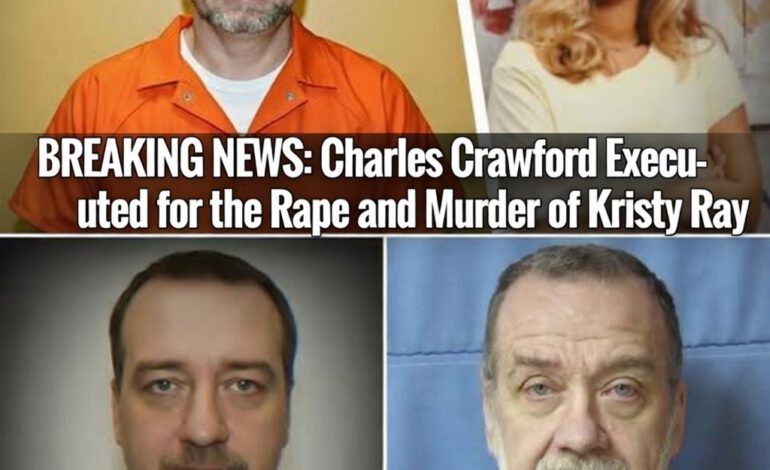

| 🚨 HEADLINE ERRORS IDENTIFIED: The viral headline says ‘Texas’ — WRONG. This execution took place in MISSISSIPPI. It also says ‘5 minutes ago’ — this is a clickbait timestamp. The execution occurred on October 15, 2025. Both errors are addressed fully below. |
The Real Story: What Actually Happened on October 15, 2025
Mississippi executed Charles Ray Crawford on the evening of October 15, 2025. He was 59 years old. He was convicted of kidnapping, raping, and murdering 20-year-old Kristy Ray in January 1993 — a crime so cold and calculated that it shocked the small communities of northern Mississippi.
Crawford was pronounced dead at 6:15 p.m. at the Mississippi State Penitentiary in Parchman. His execution was the third carried out in the United States in two days alone, part of a historic surge in executions in 2025 — the highest single-year total in more than a decade.
His final words were calm. They were religious. They were brief. And they are nothing like the dramatic ‘revelation’ some clickbait headlines promised.
Charles Crawford Execution — At a Glance
| Detail | Information |
| Full Name | Charles Ray Crawford |
| Date of Birth | February 10, 1966 |
| Age at Execution | 59 |
| Date of Execution | October 15, 2025 |
| Time of Death | 6:15 p.m. CST |
| Execution Method | Lethal injection |
| Location | Mississippi State Penitentiary, Parchman, MS |
| State | Mississippi (NOT Texas — see Fake News section) |
| Victim | Kristy Denice Ray, age 20 |
| Crime Date | January 29, 1993 |
| Conviction | Kidnapping, rape, and first-degree murder (1994) |
| Years on Death Row | 31 years |
| Last Words | “To my family, I love you. I’m at peace. I’ve got God’s peace. I’ll be in heaven. To the victim’s family, true closure and true peace, you cannot reach that without God.” |
| Last Meal | Not publicly reported |
Viral Headline Fact-Check: True, False, or Misleading?
Before going deeper, here is a clear breakdown of what the headline and related social media posts got right — and wrong.
| Claim | Verdict | Notes |
| Charles Crawford was executed | TRUE | Confirmed: Oct 15, 2025, 6:15 p.m. CST |
| The state was Texas | FALSE | The execution took place in Mississippi, not Texas |
| The victim was a college student | TRUE | Kristy Ray, 20, attended Northeast Mississippi Community College |
| It happened ‘5 minutes ago’ | FALSE / MISLEADING | Clickbait framing. Execution was Oct 15, 2025 |
| Crawford was executed by lethal injection | TRUE | Confirmed by Mississippi Dept. of Corrections |
| Last words were dramatic / shocking | PARTLY FALSE | Words were calm and religious — no courtroom-drama moment |
| Crawford was a first-time offender | FALSE | He had prior rape and assault convictions |
The Crime: What Charles Crawford Did to Kristy Ray
To understand the weight of this execution, you need to understand Kristy Ray — not as a case number, but as a person.
Who Was Kristy Denice Ray?
Kristy Denice Ray was born on November 26, 1972, in Germany. Her family eventually settled in Tippah County, Mississippi. By January 1993, Kristy was 20 years old and attending Northeast Mississippi Community College while working part-time at the Sunburst Bank — the same bank where her mother worked full-time.
She was a young woman building a life. She had plans. She had a future. On January 29, 1993, that future was taken from her.
The Day of the Kidnapping
On that Thursday afternoon, Kristy and her mother left the bank together after work. They planned to reunite later that evening at the family home in Chalybeate, a small rural community in Tippah County.
Kristy arrived home first. What she did not know was that Charles Crawford — then 26 years old and out on bail — was already inside the house, burglarizing it. When Kristy walked in, Crawford chose not to flee. He chose to take her.
Crawford forced Kristy into a vehicle and drove her to an abandoned barn in the surrounding rural area. There, he raped her. Then he handcuffed her to a pine tree and stabbed her to death. He left a handwritten ransom note at her parents’ home demanding $15,000.
| 📋 Court Record: Crawford later led police to Kristy Ray’s body. He told investigators he ‘woke up sitting on a stump in the woods’ with Kristy ‘lying at his feet, handcuffed behind her back, dead.’ He admitted he ‘must have killed her’ but claimed he could not remember doing so. |
The Ransom Note and the Arrest
When Kristy’s mother arrived home that evening, her daughter was gone. A handwritten ransom note sat on the table. A second ransom note — this one made from magazine cutouts and referencing a woman named ‘Jennifer’ — was found in the attic of Crawford’s former father-in-law.
That second note was a critical piece of evidence. Investigators quickly connected Crawford to the crime. DNA evidence also linked him to the scene. Crawford was located and arrested. He eventually confessed and led police to where he had left Kristy’s body.
Crawford Was Not a First-Time Offender — His Full Criminal Background
The Kristy Ray murder did not come out of nowhere. Crawford had a documented pattern of violent sexual crime stretching back years.
The 1991 Rape and Assault of a 17-Year-Old
On April 13, 1991, Crawford encountered his first wife’s 17-year-old sister and her friend while they were driving. He later committed a violent assault on the friend — striking her over the head with a hammer — and raped the 17-year-old girl, identified only as ‘Sue’ in court records.
Crawford claimed he blacked out during both incidents. Witnesses described a chilling change in his demeanor during the attack: his eyes dilated, he stopped blinking, he had a blank stare, and he appeared frightened.
Crawford was charged with rape and assault for these crimes. He was out on bail, awaiting trial, when he kidnapped and killed Kristy Ray in January 1993.
Timing That Matters
Crawford murdered Kristy Ray exactly four days before he was scheduled to stand trial for the rape of the 17-year-old. This timing was not coincidental, prosecutors argued — it suggested someone who knew his freedom was running out and acted with desperate, terrifying calculation.
The Sentence for the Rape Case
Crawford was ultimately convicted in the 1991 rape and sentenced to 46 years in prison. This prior conviction became a statutory ‘aggravating circumstance’ during his capital murder trial for Kristy Ray’s death — it was one of the key factors that led the jury to recommend the death penalty.
The Trial, the Insanity Defense, and the Death Sentence
Crawford’s 1994 capital murder trial was deeply contested. The strategy chosen by his attorneys would later become the central argument in more than 30 years of appeals.
The Insanity Defense and Why It Backfired
Crawford’s defense team pursued an insanity defense, arguing that he suffered from bipolar disorder, memory blackouts, and possible brain damage. A prison psychiatrist testified about Crawford’s psychiatric history, his prior hospitalization, and his 1989 bipolar diagnosis. Crawford himself claimed he could not remember committing the murder.
But there was a major problem: Crawford reportedly told his attorneys he wanted to maintain his innocence. He did not want to concede that he killed Kristy Ray. His attorneys overrode that wish. They admitted his guilt to the jury while arguing he was legally insane — pursuing the strategy they believed gave him the best chance of avoiding death.
It did not work. A clinical psychologist called by the prosecution argued Crawford had no bipolar disorder and had acted with clear premeditation. The jury convicted Crawford and sentenced him to death.
The Sixth Amendment Controversy
This decision by Crawford’s trial attorneys — to admit his guilt over his objections — became the legal flashpoint for decades of appeals. In 2018, the U.S. Supreme Court ruled in McCoy v. Louisiana that a defense attorney cannot override a client’s explicit wish to maintain innocence at trial.
Crawford’s legal team argued that ruling applied to him. They contended his Sixth Amendment rights had been violated from the start.
| “It’s almost like he didn’t even get the chance to have innocent or guilty matter because his attorney just overrode his wishes from the outset.” — Krissy Nobile, Director, Mississippi Office of Capital Post-Conviction Relief |
Why the Supreme Court Let the Execution Proceed
Justice Sonia Sotomayor, joined by Justices Elena Kagan and Ketanji Brown Jackson, wrote a dissent arguing Crawford’s case likely had merit — and that he may never have had a fair trial. But the majority of the court declined without explanation to stop the execution, citing the procedural problem that Crawford had not raised this claim early enough and had not adequately argued why the 2018 ruling should apply retroactively.
The order denying the stay came minutes before the execution was scheduled to begin.
Crawford’s Final Hours: What Happened on Execution Day
On the afternoon of October 15, 2025, Crawford spent time with his family and a preacher at Mississippi State Penitentiary in Parchman — confirmed by Marc McClure, the chief superintendent of operations for the Mississippi Department of Corrections.
His Last Words — The Full Statement
| 💬 Confirmed Last Words: “To my family, I love you. I’m at peace. I’ve got God’s peace. I’ll be in heaven. To the victim’s family, true closure and true peace, you cannot reach that without God.” |
These were not shocking words. They were not a confession of regret in the dramatic sense. They were the words of a man who had, according to prison advocates, spent 31 years transforming himself into a deeply religious figure on death row.
Krissy Nobile, his post-conviction attorney, described Crawford as ‘a respected, uplifting presence on death row’ who worked inside the prison and advocated for other inmates. Mitzi Magleby, a Mississippi prison reform advocate, stated: ‘We are not killing a man that is the same person.’
What About His Last Meal?
Unlike many high-profile executions, Crawford’s last meal was not publicly reported or disclosed by the Mississippi Department of Corrections. Any social media claims about a specific last meal are unverified and should be treated as speculation.
| ⚠️ MISINFORMATION ALERT: Multiple websites are circulating fabricated ‘last meal’ details for Crawford. The Mississippi DOC did not publicly disclose this information. Do not share or cite these claims. |
Correcting the Viral Headline: Two Significant Errors
Error #1 — ‘Texas’ Is Wrong. This Was Mississippi.
The most glaring factual error in the original headline is the state. Charles Crawford was not executed in Texas. He was executed in Mississippi — at the Mississippi State Penitentiary in Parchman, which lies in the Mississippi Delta.
Texas and Mississippi both carry out executions, but they are different states, different corrections systems, and different legal contexts. Confusing them is not a minor error — it misleads readers about the geography, politics, and context of this case entirely.
- Texas: Executes more inmates per year than any other state; uses its own protocols
- Mississippi: Carried out only a handful of executions in 2025; uses three-drug lethal injection
- Parchman: One of the oldest maximum-security prisons in the South, with a deeply troubled history
Error #2 — ‘5 Minutes Ago’ Is a Clickbait Tactic
The ‘5 minutes ago’ framing is a manufactured urgency signal. It is a standard clickbait technique used on social media and low-quality content websites to trigger FOMO (fear of missing out) and drive clicks.
The execution occurred on October 15, 2025. By the time most people encountered the ‘5 minutes ago’ headline, the execution had already been reported on by the Associated Press, CNN, CBS News, and dozens of other outlets. There was nothing ‘breaking’ about it in the moment most people saw the post.
| 📌 MEDIA LITERACY TIP: Any headline using ‘5 MINS AGO,’ ‘JUST HAPPENED,’ or ‘BREAKING’ on a social media feed without a real timestamp is designed to make old or unverified news feel urgent. Always check the publication date before sharing. |
The Bigger Picture: America’s Execution Surge in 2025
Crawford’s death did not happen in isolation. It was part of a sweeping national trend toward more executions in 2025 — a trend driven by state-level political decisions and the expiration of pandemic-era delays.
2025 Was One of the Deadliest Years for U.S. Death Row Inmates
Crawford’s execution was the 38th in the United States in 2025 at the time of his death. The country was on track to carry out more than 43 executions by year’s end — the highest total in more than a decade. For comparison, in 2013, 39 people were executed. In some years during the mid-2010s, the total had dipped below 25.
- Florida: Led all states with 14 executions in 2025
- Texas: Followed with 5 executions
- South Carolina and Alabama: 4 executions each
- Mississippi: Carried out multiple executions including Crawford
The Three Executions in Two Days
Crawford’s execution on October 15 was actually the third U.S. execution in two days. On October 14, Florida executed Samuel Lee Smithers, 72, for the 1996 murders of two women whose bodies were found in a rural pond. On the same day, Missouri executed Lance Shockley for the 2005 murder of a state trooper.
This clustering of executions reflected both the political climate and a deliberate scheduling acceleration by state attorneys general and governors.
Frequently Asked Questions About the Charles Crawford Execution
Was Charles Crawford executed in Texas or Mississippi?
Mississippi — not Texas. Crawford was executed at the Mississippi State Penitentiary in Parchman, Mississippi on October 15, 2025. The viral headline claiming ‘Texas’ is factually incorrect.
What were Charles Crawford’s last words?
Crawford’s confirmed last words were: “To my family, I love you. I’m at peace. I’ve got God’s peace. I’ll be in heaven. To the victim’s family, true closure and true peace, you cannot reach that without God.” This was confirmed by multiple credible outlets including the Associated Press and CBS News.
Who was Kristy Ray?
Kristy Denice Ray was a 20-year-old community college student from Tippah County, Mississippi. Born in Germany on November 26, 1972, she was attending Northeast Mississippi Community College and working part-time at a local bank when Crawford kidnapped, raped, and murdered her on January 29, 1993.
Did Crawford maintain his innocence?
No. Crawford admitted he ‘must have killed’ Kristy Ray, though he claimed he had no memory of the murder. His defense pursued an insanity argument rather than an innocence argument, which became a major legal controversy — as Crawford reportedly wanted to contest guilt but his lawyers overrode him.
Why was Crawford on death row for over 30 years?
Crawford exhausted multiple waves of appeals. His case involved challenges to his death sentence, separate appeals of his prior rape conviction (which was used as an aggravating factor at sentencing), and a final constitutional challenge arguing his Sixth Amendment rights were violated at trial. The U.S. Supreme Court denied his final appeal minutes before his execution.
Did three Supreme Court justices dissent from allowing the execution?
Yes. Justices Sonia Sotomayor, Elena Kagan, and Ketanji Brown Jackson all joined a dissent suggesting Crawford’s appeal may have had merit. Justice Sotomayor wrote that Crawford’s lawyers had deprived him of a ‘basic right’ — the right to direct the goals of his own defense. However, the majority of the court did not explain why it declined to act.
Conclusion: The Real Story Needed No Embellishment
The Charles Crawford execution is a real, verified, and significant legal and human event. A man convicted of kidnapping, raping, and killing a 20-year-old college student was put to death after 31 years on death row — and three Supreme Court justices believed his case raised serious constitutional concerns that deserved a hearing.
The case raises uncomfortable questions about the American justice system: What happens when a lawyer overrides a client’s right to decide their own defense? Can the death penalty be fairly applied when courts debate whether constitutional safeguards applied? These are not easy questions.
What the story does not need is a fake state (it was Mississippi, not Texas), a manufactured timestamp (‘5 minutes ago’), or speculative last meal details. The verified facts — the crime, Kristy Ray’s story, the legal battles, Crawford’s final words — are significant enough to stand on their own.
If you want reliable information on U.S. capital punishment, use these primary sources:
- Death Penalty Information Center: deathpenaltyinfo.org — non-partisan data and case records
- Associated Press: apnews.com — confirmed execution reporting
- Mississippi Department of Corrections: mdoc.ms.gov — official state records
- S. Supreme Court: supremecourt.gov — official orders and opinions
About This Article
This article is a comprehensive, fact-checked analysis of the Charles Crawford execution. All factual details were verified against reporting by the Associated Press, CBS News, CNN, WLBT (Jackson, MS), and court documents available in the public record. The article was updated on March 8, 2026, to include corrections to widely circulated headline errors. It is intended for readers seeking accurate information in an environment of significant online misinformation.
Discover more from MatterDigest
Subscribe to get the latest posts sent to your email.