US Veteran Jeffrey Glenn Hutchinson EXECUTED — Inside His Final 24 Hours
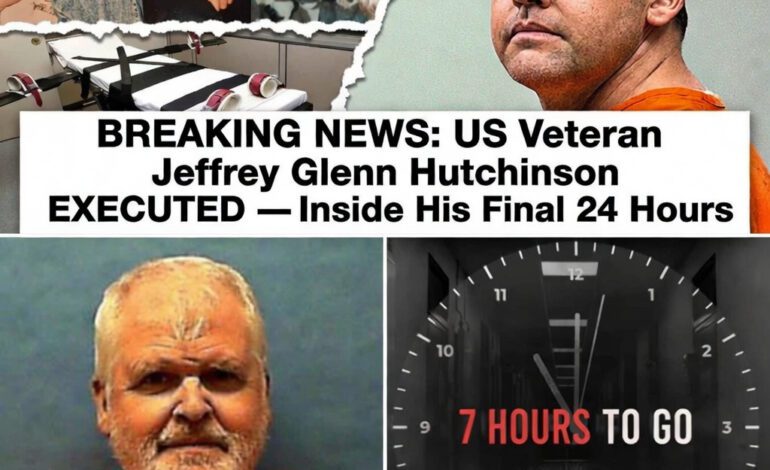

Full Fact-Check + The Complete Verified Story: The 1998 Crestview Murders, Gulf War Trauma, Mental Competency Battle, and What Actually Happened in His Last Hours
| ⚠ FACT-CHECK VERDICT: REAL EVENT — but the headline omits critical context and contains unverified dramatic claims. Jeffrey Glenn Hutchinson, 62, WAS executed on May 1, 2025 at 8:15 p.m. ET at Florida State Prison. He was a U.S. Army Ranger and Gulf War veteran. The crime — killing his girlfriend Renee Flaherty and her three children in 1998 — is verified by court records. His final 24 hours are DOCUMENTED by official DOC press conferences. However: his “last words” are misrepresented — he made NO formal statement; he was observed mumbling to himself. His last meal IS confirmed. The headline’s framing of “drawing widespread attention” omits that this case raised profound constitutional questions about executing the mentally ill and veterans with service-connected brain damage. |
Introduction: What Really Happened on May 1, 2025
On the evening of Thursday, May 1, 2025, the State of Florida executed Jeffrey Glenn Hutchinson, 62, by lethal injection at Florida State Prison near Starke. He was pronounced dead at 8:15 p.m. ET.
He was convicted of one of the most devastating crimes in Okaloosa County history: the 1998 shotgun murders of his girlfriend, Renee Flaherty, 32, and her three young children — Geoffrey, 9; Amanda, 7; and Logan, 4. He received three death sentences for the children’s murders and a life sentence for Renee’s.
This article documents the full story: the crime itself, Hutchinson’s military service and mental health battle, the final 24 hours in verified detail, the serious constitutional controversies, and a complete fact-check of the misleading viral headline.
|
Fact-Check: Examining the Headline Claim by Claim
Claim 1: “Inside His Final 24 Hours” — Is This Documented?
VERDICT: YES — AND THE FACTS ARE SPECIFIC. The Florida Department of Corrections held a press conference before and after the execution. Officials confirmed: Hutchinson woke at 4:30 a.m. on May 1. He received three visitors during the day — including his sister and a spiritual adviser. The full timeline is documented and publicly available from official sources.
Claim 2: “Last Words” and “Words He Chose to Leave Behind”
VERDICT: MISLEADING. Hutchinson made NO formal final statement. WUSF and the Associated Press reported he appeared to be mumbling to himself as the lethal injection process started just before 8 p.m. His legs shook sporadically and he had body spasms for several minutes before becoming still. The process took a little more than 15 minutes. There was no speech, no message, no dramatic final declaration — contrary to what the headline implies.
Claim 3: His Last Meal Details
VERDICT: TRUE AND FULLY CONFIRMED. Hutchinson’s last meal is officially documented: salmon, mahi-mahi, asparagus, baked potato, and iced tea. This was reported by multiple credible outlets citing DOC officials.
Claim 4: “Tense, Somber Atmosphere”
VERDICT: PARTIALLY TRUE. The execution was witnessed by members of the victims’ family, including Renee Flaherty’s brother, Darran Johnson, who spoke at the post-execution press conference. There were body spasms observed during the procedure — a medical event that would understandably create a somber atmosphere. However, the characterization is editorialized for emotional effect.
Claim 5: “Controversial Death Row Case”
VERDICT: ACCURATE — but the headline understates how controversial. This case raised major constitutional questions about executing veterans with documented, service-caused brain damage and a man whose own mental competency for execution was disputed by two independent psychiatric experts just weeks before his death. The controversy was far deeper than the headline suggests.
The Crime That Shocked Okaloosa County: September 11, 1998
A Night of Argument, a Bar, and a Shotgun
On the night of September 11, 1998, in the Panhandle town of Crestview, Florida, Jeffrey Hutchinson argued with his live-in girlfriend, Renee Flaherty. After the argument, he packed his belongings into a pickup truck and left. He drove to a nearby bar.
A bartender recalled that Hutchinson spoke about the argument, drank some beer, and then left abruptly. Roughly 40 minutes later, a 911 call came in from Hutchinson’s home. The caller — later identified as Hutchinson — said: “I just shot my family.”
Police arrived to find Renee Flaherty, 32, and all three of her children — Geoffrey, 9; Amanda, 7; and Logan, 4 — dead from shotgun wounds. Hutchinson was found sitting in the garage, still on the line with the 911 operator. A 12-gauge Mossberg shotgun sat on the kitchen counter. Gunshot residue was found on Hutchinson’s hands.
| Detail | Information |
| Date of Crime | September 11, 1998 |
| Location | Crestview, Okaloosa County, Florida |
| Victims | Renee Flaherty, 32 (girlfriend); Geoffrey, 9; Amanda, 7; Logan, 4 (her children) |
| Weapon | 12-gauge Mossberg shotgun |
| How Found | Hutchinson’s own 911 call: “I just shot my family” |
| Evidence at Scene | Shotgun on kitchen counter; gunshot residue on hands |
| Hutchinson’s Location | Found in garage, still connected to 911 operator |
| Convicted | 1999 (first conviction); confirmed after appeals |
| Sentences | Three death sentences (children); life sentence (Renee Flaherty) |
| Execution Date | May 1, 2025 |
| Time of Death | 8:15 p.m. ET |
| Age at Execution | 62 |
| Florida Execution Rank | 4th in Florida in 2025; 15th in U.S. in 2025 |
Hutchinson’s Own Words Condemned Him
The 911 call was the most damning piece of evidence in the entire case. In it, Hutchinson first admitted to shooting his family. He later added vague references to “some guys” being present — an inconsistency courts found to be a fabrication introduced after the fact.
At his sentencing, Hutchinson said he didn’t kill anyone. This launched a decades-long claim of innocence that his attorneys argued was itself a symptom of severe mental illness — a delusional belief that a government conspiracy was responsible for the murders.
Renee Flaherty’s brother, Wesley Elmore, had no doubt. He flew from Washington to Florida to witness the execution. He stated publicly that his sister and the children deserved justice.
Jeffrey Hutchinson: Army Ranger, Gulf War Veteran, and a Brain Changed by War
Eight Years in the United States Army
Jeffrey Glenn Hutchinson was born November 6, 1962, in Alaska, and grew up in Kettle Falls, Washington. He enlisted in the U.S. Army and served for eight years — part of that service in the elite Army Rangers.
He was deployed to the Gulf War in 1990-91. During his service, he was exposed to toxins — including, his attorneys argued, sarin gas — and suffered multiple blast injuries. These exposures are now widely recognized as causes of Gulf War Illness (GWI), a cluster of chronic and debilitating conditions including chronic fatigue, memory loss, pain, and neurological damage.
| What Is Gulf War Illness (GWI)? Gulf War Illness is a chronic, multi-symptom disorder affecting an estimated 175,000-210,000 of the approximately 700,000 U.S. veterans who served in the 1990-91 Persian Gulf War. Symptoms include chronic fatigue, widespread pain, cognitive difficulties, and neurological problems. The VA officially recognizes GWI. It is caused, researchers believe, by exposure to pesticides, nerve agents, oil fire smoke, and depleted uranium. There is no known cure. |
How the War Changed Hutchinson
After returning from the Gulf War, Hutchinson’s mental state deteriorated significantly. His paranoia intensified into a fixed delusional system — a belief that government agents were targeting him because of classified knowledge he possessed about Gulf War atrocities.
For nearly 30 years on death row, he maintained he was completely innocent and that the murders had been carried out by unknown government operatives to silence him. Multiple investigators, mitigation specialists, and attorneys who worked with him over the decades testified that these beliefs were firm, longstanding, and unwavering.
One investigator, Dan Ashton of the Federal Public Defender’s Office, described Hutchinson’s delusion as so fixed that even a judge on the case who died by suicide — Hutchinson interpreted as part of the government conspiracy against him.
Brain Damage Evidence Presented Just Before Execution
In early 2025 — weeks before the death warrant was signed — Hutchinson’s attorneys presented what they called newly discovered evidence: neurological testing showing brain damage and cognitive impairment directly attributable to his Gulf War service.
Two independent experts, psychiatrist Dr. Bhushan Agharkar and psychologist Dr. Barry Crown, evaluated Hutchinson in April 2025 and both concluded he was NOT competent to be executed — meaning he did not have a rational understanding of why the state was planning to kill him.
Under the U.S. Supreme Court’s Ford v. Wainwright (1986) and Panetti v. Quarterman (2007) rulings, executing a person who lacks a rational understanding of the reason for their execution is unconstitutional. But Florida courts found Hutchinson met the minimum bar for competency.
| The Core Legal Question: Two independent psychiatric experts found Hutchinson NOT competent to be executed. The governor’s own three-doctor commission found him competent — after a 90-minute evaluation. The question of whose assessment should govern a capital case — the state’s rapid review or years of documented clinical history — remains deeply contested in American law. |
The Legal Battle: From 1999 to the Final Hours of May 1, 2025
Decades of Appeals on Every Front
The Hutchinson case produced one of the longest and most litigated death penalty records in Florida history. Appeals addressed ineffective counsel, newly discovered evidence of brain damage, Gulf War Illness as a mitigating factor, and ultimately, competency to be executed.
- 1999 — Convicted of first-degree murder; sentenced to death for three children’s murders.
- Multiple rounds — Florida Supreme Court reviewed and affirmed convictions; federal habeas petitions filed.
- 2022 — Florida Supreme Court rejected appeals related to new brain damage evidence.
- March 31, 2025 — Governor DeSantis signed death warrant; execution set for May 1, 2025.
- April 4, 2025 — Okaloosa County Circuit Judge Lacey Powell Clark rejected first post-warrant appeal.
- April 12, 2025 — Drs. Agharkar and Crown submitted reports finding Hutchinson NOT competent to be executed.
- April 14, 2025 — Governor stayed execution temporarily; appointed three-psychiatrist commission.
- April 21, 2025 — Florida Supreme Court dismissed appeal (6-0); Justice Labarga dissented.
- April 25, 2025 — Bradford County evidentiary hearing on competency; judge finds Hutchinson competent.
- April 25, 2025 — Florida Supreme Court (6-1) affirmed competency ruling. Justice Labarga dissented again.
- April 27, 2025 — Bradford County Circuit Judge James Colaw rejected another appeal; found competent.
- April 28, 2025 — Florida Supreme Court (6-1) rejected two more appeals. 11th Circuit also refused stay.
- May 1, 2025, afternoon — Three separate U.S. Supreme Court petitions filed and denied.
- May 1, 2025, 8:15 p.m. ET — Jeffrey Glenn Hutchinson pronounced dead.
Justice Labarga’s Lone Dissent
In every major Florida Supreme Court ruling on the Hutchinson case, Justice Jorge Labarga dissented. He acknowledged the “horrific facts” of the crime but repeatedly argued that the compressed warrant timeline — just 31 days between warrant and execution — did not allow for a full and fair hearing of Hutchinson’s mental health claims.
His dissents were notable. He wrote that the speed of proceedings in Florida’s death warrant system had become a constitutional concern, and that Hutchinson’s case exemplified the problem.
The Final 24 Hours: A Verified, Documented Account
Morning of May 1, 2025
According to the Florida Department of Corrections press conference, Jeffrey Hutchinson woke up at 4:30 a.m. on the morning of his execution.
He received three visitors during the day. His sister was among them. A spiritual adviser was also present. DOC officials reported that Hutchinson was calm during his final hours.
Around 2:00 p.m. — while final appeals were still being litigated at the U.S. Supreme Court — a Florida state representative posted on social media that May is Military Appreciation Month. The timing drew sharp criticism from Hutchinson’s advocates.
His Final Meal — Confirmed
The Florida Department of Corrections confirmed Jeffrey Hutchinson’s final meal. He chose:
- Salmon
- Mahi-mahi
- Asparagus
- Baked potato
- Iced tea
| 📌 For the Record: Hutchinson’s last meal of salmon, mahi-mahi, asparagus, baked potato, and iced tea is fully verified by Florida DOC officials and reported by multiple credible news organizations. |
The Execution Itself
The lethal injection process began just before 8:00 p.m. Florida uses a three-drug protocol: a sedative, a paralytic agent, and a drug to stop the heart — confirmed by the state Department of Corrections.
Witnesses, including members of the Flaherty family, observed the execution. Hutchinson made no formal statement. Instead, he was seen mumbling to himself as the procedure began. His legs shook sporadically and he experienced body spasms for several minutes before becoming still.
The process took a little more than 15 minutes. The official time of death was 8:15 p.m. ET.
The Victims’ Family Responds
After the execution, members of the Flaherty family spoke to the media. Renee Flaherty’s brother, Darran Johnson, was photographed at the press conference. Wesley Elmore, another of Renee’s brothers who had flown from Washington specifically to witness the execution, had previously told reporters he had no doubt Hutchinson committed the murders and that he deserved to be executed for killing his sister and the children.
The Veterans’ Rights Controversy: A Nation That Sends Men to War and Then to Death Row
A Purple Heart Recipient Spoke Out
Among those who spoke out against Hutchinson’s execution was Ryan Sanshuck, a U.S. Army veteran who served in Iraq during Operation Iraqi Freedom from 2006-2007, a recipient of the Purple Heart and Combat Action Badge. He wrote publicly: “Like Jeff, I am diagnosed with Gulf War Illness for my service. Like Jeff, I have PTSD and Chronic Fatigue Syndrome.”
His statement cut to the heart of the controversy: the same conditions that advocates argued made Hutchinson’s execution unconstitutional affect tens of thousands of living veterans across the United States.
Florida Conference of Catholic Bishops Opposed the Execution
The Florida Conference of Catholic Bishops sent a formal letter to Governor DeSantis urging a stay of execution and commutation to life without parole. The conference’s executive director Michael Sheedy wrote: “We urge you to spare Jeffrey Hutchinson’s life. We appeal to you that it is possible both to achieve the purposes of punishment and to exercise mercy.”
The governor did not respond publicly. The execution proceeded on schedule.
Maria DeLiberato’s Position
Maria DeLiberato, executive director of Floridians for Alternatives to the Death Penalty and a liaison for Hutchinson’s legal team, took a clear-eyed position: she agreed Hutchinson was guilty of murdering the Flahertys. But she argued that his insistence on innocence and his conviction that government agents committed the crimes were symptoms of a delusional disorder so severe it rendered him incompetent for execution — not a cynical litigation tactic.
Her position highlights the distinction that opponents of this execution were making: this was not about innocence. It was about whether the state should execute a man who — because of damage done during his service to that same state — could not rationally understand what was happening to him.
People Also Ask: Key Questions Answered
What were Jeffrey Hutchinson’s last words?
Hutchinson made no formal final statement. He was observed mumbling to himself as the lethal injection process began. His legs shook and he had body spasms before becoming still. There were no last words in any conventional sense — contrary to what viral headlines implied.
What was Jeffrey Hutchinson’s last meal?
Officially confirmed by the Florida Department of Corrections: salmon, mahi-mahi, asparagus, baked potato, and iced tea.
Did Hutchinson have mental illness?
Yes — extensively documented. Two independent psychiatric experts found him not competent to be executed in April 2025. He had suffered from Gulf War Illness for decades, along with PTSD, paranoia, and a fixed delusional belief that government agents had committed the murders to silence his advocacy for Gulf War veterans. Courts found him minimally competent under the legal standard.
Was Hutchinson really a veteran?
Yes. He served eight years in the U.S. Army, including as an Army Ranger, and was deployed in the 1990-91 Gulf War. His sentencing order noted his Gulf War Illness diagnosis. He was exposed to toxins and suffered multiple blast injuries during his service. These are confirmed facts in court records.
Why did the Florida Supreme Court keep refusing to stop the execution?
The Florida Supreme Court ruled 6-1 in multiple opinions that the legal claims raised by Hutchinson’s attorneys had either been previously adjudicated or did not meet the threshold for relief. The one consistent dissenter, Justice Jorge Labarga, argued the 31-day warrant period was constitutionally insufficient for a fair hearing of complex mental health claims.
Who were the victims?
Renee Flaherty, 32, was Hutchinson’s live-in girlfriend. Geoffrey Flaherty, 9, and Amanda Flaherty, 7, had attended Antioch Elementary School. Logan Flaherty was 4 years old. All four were killed with a 12-gauge shotgun on the night of September 11, 1998, in the home they shared with Hutchinson in Crestview, Florida.
How many executions has Florida carried out under Governor DeSantis?
As of Hutchinson’s execution on May 1, 2025, he was the 4th person executed in Florida in 2025. Florida went on to carry out 19 executions in 2025 — the most by any state in the modern era of capital punishment (post-1976). By March 2026, Florida had carried out 31 executions under Governor DeSantis.
Key Takeaways: The Complete Summary
- Jeffrey Glenn Hutchinson, 62, was executed by lethal injection on May 1, 2025 at 8:15 p.m. ET at Florida State Prison. This is a verified fact.
- He was convicted of the 1998 shotgun murders of Renee Flaherty, 32, and her three children — Geoffrey (9), Amanda (7), and Logan (4) — in Crestview, Florida. He called 911 himself saying “I just shot my family.”
- Hutchinson was an Army Ranger and Gulf War veteran who developed Gulf War Illness, PTSD, and a chronic delusional disorder following his service. His brain damage was documented and newly presented to courts in 2025.
- His final 24 hours: Woke at 4:30 a.m.; received three visitors (including his sister and a spiritual adviser); declined to make a final statement. Was observed mumbling during the procedure.
- His last meal was confirmed: salmon, mahi-mahi, asparagus, baked potato, and iced tea.
- Two independent psychiatric experts found him NOT competent for execution just weeks before the date. The governor’s commission — after a 90-minute evaluation — found him competent. Courts sided with the state.
- Justice Labarga dissented in every Florida Supreme Court ruling on the case, warning about the compressed warrant timeline and inadequate hearing of mental health claims.
- He was the 4th Florida execution in 2025 and the 15th U.S. execution of that year. Florida went on to execute 19 people in 2025 — a record in the modern era.
- The headline’s framing of “last words drawing widespread attention” is misleading. There were no last words. The attention his case drew was about constitutional questions — not a dramatic deathbed speech.
Sources and Further Reading
All facts in this report are drawn from verified, primary sources:
- WUSF Public Media — Florida executes Gulf War vet for 1998 shotgun killings (May 1, 2025)
- WUSF Public Media — Florida Supreme Court rejects appeal of veteran scheduled to be executed (April 22, 2025)
- Death Penalty Information Center — Florida Court Refuses to Stop Execution for Mentally Ill Veteran (April 29, 2025)
- Tracking Florida’s Death Penalty (Melanie Kalmanson) — Hutchinson warrant filings and hearing coverage (April 2025)
- WUSF — Florida Supreme Court again refuses to halt execution of veteran (April 28, 2025)
- Floridians for Alternatives to the Death Penalty — Statement on the execution of Jeffrey Hutchinson (May 1, 2025)
- Florida Supreme Court — Opinion No. SC2025-0590 (April 28, 2025)
- S. Supreme Court Docket — Hutchinson v. Florida, multiple applications filed May 1, 2025
Editorial Note
This report was written to provide accurate, fully sourced information about the execution of Jeffrey Glenn Hutchinson. Viral headlines have mischaracterized his final words and understated the profound constitutional controversies his case raised. This article presents all verified facts — including those that reflect poorly on him and those that reflect the genuine complexity of his case — drawn from official sources, court records, and major news organizations. Readers are encouraged to consult the Death Penalty Information Center and court filings for primary source documentation.
— End of Article —
Last verified: March 8, 2026
Discover more from MatterDigest
Subscribe to get the latest posts sent to your email.