Trump Freezes As David Muir Slides One Sheet Across The Table And The Studio Realizes This Interview Just Went Off Script
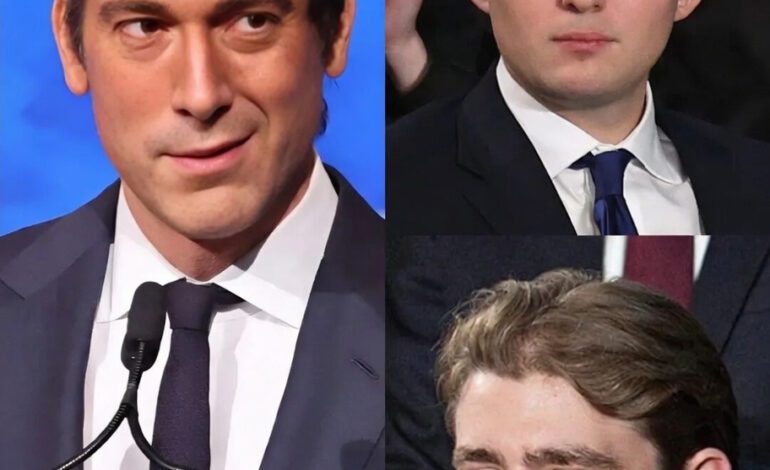

When Fake Clips Target Political Families: The Humiliation Format That Preys on Private Individuals
|
A headline catches your eye. A politician’s family member — a spouse, a child, a sibling — has apparently been caught on camera in an embarrassing moment. They bragged. They were challenged. They froze. The clip is spreading fast. People are sharing it everywhere.
Before you read further, before you form an opinion, before you share it — stop. Ask yourself the most important question: Is this person actually a public figure? Have they ever given interviews? Have they ever sought attention? If the answers are no, you are almost certainly looking at fabricated content targeting a private individual.
This is a specific, documented, and growing category of online misinformation. It is called, loosely, the ‘humiliation format’ — and it is designed to generate maximum political and emotional impact by targeting the people closest to political figures rather than the figures themselves. This guide explains exactly how it works, why it is particularly harmful, and how you can recognize it in seconds.
What Is the Political Family Humiliation Format?
Defining the Format
The political family humiliation format is a category of fabricated or heavily misleading content that shares several consistent features:
- A real, named relative of a politician or public figure is the central subject.
- The relative is depicted as making a boastful, arrogant, or overconfident claim.
- A journalist, interviewer, or unnamed questioner then delivers a single devastating challenge.
- The relative responds by freezing, going silent, becoming visibly distressed, or fleeing.
- The clip ends at the moment of maximum humiliation, before any resolution.
The narrative arc is always the same: pride, challenge, collapse. It mimics the structure of a morality tale. The target gets too big for their boots and is cut down to size. That satisfying story structure is a large part of what makes these clips so shareable — even when every element is invented.
How It Differs From Other Misinformation Formats
The journalist-goes-rogue fake (covered in a companion article) targets media professionals who are fully public figures. The political-family humiliation format is different and more ethically serious in several ways:
| Feature | Political Family Humiliation Format vs. Other Fakes |
| Target | Often a private citizen with no public role |
| Core claim | That the target was publicly humiliated and exposed as foolish |
| Emotional hook | Political anger plus schadenfreude (pleasure at another’s failure) |
| Verifiability | Harder to disprove — absence of evidence is used as ‘proof’ |
| Harm level | Higher — targets have no platform or PR resources to respond |
| Legal exposure | Higher — private individuals have stronger defamation protections |
Why Targeting Relatives Is a Deliberate Choice
The Strategic Logic of Going After the Family
Fabricating content about a politician directly carries risks. Politicians have communications teams, legal departments, media relationships, and established public records that make debunking relatively straightforward. Their public statements are archived. Their schedules are documented. Their professional lives are on the record.
Relatives are different. Most have no public record to compare against. They have given no interviews to fact-check. Their daily activities are not documented by journalists. When someone invents a scene involving a politician’s family member, there is no archive of that person’s actual behavior to contradict it. The absence of a record is exploited as an open canvas.
The Proxy Attack Strategy
Political operatives and propagandists have long understood that attacking a target’s family can be more emotionally effective than attacking the target directly. People who are indifferent to policy debates often respond viscerally to stories about family members.
Fabricated humiliation clips serve this proxy attack function. They are not really about the relative at all. They are about damaging the political figure by association — suggesting that if their family member is foolish, arrogant, or incompetent, that reflects on them. The relative is a vehicle. The real target is the politician.
Critical Point: When you see content ‘exposing’ a politician’s relative, ask who actually benefits from that story spreading. The answer will usually tell you who created it and why.
Emotional Amplification Through Innocence
There is a second, darker reason relatives are targeted. Audiences who might feel ambivalent about attacking a politician directly often feel more comfortable sharing content that attacks their family. The political figure is a legitimate target of criticism, in most people’s minds. The relative feels more accessible, more relatable — more like a person, less like a political symbol.
Paradoxically, this actually makes the harm greater. Because the target feels more human, the emotional reaction is more intense. The humiliation lands harder. The clip spreads faster.
The ‘Freeze and Fail’ Narrative: How These Stories Are Structured
The Three-Act Template
Virtually every political family humiliation clip follows the same three-act structure. Understanding it makes the format instantly recognizable:
Act One: The Boast
The target is shown making an overconfident claim. They brag about intelligence, achievement, wealth, or capability. The boast is always specific enough to feel real but vague enough to be unverifiable. Common boasts in this format include unusually high IQ scores, claimed academic achievements, business success, or insider knowledge.
The boast serves a psychological function: it makes the audience want the target to fail. We are primed from childhood to find overconfidence off-putting. The clip engineers resentment before the challenge even arrives.
Act Two: The Question
A journalist, anchor, or unnamed interviewer asks a single, calm, devastating question. The question is always presented as simple — something any genuinely intelligent or accomplished person could easily answer. The implication is clear: if you really are what you claim to be, this should be easy.
The questioner is often a real, named journalist whose credibility is borrowed to lend the scene authenticity. This is why fabricated clips of this type frequently name well-known anchors — their presence makes the scenario feel plausible.
Act Three: The Freeze
The target cannot answer. They go silent. Their expression changes. The camera holds on their discomfort. Producers and crew react with alarm. The clip ends at the apex of humiliation — before any recovery, clarification, or context can occur.
The freeze is always the final image. The story ends at maximum embarrassment by design, because resolution would reduce the emotional impact and make sharing less compelling.
The three-act template — Boast, Challenge, Freeze — is so consistent across examples of this format that recognizing the structure alone is sufficient to trigger skepticism, regardless of who is named.
Why the Structure Is So Convincing
The three-act humiliation narrative maps onto deep storytelling instincts. Humans are wired to find this arc satisfying — the proud brought low is one of the oldest narrative patterns in literature, religion, and folklore. When a piece of content follows this pattern, our brains process it as a story first and as a factual claim second.
By the time critical thinking kicks in, the emotional conclusion has already been reached. The target is stupid. The journalist was brilliant. The moment was real. Reversing that impression requires significant cognitive effort — effort that most people, scrolling quickly through social media, will not invest.
Who Gets Targeted and Why
The Most Common Targets
Analysis of this misinformation format across multiple political cycles reveals consistent patterns in who gets targeted:
- Adult children of politicians, particularly those who are young, have high public profiles through social media, or are associated with their parent’s brand or business.
- Spouses of politicians, particularly those who are perceived as having significant influence behind the scenes.
- Siblings or other relatives who have made any public appearance, even briefly, in connection with a political figure.
- Family members who have been referenced in political coverage, even once, giving creators a hook of apparent relevance.
Why Younger Relatives Are Disproportionately Targeted
Young adult relatives of politicians are particularly frequent subjects of this format for several reasons. They are old enough that targeting them does not trigger immediate child-protection instincts in audiences. They often have social media presences that feel public even when they are essentially private. And they are associated with a political figure’s legacy in a way that makes attacking them feel politically relevant.
It is worth stating clearly: having a parent, sibling, or spouse in public life does not make a person a public figure. It does not reduce their privacy rights. It does not make fabricating content about them acceptable. The law — and basic ethics — recognize this distinction.
| Legal Definition: Public Figure vs. Private Individual
Under US defamation law (established in Gertz v. Robert Welch, Inc., 1974), a private individual who has not voluntarily thrust themselves into a public controversy retains stronger legal protections against false statements than a public figure. Merely being related to a politician does not make someone a public figure. Courts have consistently upheld this distinction. |
The Special Problem of Targeting Private Citizens
Private Individuals Cannot Fight Back the Way Public Figures Can
When false content targets a politician or a celebrity, those individuals have resources that most people lack. They have communications staff who monitor their coverage. They have legal teams who can respond to defamation. They have media relationships that allow them to issue corrections through trusted channels. They have public platforms — verified social media accounts, press access, and audiences who already trust them — to deliver those corrections.
Private individuals have none of these things. A politician’s adult child who has never sought public attention cannot hold a press conference to deny something. They cannot issue a statement that reaches the same audience the fake clip did. They cannot afford the legal costs of a defamation suit in most cases. They are entirely exposed.
The Amplification Asymmetry Problem
Misinformation researchers describe an ‘amplification asymmetry’ in cases like these: the false claim reaches an enormous audience because it is emotionally compelling and algorithmically rewarded. The correction, when it comes, reaches a fraction of that audience because corrections are not emotionally satisfying and do not get amplified.
For a private individual, this asymmetry is permanent. Millions of people may see the fake clip. Thousands may see a correction. And none of those corrections will undo the harassment, the threats, or the lasting damage to reputation that the initial viral spread causes.
The Consent Problem
Public figures, by choosing public life, accept a degree of scrutiny. That is a well-established legal and ethical principle. But their relatives did not make that choice. A politician’s child, sibling, or spouse did not stand for election. They did not sign a contract accepting public scrutiny. They did not choose a career in the public eye.
Creating and sharing fabricated content about them treats them as public property without their consent. This is not a minor ethical quibble. It is a fundamental violation of a person’s right to control their own public narrative.
Remember: Clicking, sharing, or even commenting on fabricated content about private individuals contributes to the harm — regardless of whether you believe the content is true.
How These Clips Spread: Platform Mechanics and Audience Psychology
The Role of Political Identity
Fabricated political family clips spread along political identity lines. They are not shared randomly — they are shared by people who are already politically opposed to the family’s public figure. The clip confirms what they want to believe. It feels like evidence of something they already suspect. That feeling of confirmation is a powerful sharing trigger.
Importantly, this means the clips do not need to be convincing to skeptics. They only need to be convincing to believers. And believers are precisely the people least likely to fact-check content that aligns with their existing views.
Algorithmic Amplification
Social media algorithms are designed to maximize engagement. Outrage, vindication, and schadenfreude — all of which these clips are engineered to produce — are among the highest-engagement emotional responses on social platforms. An algorithm cannot distinguish between ‘this post made me angry because it’s a genuine injustice’ and ‘this post made me angry because it’s well-crafted misinformation.’ It simply amplifies what gets engagement.
This means the most emotionally manipulative content — which fabricated humiliation clips are by design — receives the most algorithmic promotion. The format is optimized, consciously or not, for the way social platforms actually work.
The ‘Even If It’s Fake’ Rationalization
A striking feature of this misinformation format is how often people share it while acknowledging it might not be real. Comments like ‘even if this is staged, it captures something true’ or ‘whether or not this happened, it feels like it could have’ are extremely common.
This rationalization deserves direct rebuttal. A fabricated scene of a real, named private individual being publicly humiliated is harmful regardless of whether it ‘feels true.’ It damages a real person. It spreads a false impression. The emotional satisfaction it provides is built on a lie. ‘Feels true’ is not a standard for sharing content about real people.
Eight Immediate Red Flags to Spot This Format
You can identify the political family humiliation format quickly and reliably. Here are eight red flags that appear in nearly every example:
Red Flag 1: The Subject Is a Relative, Not the Politician
The moment a viral political clip focuses on a relative rather than the politician themselves, your skepticism should immediately increase. Why would this relative give a high-profile interview? Why would this moment be filmed? Why would it go viral? The answers are almost never satisfying.
Red Flag 2: The Boast Is Conveniently Specific and Unverifiable
A claimed IQ score of a very precise, high number. A specific academic achievement with no verifiable record. A business claim that cannot be checked. Real people making real boasts leave verifiable trails. Fabricated boasts are designed to sound specific without being checkable.
Red Flag 3: The Freeze Happens at the Perfect Dramatic Moment
Real interview breakdowns are messy, uncomfortable, and ambiguous. Fabricated ones are cinematically perfect — the silence falls at exactly the right moment, the expression is exactly right, the clip ends at peak humiliation. Real life does not produce such clean dramatic beats.
Red Flag 4: The Journalist Named Is Well-Known But Has No Record of This Interview
Fabricated clips frequently name prominent journalists as the questioners because their credibility is borrowed to legitimize the scene. But if a famous anchor had conducted a notable interview with a political family member, there would be extensive documentation. Search for it. If you find nothing, the interview did not happen.
Red Flag 5: The Clip Has No Broadcast Details
Real television segments have program names, air dates, and network affiliations. Fabricated clips are vague: ‘in a recent interview,’ ‘during a studio appearance,’ ‘when cameras were rolling.’ Vagueness is a production choice made to prevent verification.
Red Flag 6: The Headline Uses Dramatic Punctuation and Caps
All-caps words, multiple exclamation points, ellipses used for suspense, and the word ‘FREEZES’ — these are headline formatting choices made to maximize emotional arousal before you have read a single word. Legitimate journalism does not use this formatting. Clickbait always does.
Red Flag 7: No Major Outlet Is Covering It
Apply the same rule as with all misinformation: if a genuinely newsworthy event involving a political family member occurred on camera, every major outlet would cover it. If only obscure sites and social accounts are sharing it, the event did not happen.
Red Flag 8: The Target Has No History of Public Interviews
Ask the simplest question: Has this person ever given a public interview before? If the answer is no — if they have actively avoided public attention — then the idea that they suddenly appeared on camera to boast and were humiliated is almost certainly invented.
Eight Red Flags Quick Summary: 1) Relative not politician 2) Unverifiable specific boast 3) Cinematically perfect freeze 4) Named journalist with no interview record 5) No broadcast details 6) Dramatic headline formatting 7) No major outlet coverage 8) Target has no history of public interviews
The Real-World Harm: What Actually Happens to Targets
Immediate Harassment
When a fabricated clip goes viral, the private individual named in it typically begins receiving direct harassment within hours. This includes hostile messages on any social media account they have, negative comments on posts unrelated to the story, and in serious cases, messages containing threats. The individual usually has no warning this is happening and no infrastructure to manage it.
Reputational Damage That Persists
Search engines index content quickly. When a fabricated story about a private individual reaches viral scale, it can dominate that person’s search results for months or years afterward. Every future employer, academic institution, romantic partner, or casual acquaintance who searches that person’s name may encounter the fabricated story. Corrections rarely rank as highly as original viral content.
Psychological Impact
Researchers who study harassment of public and semi-public figures consistently document significant psychological harm: anxiety, depression, withdrawal from public spaces both online and offline, and in serious cases, symptoms consistent with post-traumatic stress. For private individuals who never sought any public attention, the shock of sudden viral targeting is often particularly severe.
Chilling Effects on Legitimate Political Participation
When targeting the relatives of politicians becomes normalized and cost-free, it creates a chilling effect on political participation. People considering public service — particularly from families with younger relatives — must weigh whether their choice to run for office will expose their family to fabricated humiliation campaigns. This is not a hypothetical concern. Documented cases of this pattern have caused real candidates to reconsider or abandon public roles.
Legal Frameworks: Privacy, Defamation, and Private Individuals
Stronger Protections for Private Individuals
In most democratic legal systems, private individuals have substantially stronger legal protections against false statements than public figures. In the United States, the Supreme Court’s decision in Gertz v. Robert Welch, Inc. (1974) established that private individuals do not need to prove ‘actual malice’ — knowing falsehood or reckless disregard for truth — to succeed in a defamation claim. They need only show negligence.
This means that fabricating and publishing false statements about a private individual — including false depictions of them being publicly humiliated — carries genuine legal risk for creators and, in some jurisdictions, for those who amplify the content knowingly.
Right of Publicity and False Light
Beyond defamation, false light invasion of privacy claims can apply when content portrays a real person in a way that is highly offensive to a reasonable person and that the creator knew or should have known was false. Fabricated humiliation clips meet this standard by definition.
Platform Liability and Content Removal
Major platforms have policies that explicitly prohibit fabricated content depicting real people in false contexts, particularly content designed to harass. Private individuals — and their representatives — can request content removal under these policies. While enforcement is inconsistent, documented legal threats have accelerated removal in many cases.
| If You Are a Target
If fabricated content about you is spreading online: (1) Document everything — take screenshots with timestamps before requesting removal. (2) Report to the platform using harassment and false information policies. (3) Contact a media attorney to assess defamation and false light options. (4) Reach out to established fact-checking organizations who may investigate and publish a correction. (5) Do not engage publicly with the content — engagement often amplifies it further. |
How to Verify — and What to Do When You Find a Fake
The Verification Process
- Search the subject’s name on Google News (past week filter). Has any established outlet reported on this interview or incident?
- Search the named journalist alongside the subject’s name. Is there any record of this interview occurring?
- Look at the subject’s own verified social media. Have they addressed or denied the clip?
- Check major fact-checking sites: Snopes, PolitiFact, FactCheck.org, AP Fact Check, Reuters Fact Check.
- Ask the basic question: Has this person ever given any public interview before? If not, why would this be their debut?
- Run any video through reverse image or video search to check for prior use in a different context.
What to Do When You Identify a Fake
- Do not share the original clip — even to mock or criticize it. Sharing amplifies it.
- If you already shared it, delete your share and post a correction to your own followers.
- Report the content to the platform using the most specific policy category available.
- Share the fact-check or correction, not the original.
- If the target is someone you know, consider whether to alert them before they discover it themselves.
The single most effective thing any individual can do to reduce the harm of this format is simple: do not share unverified content about private individuals. Every share — even skeptical ones — increases reach and causes harm.
Key Takeaways
What This Format Is
- The political family humiliation format uses fabricated scenes of politicians’ relatives being publicly embarrassed to generate political emotional impact.
- It follows a rigid three-act structure: boast, single devastating question, freeze — designed to maximize schadenfreude and sharing.
- It deliberately targets private individuals who lack the resources and platforms to respond.
Why It Is Particularly Harmful
- Targets are private citizens who never consented to public scrutiny.
- They have no PR resources, legal teams, or public platforms to correct the record.
- The harm — harassment, reputational damage, psychological impact — is real and lasting.
- It creates chilling effects on political participation by threatening entire families.
How to Stop It
- Recognize the eight red flags before engaging with any content of this type.
- Apply the six-step verification process before forming any judgment.
- Never share unverified content about private individuals, regardless of political affiliation.
- Report fake content using platform tools and share corrections rather than originals.
- Understand that your share — however small — is part of the mechanism that causes harm.
Final thought: The next time a clip promises to show you a politician’s relative being humiliated on camera, the most media-literate response is not to watch it, not to share it, and not to let the promised satisfaction override your critical judgment. Private people deserve that basic protection.
Sources and Further Reading
- Gertz v. Robert Welch, Inc., 418 U.S. 323 (1974) — US Supreme Court on private individual defamation standards
- Citron, D.K. (2022). The Fight for Privacy. W.W. Norton. — comprehensive analysis of digital privacy harms to private individuals
- Reuters Institute for the Study of Journalism — Digital News Report 2025, section on synthetic media and trust
- Committee to Protect Journalists (CPJ) — documentation of journalist impersonation in fake clips, 2024-2026
- First Draft / Meedan — guides on verifying content involving private individuals online
- PEN America — research on online harassment targeting political families and its chilling effects
About This Article
This article is an educational resource on media literacy, misinformation formats, and the ethics of content about private individuals. No specific fabricated clips, named private individuals, or invented quotes are reproduced or referenced. All legal citations refer to publicly available judicial decisions. All research citations refer to publicly available institutional sources. Last updated: March 6, 2026.
Discover more from MatterDigest
Subscribe to get the latest posts sent to your email.