Poland Takes Epstein Files More Seriously Than the Country That Released Them
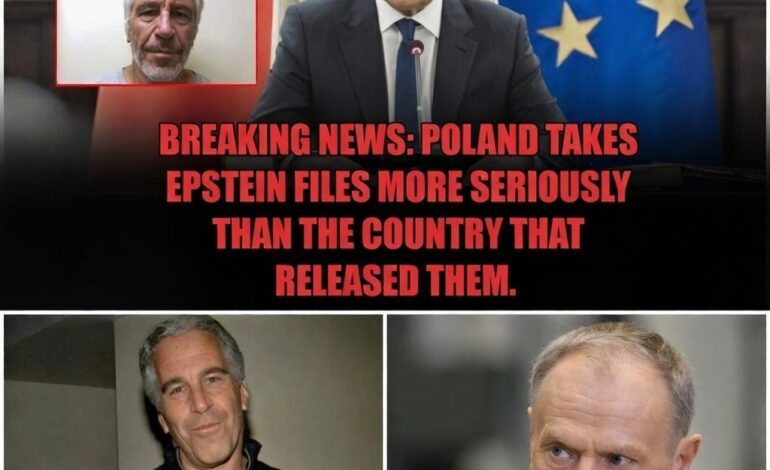

Why Warsaw launched a national security investigation while Washington said the case is closed — and what the Kraków files, Russian intelligence fears, and a growing European coalition mean for global accountability.
VERDICT: This story is REAL and VERIFIED. Every factual claim is supported by official Polish government statements, Reuters, CBS News, AP, Notes from Poland, and Anadolu Agency. Poland did establish an investigative task force. Investigation Team No. 5 is real. The Kraków references are documented. PM Tusk’s remarks about Russian intelligence are on the record.
Introduction: When Foreign Governments Act Faster Than Washington
On January 30, 2026, the U.S. Department of Justice released over three million pages of documents related to Jeffrey Epstein — the disgraced financier who died in a New York jail cell in 2019 while awaiting trial on federal sex trafficking charges. Deputy Attorney General Todd Blanche called it the final major disclosure and declared the department’s review complete.
Foreign governments disagreed — loudly.
Within days, Poland, Latvia, Lithuania, and Turkey had all launched formal investigations. Warsaw went furthest. Polish Prime Minister Donald Tusk convened a multi-agency task force, framed the investigation as a national security matter, and called Epstein’s network a potential Russian intelligence operation designed to blackmail world leaders.
Why did a NATO country in Eastern Europe move faster than the nation that released the files? That is the question this article answers — and the facts are both documented and striking.
SECTION 1: The DOJ File Release — Scale and Significance
What Was Released on January 30, 2026
The Epstein Files Transparency Act was signed by President Donald Trump in November 2025. It mandated the declassification and release of documents related to the Epstein investigation. On January 30, 2026, the DOJ released what it described as the largest single tranche of Epstein materials in history.
- Over 3 million pages of documents
- 180,000 images
- 2,000 videos
- Files covering roughly the period from 2002 to 2019
The total release was vast. But it also came with controversy. Federal prosecutors had initially identified six million pages as potentially responsive to the disclosure law. Only half that amount was released. Bipartisan lawmakers, including Representative Ro Khanna, publicly accused the DOJ of withholding critical materials — including FBI victim interview statements, a draft indictment, and hundreds of thousands of emails from Epstein’s computers.
“All they were doing was trying to make sure that these very powerful people were redacted from the files, and they did not care about the victims at all.”
— Spencer Kuvin, attorney for Epstein victims
Why the Putin References Matter — But Need Context
Prime Minister Tusk stated that over 1,000 documents in the released files contain references to Vladimir Putin. This figure has been widely reported and is accurate. However, it requires important context.
The Associated Press and other outlets clarified that most Putin mentions in the files are news article summaries, press clippings, or political commentary emails — not direct evidence of operational links between Putin and Epstein. One anonymous FBI informant claimed Epstein was “Putin’s wealth manager,” but that claim is uncorroborated.
IMPORTANT CONTEXT: The 1,000+ Putin references do not constitute direct evidence of Russian intelligence involvement. They do, however, provide the basis for Poland’s national security concern — a concern Tusk has framed carefully as a possibility that requires investigation, not an established fact.
Tusk’s language has been measured on this point. He said the possibility of Russian co-organization “is increasingly likely” and referenced reporting by Scottish journalist Andrew Marr and other analysts who have raised the hypothesis. He has not claimed it as proven.
SECTION 2: Poland’s Response — A Step-by-Step Timeline
February 3, 2026 — PM Tusk Announces the Task Force
Speaking ahead of a cabinet meeting on February 3, 2026, Prime Minister Donald Tusk announced the establishment of a special analytical team. The announcement came just four days after the DOJ file release.
“We cannot allow any of the cases involving the abuse of Polish children by the network of pedophiles and the organizer of this satanic circle, Mr. Epstein, to be treated lightly or ignored.”
— PM Donald Tusk, February 3, 2026 (official gov.pl statement)
Tusk confirmed two distinct concerns driving the probe. The first was direct: the possibility that Polish women or girls had been exploited within Epstein’s trafficking network. The second was geopolitical: the possibility that Russian intelligence had co-organized the operation as a blackmail scheme, creating what would amount to a persistent threat to NATO democracies.
The Kraków References — What the Files Actually Say
Polish media had flagged specific references in the files before the official announcement. The documents include an email from an alleged Epstein recruiter in Kraków, claiming access to groups of Polish women or girls. Tusk acknowledged these references directly.
Additional documents mention a woman with Polish connections who communicated extensively with Epstein and traveled to the United States at his expense, and a person identified as an estate manager in Florida. Investigators have not publicly confirmed which of these specific leads they are treating as primary.
NOTE ON EVIDENCE: The Kraków email references are documented in the released files. However, Polish officials have not confirmed the identity of the individuals involved. Tusk’s office has stated that investigators will evaluate every publicly available document before seeking classified materials from U.S. authorities.
February 24, 2026 — Investigation Team No. 5 Is Formally Established
On February 24, 2026, Poland’s National Prosecutor’s Office took the investigation from analytical to formal. The office announced the creation of Investigation Team No. 5, a dedicated unit tasked with conducting preliminary inquiries into what prosecutors described as an organized criminal group of an international nature.
The team’s mandate covers activity between 2005 and 2018. Prosecutors said the group allegedly operated with the involvement of Polish citizens and engaged in human trafficking by recruiting minors through deception — promising careers in fashion before subjecting victims to sexual exploitation.
- Three experienced prosecutors with organized crime and human trafficking backgrounds lead the team.
- A formal criminal investigation will be opened if the preliminary inquiry produces sufficient evidence.
- Justice Minister Waldemar Zurek chairs an inter-agency panel that includes police, intelligence services, and the interior ministry.
- Poland has stated it will request classified materials from U.S. authorities if domestic leads require them.
“It is our duty to provide a reliable and impartial explanation of all Polish aspects in the so-called Epstein affair. The Polish state must check whether crimes have taken place on the territory of the Republic of Poland and whether Polish citizens were involved in the case.”
— Justice Minister Waldemar Zurek, official statement
SECTION 3: The Russian Intelligence Angle — What Is Actually Claimed
The Honey Trap Hypothesis
The theory that Epstein’s operation served Russian intelligence — what Tusk called a “honey trap” — is not new. It has circulated among intelligence analysts and investigative journalists for years. What is new is a sitting NATO head of government raising it formally as a national security concern.
“More and more commentators and experts assume that it is very probable that this was a prepared operation by the Russian KGB, the so-called honey trap intended to create material to blackmail prominent figures.”
— PM Donald Tusk, February 3, 2026
Tusk cited Epstein’s unexplained financial resources, his connections to young Russian women, and claims circulating in global media that the operation served as a blackmail apparatus. He also referenced journalist Andrew Marr, who has reported on these possible connections.
Why Poland Has Specific Reason to Worry
This is not hypothetical concern for Warsaw. Poland is a frontline NATO state bordering Ukraine and Belarus. It has been the target of documented Russian hybrid operations since at least 2022, including espionage, sabotage, cyberattacks, and coordinated disinformation campaigns.
In a striking coincidence, on the same day Tusk announced the Epstein task force, a long-serving Polish defense ministry official was detained on suspicion of collaborating with Russian and Belarusian intelligence. That context shaped how Warsaw read the Epstein files — not as historical scandal but as active threat.
“I don’t need to explain how serious this possibility would be for Poland’s national security. If Russian services co-organised this scheme, it can only mean one thing — that they may hold compromising material on many leaders who remain active today.”
— PM Donald Tusk
What Has Not Been Proven
It is important to be precise. No confirmed, direct evidence of Russian FSB or GRU operational involvement in Epstein’s network has been publicly released. The Russian Embassy in Warsaw and the Russian foreign ministry have not responded to requests for comment. The 1,000 Putin document references are largely news summaries, not operational communications.
Tusk has framed his concern as a hypothesis requiring investigation — not a proven fact. That is the appropriate epistemic standard, and it is the one responsible journalism should apply.
SECTION 4: Europe’s Wider Response — Country by Country
Poland was the most prominent but not the only European country to respond to the file release with formal action. Here is what each country found and did.
| Country | What the Files Showed | Action Taken | Status (March 2026) |
| Poland | Kraków recruiter emails; Polish citizen connections; 1,000+ Putin refs | Task force + Investigation Team No. 5 formed Feb. 24 | Active — preliminary inquiry ongoing |
| Latvia | Latvia mentioned 500+ times; Riga 800+ times; modeling agency names; passport data for several Latvian women | Latvian State Police opened criminal proceedings Feb. 4 | Active — human trafficking investigation |
| Lithuania | Lithuanian models and arts figures named; €75,000 transfer to Vilnius company documented | Prosecutors launched pre-trial investigation Feb. 3 | Active — President Nauseda called for ‘principled intervention’ |
| Turkey | Allegations Turkish minors trafficked; Ankara prosecutor reviewing files | Ankara Public Prosecutor’s Office inquiry begun Dec. 2025; expanded Feb. 3, 2026 | Active |
| United Kingdom | Prince Andrew arrested; Peter Mandelson scrutinized; former PM Jagland charged | Multiple criminal investigations; arrests made | Most advanced of all non-US investigations |
| United States | Over 3M pages released Jan. 30 | DOJ declared review ‘complete’; no new prosecutions expected | Closed — per DOJ, despite bipartisan congressional criticism |
The contrast between the U.S. posture and the European response is stark. Investigative journalist Vicky Ward, who first reported on Epstein in 2003, captured it this way in an NPR interview: in the UK, a prince has been arrested, politicians have fallen, and criminal investigations are producing results. In the U.S., where the files originated, the Justice Department says the job is done.
SECTION 5: The Domestic Political Dimension in Poland
Not everyone in Poland embraced the investigation. The political opposition — led by Law and Justice (PiS) — accused Prime Minister Tusk of using the Epstein files for political theater.
Opposition Criticism
MEP Arkadiusz Mularczyk of PiS argued that the Epstein probe was cover for Tusk to revive a narrative of Trump-Russia collusion. He noted that the DOJ files contain material that did not incriminate former President Trump, and suggested Tusk was chasing political ghosts rather than genuine Polish leads.
Mularczyk also pointed to a recent domestic scandal — a nightclub owner near Gdańsk who received a prison sentence for sex offences with minors but was allowed to leave the country before his appeal — as evidence that the current government treats child safety selectively.
Tusk’s Response
Tusk addressed the criticism directly, stating that any attempt to relativize the issue of child exploitation is unacceptable. He framed the investigation in terms of duty: “Every decent person should reject any attempt to relativize the issue of pedophilia. This is a crime against children.”
The Polish government has also stated that the investigation will operate under classified procedures — meaning the full scope of what investigators find may not become public immediately.
SECTION 6: What the U.S. Investigation Missed — and Why It Matters
The DOJ’s Position
Deputy Attorney General Todd Blanche declared on January 30, 2026 that the DOJ review was “complete” and signaled that no further prosecutions are expected. The DOJ stated that it released only 3 million of the 6 million potentially responsive pages because officials had “erred on the side of over-collection” in the initial identification phase.
Congressional Pushback
Bipartisan lawmakers disagreed sharply. Representative Ro Khanna and other members accused the DOJ of violating the Epstein Files Transparency Act by withholding materials specifically identified in the law, including FBI 302 victim interview statements and a draft indictment from the 2007 Florida investigation.
KEY QUESTION: If foreign governments — operating on publicly released documents alone — are finding actionable leads involving their own citizens, what does it say about U.S. institutional accountability that no new domestic prosecutions are expected from the same files?
The UN Human Rights Council’s Assessment
The UN Human Rights Council weighed in during this period, stating that the Epstein case bears what it described as the marks of a crime against humanity and warrants further international investigation. That framing aligned with what Poland, Latvia, and Lithuania were already acting on.
SECTION 7: People Also Ask — Answered Directly
Why is Poland investigating the Epstein files?
Poland launched an investigation because the released DOJ documents contain references to individuals in Kraków who allegedly recruited Polish women or girls for Epstein’s network. PM Tusk also cited national security concerns, pointing to Epstein’s possible connections to Russian intelligence as a direct threat to Poland’s security, given Russia’s ongoing hybrid operations against NATO countries.
What is Investigation Team No. 5 in Poland?
Investigation Team No. 5 is a formal prosecutorial body established by Poland’s National Prosecutor’s Office on February 24, 2026. It is tasked with conducting preliminary inquiries into what prosecutors describe as an organized international criminal network active between 2005 and 2018, with alleged involvement of Polish citizens in recruiting minors for sexual exploitation.
Did Russia really help organize Epstein’s operation?
This is an unproven hypothesis, not an established fact. PM Tusk and several analysts have raised the possibility, citing Epstein’s unexplained financial resources, his connections to young Russian women, and over 1,000 references to Putin in the released files. However, most Putin references are news summaries, not operational documents. Poland’s investigation is explicitly designed to assess this hypothesis — not to confirm it.
Are Latvia and Lithuania also investigating?
Yes. Latvia’s State Police opened criminal proceedings on February 4, 2026, focusing on potential recruitment of Latvian nationals for sexual exploitation. Riga is mentioned more than 800 times in the released files. Lithuania’s prosecutors launched a pre-trial investigation on February 3, 2026, following references to Lithuanian models and arts figures in the documents.
Why did the U.S. say the investigation is complete?
Deputy AG Todd Blanche declared the DOJ review complete on January 30, 2026. The department released approximately 3 million of the 6 million pages initially identified as responsive to the Epstein Files Transparency Act. Bipartisan lawmakers have challenged that claim, accusing the DOJ of withholding victim interview statements, a draft indictment, and hundreds of thousands of emails.
How many documents in the Epstein files mention Vladimir Putin?
Over 1,000 documents in the released files contain references to Vladimir Putin. However, the Associated Press and other outlets have clarified that most of these references are news article summaries or political commentary — not direct evidence of operational links between Putin and Epstein’s network.
Key Takeaways
- Poland’s response to the Epstein files is REAL and documented. PM Tusk announced a task force on February 3, 2026. Investigation Team No. 5 was formally established on February 24, 2026.
- The Polish investigation has two dimensions: a criminal one (potential exploitation of Polish women and girls) and a national security one (the possibility of Russian intelligence involvement in a blackmail operation).
- The Kraków recruiter references are documented in the released files. Individual identities have not been publicly confirmed.
- The 1,000+ Putin references in the files are real but require context — most are news summaries, not operational intelligence documents.
- Latvia and Lithuania launched their own formal investigations within days of the file release. Turkey began reviewing the files in December 2025.
- The U.S. DOJ declared its review complete while releasing only half the initially identified documents. Bipartisan lawmakers have disputed that claim.
- The UN Human Rights Council has described the Epstein case as bearing the marks of a crime against humanity and called for further international investigation.
- Poland’s geographic position as a frontline NATO state — already subject to documented Russian espionage and hybrid operations — gives Warsaw specific reason to take the Russian intelligence angle seriously.
Sources & Further Reading
Official Polish government statement (gov.pl, February 3, 2026) | CBS News | Reuters | AP | Notes from Poland | Anadolu Agency (aa.com.tr) | Balkan Insight | bne IntelliNews | LSM.lv (Latvian public broadcaster) | U.S. News & World Report | Wikipedia: Epstein Files (updated March 2026) | DOJ Epstein document library (justice.gov/epstein). All facts verified against primary sources as of March 4, 2026.
Discover more from MatterDigest
Subscribe to get the latest posts sent to your email.