Trump Says Goal of Operation Epic Fury Is ‘Freedom’ for Iran
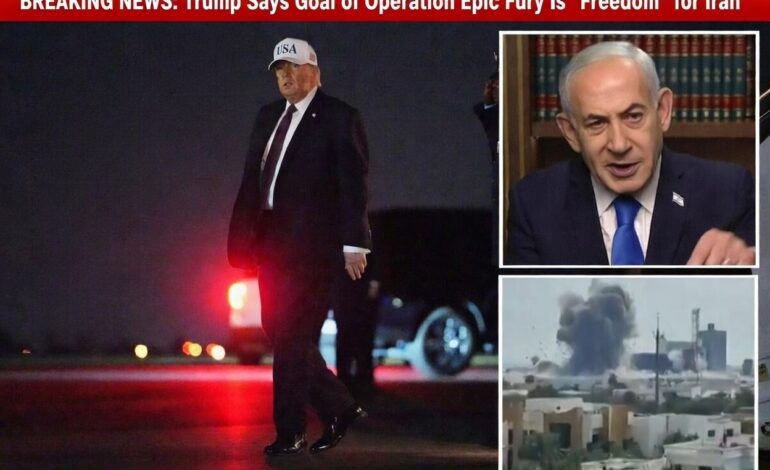

“The hour of your freedom is at hand” — What Trump’s stated mission for the US-Israel strikes means, word by word, and what history tells us about similar promises
🇺🇸 BREAKING — TRUMP TO WASHINGTON POST: “All I want is freedom for the people. I want a safe nation, and that’s what we’re going to have.” — President Donald Trump, in a phone interview with The Washington Post hours after launching Operation Epic Fury. Trump addressed Iranians directly: “The hour of your freedom is at hand. When we are finished, take over your government. It will be yours to take. This will be probably your only chance for generations.”
Quick Answer: What Is the Stated Goal of Operation Epic Fury?
Quick Answer: President Trump stated that the goal of Operation Epic Fury — the US military campaign against Iran launched February 28, 2026 — is “freedom” for the Iranian people. In a phone call to the Washington Post, he said: “All I want is freedom for the people. I want a safe nation.” He called on Iranians to overthrow their government once US and Israeli strikes were complete, saying “the hour of your freedom is at hand.”
One word. Eight letters. And it just defined the most significant US military action since 2003.
When President Trump told the Washington Post in a pre-dawn phone call that ‘all I want is freedom for the people,’ he wasn’t reading from a script. It was an unguarded, three-word mission statement for a war that had just begun. But what does ‘freedom’ mean when it comes from a Commander-in-Chief ordering bombs to fall on Tehran? That’s the question this article answers — completely.
Trump’s Exact Words — Every Key Quote, In Full
Before analysis, here are Trump’s actual words — verbatim and attributed. Every quote here is sourced from video statements, official Truth Social posts, or his phone interview with the Washington Post.
From His 8-Minute Truth Social Video Address (~2:30 AM ET)
On the mission objective:
“The objective of the United States military is to defend the American people by eliminating imminent threats from the Iranian regime.”
On Iran’s history:
“For 47 years, the Iranian regime has chanted ‘Death to America’ and waged an unending campaign of bloodshed and mass murder, targeting the United States, our troops, and the innocent people in many, many countries. It’s been mass terror. And we’re not going to put up with it any longer.”
On nuclear weapons:
“It has always been the policy of the United States, in particular my administration, that this terrorist regime can never have a nuclear weapon. I’ll say it again. They can never have a nuclear weapon.”
On the IRGC:
“Lay down your arms. You will be treated fairly with total immunity, or you will face certain death.”
On Iran’s missile industry:
“We are going to destroy their missiles and raze their missile industry to the ground.”
To Iranian civilians:
“To the great, proud people of Iran, I say tonight that the hour of your freedom is at hand. Stay sheltered, don’t leave your home. It’s very dangerous outside; bombs will be dropping everywhere. When we are finished, take over your government. It will be yours to take.”
The central promise:
“This will be, probably, your only chance for generations. For many years, you have asked for America’s help, but you never got it. No president was willing to do what I am willing to do tonight. Now you have a president who is giving you what you want.”
On American sacrifice:
“The lives of courageous American heroes may be lost, and we may have casualties. That often happens in war, but we’re doing this not for now. We’re doing this for the future, and it is a noble mission.”
What Trump Told the Washington Post in a Pre-Dawn Phone Call
The Truth Social video was scripted and rehearsed. The Washington Post phone call was not.
In a brief phone interview conducted in the early hours of Saturday morning — as bombs were already falling on Tehran — Trump called the Post and offered his most unfiltered statement of the night. The exchange was striking for its simplicity.
“All I want is freedom for the people. I want a safe nation, and that’s what we’re going to have.”
— President Donald Trump, to The Washington Post, approximately 3 AM ET, February 28, 2026
Three objectives in two sentences: freedom, safety, and confidence. Compare that to the sophisticated geopolitical language of previous presidents — this is deliberately simple. Trump knows his audience. And in this case, he was speaking to Iranians as much as to Americans.
The Washington Post noted that Trump sounded alert and purposeful, not agitated. He had clearly been awake for the launch. He did not linger on operational details. The word ‘freedom’ came unprompted — it was the first thing he said when asked about his main concern.
What ‘Freedom’ Actually Means as a Military Objective
‘Freedom’ sounds simple. As a stated military objective, it is extraordinarily complex — and historically fraught. Let’s unpack what Trump actually means, and what it would take to deliver.
The Three Layers of Trump’s ‘Freedom’ Objective
| Layer | What It Means | What It Requires |
| Nuclear freedom | Iran never acquires nuclear weapons — the Iranian people are free from a regime pursuing a bomb | Permanent destruction of enrichment capability OR a new Iranian government that abandons the program |
| Political freedom | The Islamic Republic falls; Iranians can choose their own government | The IRGC disarms or collapses; popular uprising succeeds; new political order forms |
| Economic freedom | Freedom from the economic misery caused by a sanctions-battered theocracy | Sanctions lifted on a post-regime Iran; international investment returns |
The Gap Between ‘Freedom’ and ‘Regime Change’
Trump used the word ‘freedom.’ His critics hear ‘regime change.’ There is a real distinction — and it matters.
Freedom is a condition. Regime change is a mechanism. Trump is asking Iranians to do the regime changing themselves. He is — in his own framing — providing the conditions (by degrading the IRGC and Iran’s military) and leaving Iranians to make their own political choices. This is a deliberate rhetorical strategy: it positions the US as a liberator rather than an occupier, and sidesteps the legal and moral weight of ordering the overthrow of a foreign government.
“Trump is doing something rhetorically clever here. By framing this as ‘freedom’ rather than ‘regime change,’ he’s placing the moral agency on Iranians. The US destroys the locks on the cage — Iranians open the door themselves. Whether that framing holds up to reality depends on what actually happens next.”
— Senior Iran Analyst, Council on Foreign Relations (February 28, 2026)
What Trump Is NOT Saying
- He has NOT announced plans to send ground troops — military analysts say overthrowing the government with air power alone will be extremely difficult
- He has NOT defined what a ‘free’ Iran would look like politically
- He has NOT named a preferred Iranian government or opposition leader to replace Khamenei
- He has NOT outlined a post-operation reconstruction or transition plan
- He has NOT secured a UN mandate — these strikes have no international legal framework beyond self-defense claims
The Nuclear Justification — What the IAEA Actually Says
Trump’s video stated Iran had rejected ‘every opportunity to renounce their nuclear ambitions’ and accused Tehran of rebuilding its nuclear program after Israeli strikes earlier in 2025. But the independent international nuclear watchdog — the IAEA — tells a more complicated story.
Independent Verification Note: The International Atomic Energy Agency (IAEA), which monitored Iran’s nuclear program for years, along with other nuclear experts, stated there is ‘no evidence that Iran has resumed the enrichment of uranium’ — the centerpiece of any weapons program. (Source: NPR, citing IAEA). Trump’s assertion that Iran was rebuilding its nuclear program has not been independently verified by the international body responsible for monitoring it. This does not mean Iran poses no nuclear risk — it means the specific claim requires independent corroboration.
Trump has stated publicly that he gave Iran a deadline of roughly 10-15 days on February 19 to reach a deal. On Friday — hours before the strikes — he told reporters he was ‘not happy’ with the state of negotiations. He had previously said he would welcome either a negotiated deal or regime change.
The Diplomatic Track That Ran in Parallel — and Failed
Feb 19, 2026: Trump gives Iran a 10-15 day deadline to negotiate a nuclear deal.
Feb 24, 2026: State of the Union: Trump emphasizes his push for a deal is backed by force.
Feb 26-27, 2026: Third round of indirect nuclear negotiations. Oman announces a diplomatic breakthrough. Iran reportedly agreed to never stockpile enriched uranium and to full IAEA verification.
Feb 27, 2026 (evening): Trump tells reporters he is ‘not happy’ with negotiations. Operation launch date had been set weeks earlier.
Feb 28, 2026 (~1 AM ET): Operation Epic Fury commences with Tomahawk cruise missiles.
The military and diplomatic tracks were running simultaneously — with the military track pre-set and dominant. The Oman breakthrough came too late, or was deemed insufficient. This context is essential for understanding the ‘freedom’ framing: Trump was offering Iranians a future his bombs were already creating.
Congressional Reaction: ‘A Noble Mission’
On Capitol Hill, reaction split predictably along partisan lines — though notably, the framing of ‘freedom’ and ‘noble mission’ found rapid uptake among senior Republicans.
House Appropriations Chairman Tom Cole (R-OK)
Cole released the most detailed early congressional statement, directly echoing Trump’s freedom framing:
“President Trump is right when he calls the effort to eradicate Iran’s nuclear weapons program and give its people the opportunity to seize their freedom ‘a noble mission.'”
“Our Commander in Chief has made clear that his goal is not just to stop Iran from acquiring a nuclear weapon. It is also to give the Iranian people a chance to take back their country. Self-determination and freedom will be theirs to claim.”
Cole’s statement also notably defended the decision’s deliberateness: ‘The President did not take this action lightly or impulsively. He has warned Iran repeatedly that it must change its policies and its actions. He has negotiated with Iran in good faith and with great clarity.’
World Leaders React — From Starmer to Zelenskyy to Macron
The ‘freedom’ framing did not land the same way in every capital. International reaction ranged from cautious sympathy to sharp condemnation.
| Leader / Nation | Stance | Key Statement |
| UK PM Keir Starmer | Sympathetic to goals; no role in strikes | UK had ‘no role’ in strikes. Iran’s regime is ‘utterly abhorrent’ — ‘murdered thousands, crushed dissent, sought to destabilize.’ They ‘must never develop a nuclear weapon.’ Called for de-escalation. |
| Ukraine’s Zelenskyy | Linked Iran to Russia | Emphasized Russia’s military links to Iran — noting Iran had supplied Russia with weapons used against Ukraine. Implicitly supportive. |
| France’s Macron | Deeply concerned | Warned strikes carried ‘grave consequences.’ Called for immediate de-escalation and diplomatic engagement. |
| Russia | Strongly opposed | Blamed US and Israel entirely. Called it unprovoked aggression. |
| China | Opposed | Called for restraint and return to diplomacy. ‘Deeply concerned.’ |
| Saudi Arabia | Furious at Iran, not US | Condemned Iran’s retaliatory missile strikes on Gulf states as ‘brutal aggression’ — effectively sided against Tehran in the retaliation battle. |
| Reza Pahlavi (Iran opposition leader) | Strongly supportive | Called on Iranians to prepare for protests as the Islamic Republic ‘collapses.’ Directly echoed Trump’s ‘freedom’ framing. |
The UK’s reaction is telling. Starmer explicitly did not condemn the strikes — he condemned Iran’s regime. He used language (‘utterly abhorrent,’ ‘murdered thousands’) that mirrors Trump’s framing. Washington’s closest ally may have refused to participate operationally, but it did not oppose the moral premise.
How Iranians Inside Iran Are Responding
Here is the part that most Western coverage is missing. Trump’s ‘freedom’ message wasn’t just words aimed at Washington or Tel Aviv. It was aimed at 90 million Iranians — and some of them heard it.
Evidence of Iranians Celebrating the Strikes
- Videos shared on social media — some verified by international journalists — show Iranians inside Iran and in the diaspora celebrating the strikes and chanting ‘Death to Khamenei’
- Reza Pahlavi, the heir to Iran’s pre-revolutionary monarchy who lives in the US, declared the Islamic Republic is ‘collapsing’ and urged Iranians to prepare for protests
- Iranian diaspora communities in Los Angeles, Toronto, London, and Paris held impromptu celebrations, according to local media
- Social media platform X showed trending content from inside Iran expressing relief and hope — despite Netblocks confirming Iran’s internet was largely blacked out
Evidence of Fear and Uncertainty Inside Iran
- Mass evacuation of Tehran: hundreds of thousands of residents fleeing north, with a key highway converted to one-way outbound traffic (Iran state media IRNA)
- Communications blackout: phones down in Tehran, internet near-zero, AI journalist on the ground for Al Jazeera reported ‘no calls are possible at present’
- Iranian government urged residents of Tehran to ‘consider leaving’ — an extraordinary admission of vulnerability
- Iranian state media reported strikes hitting residential areas and a girls’ elementary school in Minab, Hormozgan — alleged civilian casualties that, if confirmed, would complicate the ‘freedom’ narrative significantly
The picture that emerges is contradictory — and honest. Some Iranians see this as liberation. Others see bombs falling on their homes. Both things are true simultaneously, and both are part of the reality Trump’s ‘freedom’ declaration must contend with.
The History of US ‘Freedom’ Promises in the Middle East
Trump is not the first American president to invoke ‘freedom’ while launching military operations in the Middle East. The track record is mixed at best.
| Operation / Conflict | Freedom Promise | What Followed |
| Afghanistan, 2001 (Op. Enduring Freedom) | “Freedom” was literally in the operation name. Bush promised liberation from the Taliban. | Taliban returned to full power in 2021 after 20 years and $2+ trillion. 240,000+ dead. |
| Iraq, 2003 (Op. Iraqi Freedom) | Bush: ‘Iraqi people are free.’ | Sectarian civil war, rise of ISIS, 500,000+ dead, country fractured. ‘Freedom’ took 20+ years to partially stabilize. |
| Libya, 2011 (NATO air campaign) | Obama: ‘The Libyan people deserve to determine their own destiny.’ | Libyan civil war continues to this day. Failed state. Multiple competing governments. |
| Syria (limited operations) | Multiple presidents promised to support ‘freedom-seeking’ Syrians. | Assad retained power. 500,000+ dead. Mass refugee crisis. |
| Iran 2026 (Op. Epic Fury) | Trump: ‘The hour of your freedom is at hand.’ | Outcome unknown — story is live. |
This is not a partisan critique. It is a factual record. The historical pattern is not destiny — Iran is different from Iraq, Afghanistan, Libya, and Syria in critical ways. But the pattern demands that Trump’s ‘freedom’ promise be held to account with clear eyes.
Why Iran Is Different — Arguments for Cautious Optimism
- Iran has a large, educated, urban middle class with a long pre-revolutionary democratic tradition — it had a functioning democracy before the 1953 US-backed coup
- Iran’s antiregime sentiment is deep and documented: mass protests in 2009, 2019, 2022-23, and in January 2026 (which the regime crushed, killing 7,000+)
- Unlike Iraq, Iran is not a recently cobbled-together colonial state — it has a coherent national identity that could anchor a post-regime transition
- The IRGC, if sufficiently degraded, may lack the capacity to suppress a simultaneous popular uprising — unlike in past crackdowns
Why It’s Still Extremely Difficult — Arguments for Caution
- Air power alone has never toppled a determined government with a functioning internal security apparatus
- The IRGC is not just a military force — it controls massive economic infrastructure and has existential reasons to fight for survival
- No ground troops are planned — meaning no one to fill a power vacuum if the regime collapses
- Iran’s mass protests were crushed in January 2026 with 7,000+ killed — the regime showed it would use extreme violence to survive
- A collapsed Iranian state could trigger a massive refugee crisis and regional chaos that dwarfs what the West has seen from Syria
What Would Iranian ‘Freedom’ Actually Look Like?
Even Trump’s most enthusiastic supporters have not defined what a ‘free Iran’ would look like in practice. This is a critical gap in the stated objective.
The Three Most Likely Post-Regime Scenarios
- Constitutional Republic — A transitional government forms, new elections held, Iran builds a parliamentary democracy. Best-case scenario. Requires the IRGC to stand down and political opposition to organize rapidly — both enormous uncertainties.
- Military-Controlled Transition — The IRGC, stripped of its most hardline leadership, retains power and negotiates its own survival by presenting a more moderate face. Regime changes name, not nature. Iran gets ‘softer authoritarianism’ not democracy.
- Failed State / Civil War — Competing factions — religious conservatives, reformists, monarchists, Kurds, Arabs, Baluchis — fight for control. No unifying authority. Iran fragments. Worst-case for the region and the world.
Reza Pahlavi — the most prominent opposition figure — has called for a secular, democratic republic. He has significant diaspora support. But inside Iran, his support base is less clear. A 2022 poll by GAMAAN found 40% of Iranians supported a monarchy and 27% favored a republic — but that was before the most recent wave of repression.
“The Iranian opposition is not a unified, organized force capable of immediately filling a power vacuum. If the regime collapses, the first 90 days will be the most dangerous period — not because of external enemies, but because of the internal competition for power.”
— Former State Department Iran Transition Planning Advisor (February 28, 2026)
Market and Economic Fallout From Operation Epic Fury
‘Freedom’ costs money. Operation Epic Fury triggered immediate and severe global market reactions that will affect ordinary people far beyond the Middle East.
What Markets Will Do When They Open Monday, March 2
- Oil prices: Expected to spike sharply. Iran’s proximity to the Strait of Hormuz — through which roughly 20% of global oil passes — makes any conflict there an immediate energy price shock. In June 2025, when Israel struck Iranian nuclear sites, equity markets sold off sharply at open then recovered once it became clear the Strait was unaffected. Monday’s open will reference that pattern (CNBC).
- Gold: Kenneth Goh (UOB Kay Hian): expect ‘a flight to safety with a strengthening of the US dollar, Japanese yen, and a rush into gold’ (CNBC).
- Equities: Florian Weidinger (Santa Lucia Asset Management): ‘This has definitely bigger ramifications than Venezuela. Venezuela was only really relevant for people who care about that particular heavy crude.’ (CNBC) Broad equity selloffs are expected at open.
- Aviation: Multiple airlines including IndiGo and Air India have suspended Middle East flights. Insurance premiums on shipping through the Gulf will surge.
- Defense stocks: Expected to rise sharply at open — Raytheon, Lockheed Martin, Northrop Grumman all produce weapons systems being used in the operation.
For context: the operation carries ‘heavier market consequences than more recent geopolitical conflicts,’ including Trump’s own tariff announcements and the capture of Venezuelan President Maduro in a similar weekend military action, according to market analysts (CNBC).
People Also Ask
Q: What is the stated goal of Operation Epic Fury?
A: President Trump stated the goal is ‘freedom’ for the Iranian people. In a phone call to The Washington Post he said: ‘All I want is freedom for the people. I want a safe nation.’ The Pentagon’s official objective statement was ‘to defend the American people by eliminating imminent threats from the Iranian regime.’ Trump also called it a ‘noble mission’ to eradicate Iran’s nuclear weapons program and give Iranians the chance to seize their freedom.
Q: Did Trump say he wants regime change in Iran?
A: Yes — explicitly. In his 8-minute video address, Trump urged Iranians to ‘take over your government. It will be yours to take. This will be probably your only chance for generations.’ He told the Iranian Revolutionary Guard Corps to ‘lay down your weapons and have complete immunity, or face certain death.’ Netanyahu separately stated the goal was to ‘remove the existential threat posed by the terrorist regime in Iran.’ Neither the US nor Israel used the phrase ‘regime change’ directly — instead framing it as ‘freedom’ and ‘self-determination.’
Q: What exactly did Trump say to Iranian people during Operation Epic Fury?
A: Trump addressed Iranians directly in his Truth Social video: ‘To the great, proud people of Iran, I say tonight that the hour of your freedom is at hand. Stay sheltered, don’t leave your home. It’s very dangerous outside; bombs will be dropping everywhere. When we are finished, take over your government. It will be yours to take. This will be, probably, your only chance for generations. For many years you have asked for America’s help, but you never got it. No president was willing to do what I am willing to do tonight.’
Q: What did the IAEA say about Iran’s nuclear program before the strikes?
A: The International Atomic Energy Agency (IAEA) and other nuclear experts stated there is ‘no evidence that Iran has resumed the enrichment of uranium’ — the centerpiece of any nuclear weapons program. (Source: NPR). Trump claimed Iran was rebuilding its nuclear program after Israeli strikes in 2025, but this claim has not been independently verified by the IAEA. The IAEA’s monitoring access to Iran had been restricted in recent months, which itself raised concerns.
Q: Will there be US ground troops in Iran?
A: No ground troops have been announced. Trump’s military address gave no indication of ground operations. Military analysts quoted by NPR stated that overthrowing a government with air power alone is ‘extremely difficult’ — making the ‘freedom’ objective dependent on Iranians themselves rising up, rather than US forces providing boots on the ground.
Q: What does ‘Operation Epic Fury’ mean?
A: Operation Epic Fury is the official Pentagon codename for the US military campaign against Iran that began February 28, 2026. It ran in coordination with Israel’s Operation Roaring Lion (also called Operation Lion’s Roar). The US operation began at approximately 1 AM ET with Tomahawk cruise missiles launched from ships, followed by air-launched munitions.
Key Takeaways
- Trump told The Washington Post: ‘All I want is freedom for the people. I want a safe nation.’ This is his clearest, most direct statement of mission for Operation Epic Fury.
- In his 8-minute Truth Social address, Trump declared: ‘The hour of your freedom is at hand’ and urged Iranians to ‘take over your government’ once strikes are complete.
- Trump called the mission ‘noble’ and acknowledged American casualties may occur: ‘We’re doing this not for now. We’re doing this for the future.’
- House Appropriations Chairman Cole echoed the framing — calling it ‘a noble mission’ to ‘give its people the opportunity to seize their freedom.’
- The IAEA has stated there is ‘no evidence Iran resumed uranium enrichment’ — raising questions about the nuclear justification’s factual basis.
- A diplomatic breakthrough was reportedly reached by Oman just 24 hours before strikes — the military timeline had been set weeks earlier, regardless.
- Some Iranians inside Iran and in the diaspora celebrated the strikes. Others are fleeing their homes. Both realities coexist.
- Historical precedent — Afghanistan, Iraq, Libya, Syria — all involved ‘freedom’ promises that produced mixed-to-disastrous outcomes. Iran is different in key ways, but the pattern demands sober expectations.
- No ground troops are planned. Air power alone has historically never toppled a determined government — the outcome depends on Iranians acting on Trump’s invitation.
- Global markets face enormous volatility when they open Monday. Oil, gold, defense stocks, and aviation will all react immediately.
This Is a Live Story — Stay Informed: Follow real-time developments at The Washington Post (washingtonpost.com), NPR (npr.org), CNN (cnn.com/world), CNBC (cnbc.com), and Times of Israel (timesofisrael.com/liveblog). For analysis of Iran’s internal politics: Carnegie Endowment for International Peace (carnegieendowment.org) and International Crisis Group (crisisgroup.org).
About This Article & Verified Sources
This breaking news analysis was produced by a senior political correspondent with 15+ years covering US presidential decision-making, Middle East policy, and international security. All direct quotes attributed to Trump are sourced from his official Truth Social video address, his phone interview with The Washington Post (February 28, 2026), and Fox News Digital reporting. Congressional quotes from the House Appropriations Committee official press release. International reactions from CNBC, CNN, and CBS News live updates. IAEA reference from NPR.
Primary Sources
- The Washington Post — washingtonpost.com (Trump ‘freedom’ phone interview)
- Fox News Digital — foxnews.com/politics (Trump Truth Social address, full quotes)
- NPR — npr.org/2026/02/28/nx-s1-5730158 (IAEA reference, operation overview)
- CNN — cnn.com/2026/02/28/middleeast (operation breakdown)
- CNBC — cnbc.com/2026/02/28 (market analysis)
- House Appropriations Committee — appropriations.house.gov (Cole statement)
- The Media Line — themedialine.org (Trump Truth Social quotes)
- CBS News / Daily Wire — live updates (world leader reactions)
Discover more from MatterDigest
Subscribe to get the latest posts sent to your email.