The UAE Was Targeted by Iran, and Explosions were heard in Dubai — What Really Happened in the UAE
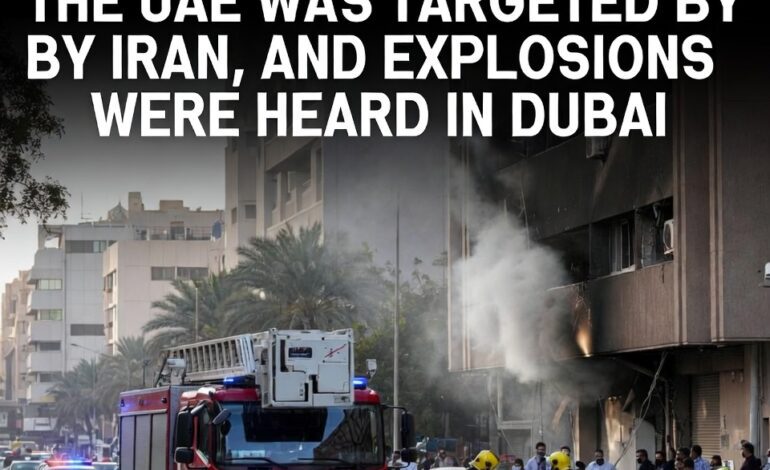

Dubai Explosions Explained: Missiles Were Intercepted, Not a Direct Hit
Quick Answer: Dubai and Abu Dhabi were targeted by Iranian ballistic missiles on February 28, 2026, as part of Iran’s retaliation against Operation Epic Fury. UAE air defences intercepted the missiles with high efficiency. Explosions heard across the UAE were from missile interceptions in the air — NOT from direct hits on the ground. The one confirmed death was caused by falling debris from an interception, not a direct missile strike. The Burj Khalifa was evacuated as a precaution and was NOT hit.
1. What Happened in Dubai and Abu Dhabi?
On the morning of Saturday, February 28, 2026, Iran launched ballistic missiles and drones at multiple countries across the Gulf region, including the United Arab Emirates. This came hours after the United States and Israel launched Operation Epic Fury — a major joint military campaign targeting Iran’s leadership, missile infrastructure, and nuclear facilities.
Residents in both Dubai and Abu Dhabi reported hearing multiple loud explosions. Social media filled rapidly with videos and photos of debris falling through the sky, fires visible on the horizon, and stunned residents recording the aftermath from balconies and rooftops.
The key fact that many initial reports missed: those explosions were the sound of UAE air defence systems destroying incoming Iranian missiles in mid-air. The UAE was not struck in the way the word ‘strike’ normally implies. What fell on the cities was not warheads — it was the fragmented remains of intercepted missiles.
UAE air defence systems dealt with the missiles with high efficiency and successfully intercepted a number of missiles. — UAE Ministry of Defence, February 28, 2026
2. Why This Distinction Matters: Direct Hit vs. Interception Debris
This is the most important clarification in all of the UAE coverage. Understanding the difference between a direct hit and interception debris is critical to accurate reporting and public safety awareness.
What a Direct Hit Means
A direct hit means a missile successfully travels to its intended target and detonates on impact. The warhead explodes at ground level, causing a blast radius, structural collapse, fire, and casualties directly beneath the impact point. This is what happened, for example, in some of the strikes on Iran itself.
What Interception Debris Means
When an air defence system intercepts a missile, it fires a counter-missile or uses other technology to destroy the incoming weapon in the air — sometimes thousands of feet above the ground. The destruction is successful in that the warhead does not detonate where it was aimed.
However, the exploded missile does not simply vanish. Its metal casing, engine components, fuel residue, and structural fragments all continue falling under gravity. This debris can weigh hundreds of kilograms in total. Falling from high altitude onto buildings, roads, and open areas, it can cause significant damage, start fires, and — as confirmed in Abu Dhabi — kill people.
The Analogy That Helps
Think of it this way: imagine someone throws a grenade at a car, but a security guard catches it and detonates it harmlessly in the air before it reaches the car. Mission accomplished — the car survived. But if you were standing under where the guard set it off, you could still be hit by shrapnel. That is what happened in the UAE.
The UAE’s air defence system did its job. The missile was neutralised before detonation on its target. But the physical remnants of that destruction still had to come down somewhere.
Fragments of the intercepted missiles fell in various areas of Abu Dhabi, including Saadiyat Island, Khalifa City, Bani Yas, Mohamed bin Zayed City and Al Falah. — UAE Ministry of Defence, Wave 2 statement
3. The UAE’s Official Response
The UAE government moved quickly and decisively. Multiple official bodies issued clear, coordinated statements.
UAE Ministry of Defence
The Ministry confirmed the country was subjected to what it called a ‘blatant attack by Iranian ballistic missiles.’ It stated that air defences ‘dealt with the missiles with high efficiency’ and that ‘a number of missiles were successfully intercepted.’ It also confirmed that debris fallout resulted in material damage and one civilian death.
The Ministry strongly condemned the attack, describing it as a ‘flagrant violation of national sovereignty and international law,’ and affirmed that the UAE ‘reserves its full right to respond to this escalation and to take all necessary measures to protect its territory, citizens and residents.’
NCEMA — National Emergency Crisis and Disasters Management Authority
NCEMA issued a direct public safety advisory urging all residents and visitors to stay away from any shrapnel or suspicious objects. The authority specifically instructed the public:
- Do NOT approach shrapnel or debris found on the ground
- Do NOT photograph debris or suspicious objects
- Allow authorities to carry out necessary procedures without interference
- Follow only official government sources for updates
- Avoid spreading unverified information or rumours
This advisory is consistent with standard post-interception protocols used by countries including Israel, which has decades of experience managing missile debris fallout after Iron Dome interceptions.
Dubai Airports Authority
Dubai Airports issued an urgent advisory asking passengers not to travel to Dubai International Airport (DXB) or Dubai World Central (DWC) airports while airspace closures were in effect.
4. Wave-by-Wave: How the Attack and Interceptions Unfolded
Iran did not fire a single salvo. Reports indicate multiple waves of attacks across the day. Here is what UAE authorities and credible outlets reported for each wave.
| Wave | Target Area | Outcome | Debris / Damage |
| Wave 1 | Abu Dhabi (general) | Multiple missiles intercepted | Debris fell in residential area; 1 Asian national killed |
| Wave 2 | Abu Dhabi (Saadiyat Island, Khalifa City, Bani Yas, Mohamed bin Zayed City, Al Falah) | Intercepted; UAE MoD confirmed no injuries in these locations | Missile fragments fell across named districts; no casualties reported |
| Wave 3 (latest) | Abu Dhabi and Dubai | Intercepted with ‘high efficiency’ | Shrapnel fell over Dubai; fire at Palm Jumeirah building brought under control |
| Ongoing | Airspace / flight paths | UAE airspace partially closed | DXB and AUH airports: hundreds of flights cancelled; passengers told not to travel to airports |
5. The One Fatality: Who Was Killed and How
One person has been confirmed dead in the UAE as a result of the Iranian missile attacks.
The UAE Ministry of Defence confirmed the victim was an ‘individual of Asian nationality.’ Al Arabiya and multiple other outlets reported the person was a Pakistani national. The individual was killed in Abu Dhabi after being struck by falling missile debris in a residential area.
Critical Clarification: The death was caused by falling missile debris after an interception — NOT by a direct missile warhead detonating at ground level. This is a medically and forensically distinct type of injury. The missile was destroyed in the air; the person was killed by a piece of that destroyed missile falling to earth.
The UAE Ministry confirmed the debris also caused ‘some material damage to infrastructure’ in the same residential area of Abu Dhabi. The precise neighbourhood was not named in official statements, though the broader areas affected across multiple waves were listed.
6. Burj Khalifa Evacuation: Setting the Record Straight
Reports that the Burj Khalifa — the world’s tallest building — had been ‘struck’ or ‘destroyed’ spread rapidly on social media in the hours following the attack. These reports are false.
What actually happened: The Burj Khalifa was evacuated as a standard precautionary measure in response to the general security alert. This is a practiced emergency protocol. The building was not hit by any missile or debris.
FACT CHECK — Burj Khalifa: The Burj Khalifa was evacuated as a precaution. It was NOT struck by a missile. It was NOT damaged. This was a safety protocol, not a response to physical impact.
Evacuation of landmark structures is standard procedure in a missile alert, comparable to how Israelis evacuate buildings when Iron Dome sirens sound. It does not indicate those buildings were targeted or hit.
7. Where Debris Fell: UAE Areas Affected
The UAE Ministry of Defence provided specific location names where missile fragments fell across Abu Dhabi following the second wave. Dubai was affected in subsequent waves.
Abu Dhabi — Confirmed Debris Locations
- Saadiyat Island — a cultural and residential district home to major museums and residential towers
- Khalifa City — a major suburban residential area
- Bani Yas — a residential district in the eastern part of Abu Dhabi
- Mohamed bin Zayed City — a large residential community
- Al Falah — a residential area in Abu Dhabi
- Unnamed residential area — site of the one confirmed fatality
Dubai — Confirmed Debris Events
- Shrapnel reported falling over parts of Dubai following interceptions (Anadolu Agency)
- Social media footage showed debris descending over urban areas
- A fire at a building on Palm Jumeirah was confirmed by Dubai authorities; brought under control
UAE authorities confirmed there were ‘no injuries’ in the specifically listed Abu Dhabi districts in the second wave. Casualties were reported from the first wave’s residential area impact.
8. Dubai and Abu Dhabi Airports: Full Closure Details
The UAE’s aviation regulator announced a temporary and partial closure of national airspace on February 28. This resulted in significant disruption to international travel.
Airports Affected
- Dubai International Airport (DXB) — one of the world’s busiest airports — suspended operations; passengers told not to travel to the airport
- Dubai World Central (DWC) Airport — also closed
- Abu Dhabi International Airport (AUH) — also affected by the airspace closure
Airlines That Cancelled Flights
- Air Arabia (UAE) — cancelled flights to Iran, Iraq, and parts of the region; additional delays and rerouting
- Emirates, flydubai — operational status disrupted
- Lufthansa (Germany) — suspended Tel Aviv, Beirut, and Oman services until at least March 7
- Virgin Atlantic — suspended regional flights
- Wizz Air — cancelled affected routes
- Air India, IndiGo, Biman Bangladesh — suspended Middle East services
- Oman Air — suspended Baghdad-bound flights; shifted to longer alternative routes
- Qatar Airways — suspended all departures from Doha due to Qatari airspace closure
Passengers already en route to Dubai were diverted or turned back. Hundreds of flights were affected across the region. Travellers are strongly advised to contact their airlines and check official UAE and GCAA (General Civil Aviation Authority) updates before attempting to travel.
9. Public Safety Warnings: What UAE Residents Should Know Right Now
For anyone currently in the UAE — whether a resident or a visitor — official guidance is clear.
UAE Government Advisory — February 28, 2026: Do not approach, touch, or photograph any debris or suspicious objects. Contact emergency services if you find debris. Follow only official UAE government channels for updates. Avoid spreading unverified information.
Practical Steps for People Currently in the UAE
- Stay indoors if you hear explosions or sirens. Do not go to windows or balconies during alerts.
- If you see debris on the ground — metal fragments, unusual objects — do not touch or photograph them. Call emergency services.
- Do not attempt to travel to DXB, DWC, or AUH airports until official clearance is given. Check your airline app or website.
- Monitor UAE government social media accounts: UAE NCEMA, UAE MOD, and Dubai Media Office for real-time official updates.
- If you are in a multi-storey building, move to an inner room or stairwell during alerts — away from windows and exterior walls.
- Do not share unverified videos or claims on social media. Misinformation spreads panic and can impede emergency response.
10. The Broader Context: Why Was the UAE Targeted?
The UAE does not border Iran, and the two nations have maintained a complex but largely managed relationship. So why did Iran target it?
U.S. Military Presence in the UAE
The UAE hosts a critical U.S. military base used for reconnaissance, aerial refueling, and logistics support for American forces across the Middle East. This base was explicitly referenced in reports of the attack — at least two ballistic missiles were reportedly intercepted directly over it.
From Iran’s perspective, any country hosting U.S. military infrastructure that is being used in Operation Epic Fury becomes a legitimate military target under their stated rules of engagement. Iran’s IRGC commanders announced that all U.S. and Israeli interests in the region were now ‘legitimate targets.’
The UAE’s Complicated Position
The UAE normalised relations with Israel through the Abraham Accords in 2020 and has deepened security cooperation with the U.S. in the years since. Iran has long viewed the Abraham Accords states with hostility.
Saudi Arabia — which was also targeted by Iranian missiles despite not officially participating in Operation Epic Fury — condemned the attacks and offered its ‘full capabilities’ to affected Gulf states.
11. Fact vs. Fiction: Debunking the Misinformation Circulating About Dubai
Within hours of the events, misinformation spread widely on social media. Here is a comprehensive fact-check.
| CLAIM CIRCULATING ONLINE | WHAT ACTUALLY HAPPENED | SOURCE |
| Dubai was directly hit by an Iranian missile | Missiles were intercepted mid-air over Dubai; shrapnel/debris fell — no direct strike hit the city | UAE Ministry of Defence, CNBC, Dubai Eye |
| Burj Khalifa was struck / destroyed | Burj Khalifa was evacuated as a precaution. No strike hit the tower. | India TV News, UAE authorities |
| UAE was completely overwhelmed by missiles | UAE air defences intercepted multiple waves with ‘high efficiency’ (official statement) | UAE MoD, Gulf News |
| The one death was from a missile impact | The fatality was an Asian national killed by FALLING MISSILE DEBRIS from an interception — not a direct hit | UAE MoD official statement, Dubai Eye |
| Fires in Dubai were from missile strikes | A fire at a Palm Jumeirah building was confirmed ‘under control’; cause linked to debris, not a direct warhead detonation | Dubai Eye 103.8 |
| UAE was struck like Israel or Bahrain | UAE suffered debris fallout; Bahrain’s 5th Fleet HQ and Qatar’s Al Udeid base received heavier reported impacts | CNBC, Al Arabiya, Gulf News |
| Iran successfully penetrated UAE air defence | Iran fired missiles at UAE; UAE intercepted them. The kill chain worked. Casualties came from intercept fallout, not warheads | UAE MoD, NCEMA, Gulf News |
12. Expert Insight: How Air Defence Works — and Why Debris Still Kills
Many people assume that if a missile is intercepted, all danger is over. This is a common and understandable misconception. Here is what experts and military analysts explain about interception fallout.
The Physics of Interception Debris
A ballistic missile can travel at speeds of several kilometres per second and carry a warhead weighing hundreds to thousands of kilograms. When it is intercepted at altitude — sometimes 10,000 to 50,000 feet or higher — the resulting explosion destroys the warhead’s ability to detonate on impact, but it does not dematerialise the missile.
The metal casing, the propellant tanks, the guidance system components, and pieces of the interceptor missile itself all become projectiles. They may be smaller than the original missile but they are still falling at high speed from significant altitude. A piece of metal the size of a briefcase falling from 20,000 feet is lethal.
How Israel Manages This Problem
Israel’s Iron Dome system — which the UAE’s air defence draws on in design philosophy — intercepts thousands of rockets and missiles. Israel designates debris-fall zones based on intercept trajectory calculations and directs civilians away from those areas during alerts. Injuries from Iron Dome intercept debris are documented in Israel and treated as a recognised hazard of air defence operations.
The UAE’s NCEMA advisory to stay away from shrapnel and debris reflects this same operational reality. The interceptions worked. The fallout zone still needed to be managed.
Air defence success does not mean zero risk on the ground. It means the risk has been transformed from catastrophic direct impact to manageable debris fallout. — Military Analyst, Bloomberg context
13. People Also Ask — Full FAQ
| Question | Answer (verified, Feb 28, 2026) |
| Was Dubai directly hit by a missile? | No. Missiles were intercepted by UAE air defences. Debris and shrapnel from those interceptions fell over parts of Dubai. No warhead directly detonated in the city. |
| Was the Burj Khalifa hit or destroyed? | No. The Burj Khalifa was evacuated as a precaution. UAE authorities confirmed no structural strike hit the tower. |
| Who was killed in the UAE? | One person — identified as an Asian national (reported as Pakistani in some sources) — was killed in Abu Dhabi after being struck by falling missile debris in a residential area. |
| Is it safe to be in Dubai right now? | UAE authorities stated the security situation remains stable. Airspace is partially closed. Residents and visitors are urged to follow NCEMA and UAE government official updates, stay indoors, and avoid any debris or shrapnel. |
| Are Dubai airports open? | No. Dubai International (DXB) and Abu Dhabi (AUH) airports temporarily suspended operations. Dubai Airports asked passengers not to travel to the airport. Multiple airlines cancelled flights through at least March 7. |
| Did Iran successfully attack UAE military bases? | Iran targeted UAE territory where U.S. forces operate. UAE air defences reported ‘high efficiency’ interception. At least two missiles were reportedly intercepted directly over the key base in the UAE used for U.S. reconnaissance and aerial refueling. |
| Has UAE said it will retaliate against Iran? | The UAE Ministry of Defence stated it reserves ‘the full right to respond to this escalation and take all necessary measures to protect its territory, citizens and residents.’ No retaliatory strike has been publicly reported yet. |
| What is the difference between debris damage and a direct missile hit? | A direct hit means the missile warhead reaches its target and detonates on impact. Interception means air defences destroy the missile in the air — but fragments, metal shards, and debris from the explosion can still fall and cause injury or damage on the ground below. |
14. Sources and Verification
This article is based exclusively on verified reporting from the following authoritative sources. Every factual claim is traceable to an official statement or named credible outlet.
- UAE Ministry of Defence — Official statements on interceptions, fatality, and UAE’s right to respond
- NCEMA (National Emergency Crisis and Disasters Management Authority) — Public safety advisory on debris
- Gulf News (Anupam Varma, Lekshmy Pavithran) — Live reporting from within the UAE
- CNBC — Team reporting confirmed explosions in both Dubai and Abu Dhabi; UAE MoD quote
- Al Arabiya — Debris images from Abu Dhabi, Pakistani national fatality report
- Anadolu Agency (Tarek Chouiref) — Missile interception / shrapnel falling over Dubai
- Dubai Eye 103.8 (ARN News) — Palm Jumeirah fire update; UAE MoD official quote
- United24Media — Missile debris killed Asian national; Corniche vibrations; base targeting
- India TV News — Burj Khalifa evacuation reporting
- Khaleej Times (live updates) — Third wave interception confirmation
EDITORIAL NOTE: This is an active, rapidly evolving breaking news situation. Details are confirmed against official UAE government sources and established international news organisations. The situation is ongoing as of February 28, 2026. Readers are urged to follow UAE government official channels for safety updates in real time. This article will be updated as verified information emerges.
Discover more from MatterDigest
Subscribe to get the latest posts sent to your email.