Operation Epic Fury: U.S. and Israel Strike Iran — IRGC Commanders Killed, Khamenei Status Unknown
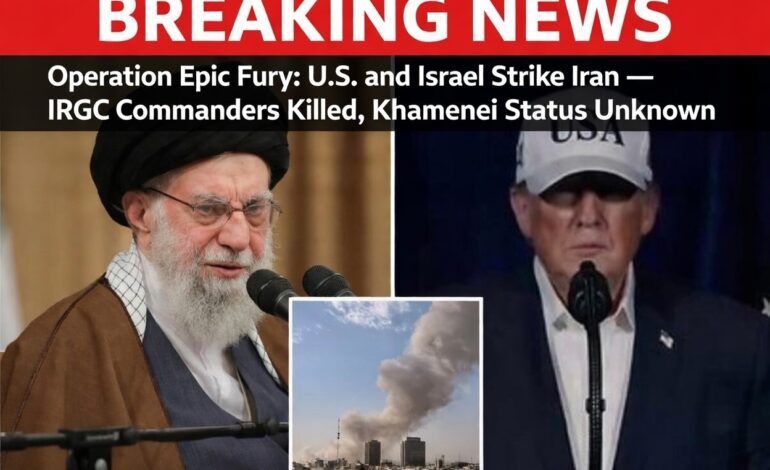

Quick Answer: The United States and Israel launched a massive coordinated military campaign against Iran on February 28, 2026, codenamed Operation Epic Fury (U.S.) and Operation Lion’s Roar (Israel). IRGC Commander Gen. Mohammad Pakpour and Defense Minister Amir Nasirzadeh are believed killed. Supreme Leader Khamenei’s status is unconfirmed. Iran has retaliated with missile and drone strikes on U.S. bases across the Middle East. The Strait of Hormuz faces closure risk.
1. What Is Operation Epic Fury?
Operation Epic Fury is the official name assigned by the United States Department of Defense to a major joint military campaign launched against the Islamic Republic of Iran on Saturday, February 28, 2026. It is one of the largest direct military operations against Iran in American history.
Israel conducted its parallel component under the name Operation Lion’s Roar (also reported as Operation Roaring Lion). Together, the two operations represent a coordinated attempt by the U.S. and Israel to simultaneously destroy Iran’s military infrastructure, eliminate its leadership, and — in Trump’s own words — give the Iranian people an opportunity to overthrow their government.
What Were the Operation’s Official Objectives?
- Destroy Iran’s ballistic missile program and missile launch infrastructure
- Eliminate senior IRGC commanders and regime officials
- Target Iran’s nuclear facilities and weapons-development capacity
- Neutralize Iran’s naval assets threatening key waterways
- Degrade Iran’s ability to project force through proxy networks
CNN reported the operation was the result of “months of joint planning” and was expected to continue for several days. Trump himself acknowledged the operation could produce American casualties.
We are going to destroy their missiles and raze their missile industry to the ground. We will annihilate their navy. We will ensure that Iran does not obtain a nuclear weapon. — President Donald Trump, February 28, 2026
2. The Strikes Begin: What Happened on February 28
The operation began in the pre-dawn hours of Saturday, February 28, 2026 (Tehran time). Massive explosions were reported across Iran’s capital and multiple other major cities simultaneously.
Cities Struck in the Opening Wave
- Tehran: Strikes near the compound and offices of Supreme Leader Ayatollah Ali Khamenei; near the presidential palace; near IRGC headquarters
- Isfahan: Strikes reported on nuclear-related facilities
- Qom: Explosions reported
- Karaj: Strikes confirmed
- Kermanshah: Explosions reported
- Tabriz: Strikes reported
- Shiraz: Explosions reported
- Minab, Hormozgan province: Israeli strike on a school near a Revolutionary Guard base killed at least 40 people and wounded 45, Iranian state media reported
Social media footage showed thick black smoke rising from central Tehran in multiple locations. Satellite imagery later confirmed heavy damage to Khamenei’s fortified compound in the capital.
U.S. vs. Israeli Strike Roles
A senior U.S. official told Axios that the roles were divided: American strikes focused on Iran’s missile program and launch infrastructure, while Israeli strikes focused on both eliminating senior Iranian officials and targeting the missile program directly.
Fox News confirmed that the U.S. military was not officially targeting Iranian leadership, but Israel was. The Pentagon’s focus was on military targets and ballistic missile sites posing an “imminent threat.”
3. High-Value Targets: Who Was Killed, Who Was Targeted
This is a rapidly evolving situation. The following table reflects the best-available information as of the time of publication. All kills are reported, not officially confirmed by Iran.
| Name | Title | Status | Source |
| Gen. Mohammad Pakpour | IRGC Commander | LIKELY KILLED | Reuters (3 sources), Times of Israel, Axios |
| Amir Nasirzadeh | Defense Minister | LIKELY KILLED | Reuters (3 sources), Gulf News, Axios |
| Ali Shamkhani | Defense Council Secretary / Nuclear Advisor | POSSIBLY KILLED | Reuters, CNN, Channel 12 Israel |
| Ali Larijani | Supreme Nat’l Security Council Sec. | TARGETED — STATUS UNCLEAR | CNN, Axios |
| Sayyid Abdolrahim Mousavi | Armed Forces Chief of Staff | TARGETED — STATUS UNCLEAR | IBTimes AU, Israeli sources |
| Ayatollah Ali Khamenei | Supreme Leader (age 86) | TARGETED — WHEREABOUTS UNKNOWN | Reuters, NPR, Axios, AP |
| Masoud Pezeshkian | President of Iran | TARGETED — CLAIMED ALIVE by FM | Reuters, NPR, Iranian FM statement |
| Khamenei’s sons | Regime figures | TARGETED — BELIEVED SURVIVED | Axios, Israeli official sources |
| Mahmoud Ahmadinejad | Former President | TARGETED — STATUS UNCLEAR | Axios, Israeli sources |
Key Details on the Confirmed and Likely Kills
Gen. Mohammad Pakpour — IRGC Commander
Pakpour served as commander of the Islamic Revolutionary Guard Corps ground forces and was a central figure in coordinating Iran’s proxy operations across the Middle East. His elimination, if confirmed, would represent one of the most consequential blows to the IRGC’s command structure since the killing of General Qasem Soleimani in 2020.
Three sources — two familiar with Israeli military operations and one regional contact — confirmed to Reuters that Pakpour was killed. Israeli officials earlier assessed his killing as likely. Iranian authorities denied the report, with a regime-affiliated channel saying “all commanders of Iran’s armed forces are safe and sound.”
Amir Nasirzadeh — Defense Minister
Nasirzadeh previously served as deputy chief of staff of Iran’s armed forces and had a background as a fighter pilot before ascending to his role as defense minister. His death, if confirmed, removes a key architect of Iran’s conventional military strategy and could disrupt coordination between Iran’s regular military and the IRGC during ongoing hostilities.
The same three sources who confirmed Pakpour’s killing told Reuters that Nasirzadeh was also killed in Israeli strikes.
Ali Shamkhani — Nuclear Advisor / Defense Council Secretary
Shamkhani served as secretary of Iran’s newly formed Defense Council and was Khamenei’s top security adviser overseeing the nuclear program. Israeli Channel 12 reported a high likelihood he was eliminated. CNN also reported him as a target. His status has not been independently confirmed.
4. Supreme Leader Khamenei: Targeted, Status Unknown
The most consequential question of the operation remains unanswered: what happened to 86-year-old Supreme Leader Ayatollah Ali Khamenei?
An Israeli official told Reuters that both Khamenei and Iranian President Masoud Pezeshkian were targeted in the opening phase of the strikes, though the result was not immediately known. A person briefed on the operation told NPR that Khamenei “was hit” — but that assessment has not been independently confirmed.
Conflicting Reports
- Israeli intelligence: Preliminary assessment is Khamenei was injured in the strike on his compound
- Iranian Foreign Minister Abbas Araghchi (NBC News): Khamenei and Pezeshkian are alive “as far as I know.” All high-ranking officials are alive.
- Satellite imagery: Khamenei’s fortified Tehran compound shows heavy damage or destruction
- Communications: Multiple reports indicate Khamenei has been cut off from normal communications channels
- Iranian state media: Promised a televised statement from Khamenei
Analysts note that Iran likely had a pre-recorded statement prepared precisely for this contingency, to project continuity of leadership and maintain morale among regime supporters regardless of actual conditions.
He is alive, as far as I know. All high-ranking officials are alive, everything is fine. — Iranian Foreign Minister Abbas Araghchi, NBC News, February 28, 2026
5. Iran Fights Back: Regional Retaliation
Iran did not wait before responding. Within hours of the initial strikes, the IRGC launched a “first wave” of ballistic missiles and drones targeting U.S. military installations and Israeli territory across the region.
A senior IRGC commander, Ebrahim Jabbari, made a pointed statement through state television: Iran had used only “scrap missiles” in the opening retaliation and would soon unveil “unforeseen weapons.” The threat signals that Iran is holding back more advanced capabilities for subsequent waves.
| Location | Iranian Action | Reported Outcome |
| Israel (Tel Aviv, Jerusalem) | Ballistic missiles + drones | Air defenses intercepted multiple missiles; 1 civilian injured by shrapnel |
| Bahrain (U.S. 5th Fleet HQ, Manama) | Ballistic missiles | Explosions reported; smoke seen over base; air raid sirens activated |
| Qatar (U.S. air bases) | Ballistic missiles | Missiles intercepted; no major casualties reported |
| Kuwait (U.S. bases) | Ballistic missiles | Missiles fired; interceptions reported |
| UAE (U.S. base, Abu Dhabi area) | Ballistic missiles | 1 Pakistani migrant worker killed by debris from interception |
| Jordan (Muwaffaq Salti airbase) | Missiles — unconfirmed | Claimed hit; no confirmation from U.S. or Jordan |
| Iraq / Syria (U.S. bases) | Drones + missiles | Attacks reported; details unclear |
| Saudi Arabia | Missiles | Interceptions claimed by Saudi air defense |
| Strait of Hormuz / Gulf waterways | Iranian naval blockade signaled | Oil tankers diverting; Brent crude markets closed; price spike anticipated |
The Strait of Hormuz: A Global Economic Flashpoint
Perhaps the most significant economic development unfolding alongside the military strikes is Iran’s signaling of a blockade of the Strait of Hormuz. Roughly 20% of the world’s traded oil passes through this narrow waterway.
Oil tankers began diverting away from the strait almost immediately after news of the strikes broke. Brent crude futures markets were closed at the time of initial reporting, but Bloomberg headlined that tankers were already “avoiding the vital Hormuz Strait.” A major oil price spike is widely anticipated when markets open.
6. Trump’s Address: What the President Said
President Trump posted an eight-minute video to Truth Social announcing the start of what he called “major combat operations” against Iran. The White House simultaneously posted the statement to its official social media accounts.
Key Statements from Trump’s Address
- “We are going to destroy their missiles and raze their missile industry to the ground.”
- “We are going to annihilate their navy.”
- “We will ensure that Iran does not obtain a nuclear weapon.”
- “The hour of your freedom is at hand. Stay sheltered. Don’t leave your home.”
- “When we are finished, take over your government. It will be yours to take. This will be probably your only chance for generations.”
- To the IRGC: “Lay down your weapons and have complete immunity, or in the alternative, face certain death.”
Trump explicitly framed the operation as having a dual objective: military degradation of Iran’s capabilities, and political — creating the conditions for the Iranian people to overthrow their government. He also directly acknowledged that American casualties were possible and expected.
7. Netanyahu and Israel’s Stated Objectives
Israeli Prime Minister Benjamin Netanyahu made a televised address describing Operation Lion’s Roar as essential to “remove the existential threat posed by the terrorist regime in Iran” and to give Iranian citizens the ability to take their fate into their own hands.
The time has come for all sections of the people in Iran to topple the Ayatollah regime. — Israeli PM Benjamin Netanyahu, February 28, 2026
Netanyahu’s statement went further than Trump’s in explicitly calling for regime change as the primary objective of the strikes. Israeli officials told Axios they still lacked full clarity on which Iranian leaders had been killed, and that it would take several more hours to complete damage assessments.
8. The Road to War: How We Got Here
This operation did not emerge without warning. A long chain of events led to this moment.
Key Milestones on the Path to Operation Epic Fury
- June 2025: U.S. and Israel conduct the first direct large-scale exchange — the 12-Day Air War — targeting Iranian nuclear and military sites. Several senior commanders killed in that operation.
- Late 2025: Massive nationwide anti-government protests erupt across Iran, driven by economic collapse, the fall of the rial, and rising prices.
- February 2026, early: The U.S. deploys a second carrier strike group (USS Gerald R. Ford) to the Middle East, joining the USS Nimitz already in the region.
- February 13, 2026: Trump publicly states that regime change in Iran would be “the best thing that could happen.”
- February 14, 2026: U.S. officials tell Reuters the military is preparing for weeks-long sustained operations, not a limited strike.
- February 27, 2026: Oman’s Foreign Minister announces a diplomatic “breakthrough” — Iran has agreed to zero uranium stockpiling and full IAEA verification. Peace reportedly “within reach.”
- February 28, 2026 (pre-dawn): Despite the Omani diplomatic breakthrough announced just hours earlier, strikes begin. Oman’s FM says the negotiations were “yet again undermined.”
The timing is extraordinary. Iran had reportedly agreed — through Omani mediation — to irreversibly downgrade its enriched uranium and accept full international verification just one day before the strikes began. Whether the strikes were already locked in, or whether the diplomatic breakthrough was rejected by the U.S. and Israel as insufficient, remains a key question that reporters are actively pursuing.
9. Global Reactions: Allies, Adversaries, and Markets
United States
Senator Lindsey Graham (R-SC) called the potential collapse of Iran’s regime “the biggest geopolitical shift in the Middle East in a thousand years,” declaring “the mothership of terrorism is about to go down.” Secretary of State Marco Rubio notified Congressional leaders including House Minority Leader Hakeem Jeffries ahead of the strikes.
Israel
Reza Pahlavi, the former crown prince of Iran, described the strikes as a promised act of “humanitarian intervention” and called on Iranian citizens to abandon the regime. He urged the U.S. to exercise caution to preserve civilian lives.
European Union
EU Foreign Policy Chief Kaja Kallas described the situation as “perilous” and called for civilians to be protected and international law to be upheld.
France
President Emmanuel Macron warned the conflict carries “grave consequences for international peace and security” and described the current escalation as “dangerous for everyone.”
United Kingdom
A British government statement said the UK does “not want to see further escalation into a wider regional conflict” and confirmed it had bolstered “defensive capabilities” in the region.
Canada
Prime Minister Mark Carney said Canada supports U.S. efforts to prevent Iran from obtaining a nuclear weapon and from further threatening international peace and security.
Oman
Foreign Minister Badr Al-Busaidi expressed deep frustration, saying negotiations he mediated were “yet again undermined” by the escalation and urged the U.S. “not to get sucked in further.”
Qatar and UAE
Qatar condemned Iranian missile attacks on its territory as “a flagrant violation of its national sovereignty.” The UAE warned of “grave consequences” after a Pakistani worker was killed by missile debris on its soil.
Airspace and Aviation
- Iran, Israel, Iraq, Kuwait, Bahrain, Qatar, and UAE all closed their airspace
- Lufthansa, Wizz Air, Virgin Atlantic suspended flights to the region until at least March 7
- Air India, IndiGo, and Biman Bangladesh Airlines suspended Middle East services
- Multiple planes were rerouted mid-flight as closures cascaded across the region
10. Casualties and Civilian Impact
Full casualty figures are not yet available and will not be for some time. What is confirmed or reported as of publication:
Iran
- IRGC Commander Gen. Mohammad Pakpour: Reported killed (Reuters, 3 sources)
- Defense Minister Amir Nasirzadeh: Reported killed (Reuters, 3 sources)
- Ali Shamkhani: Possibly killed (Channel 12 Israel, CNN)
- At least 40 civilians killed, 45 wounded in Israeli strike on a girls’ school in Minab (Iranian state media IRNA; Reuters unable to independently confirm)
- Numerous unnamed senior IRGC commanders and political officials: Reported killed (Iranian source close to establishment, Reuters)
Israel
- Air defense systems intercepted multiple Iranian missiles over Jerusalem and other locations
- 1 civilian reported injured by shrapnel
- Infrastructure damage under assessment
Gulf Region (Iranian Retaliation)
- UAE: 1 Pakistani migrant worker killed by debris from missile interception
- Bahrain: Smoke reported over U.S. 5th Fleet headquarters; casualties not confirmed
- Qatar, Kuwait, Saudi Arabia: Missile attacks intercepted; no confirmed casualties reported
Iran’s IRGC also claimed it struck a U.S. Navy auxiliary supply vessel, reporting “serious damage.” The U.S. military had not confirmed this at time of publication.
11. What Comes Next: Expert Analysis
Can Iran Survive a Decapitation Strike?
Analysts are cautious about overstating the impact of leadership losses. The IRGC is a deeply institutionalized organization designed to maintain operational continuity even after leadership changes. Iran demonstrated this resilience after the 2020 killing of General Soleimani — the organization adapted and continued operating.
However, the scale of this strike goes far beyond Soleimani. Multiple simultaneous leadership kills — if confirmed — combined with infrastructure destruction represent a qualitatively different challenge to command continuity.
Regime Change: Fantasy or Possibility?
Both Trump and Netanyahu explicitly called for the Iranian people to seize this moment to topple their government. Regime change driven by external military pressure is historically very difficult to achieve, and even analysts sympathetic to the operation’s goals caution that a leaderless, wounded Iran could be as dangerous as a stable one.
If senior Iranian officials were indeed killed, that would be significant. But it doesn’t mean the end of the Islamic Republic. — Bloomberg analysis, February 28, 2026
The Hormuz Variable
A prolonged closure of the Strait of Hormuz would be catastrophic for global energy markets and the world economy. This may be Iran’s most powerful remaining card. The longer the strikes continue, the more likely Iran is to use it.
Iran’s Promised Escalation
The IRGC commander’s statement about “scrap missiles” and “unforeseen weapons” is not empty posturing. Iran has developed hypersonic missile capabilities and a range of advanced munitions not yet deployed in this conflict. Escalation in the next 24-72 hours remains highly likely.
12. People Also Ask — Key Questions Answered
| Question | Answer (as of Feb 28, 2026) |
| What is Operation Epic Fury? | The official Pentagon name for the joint U.S.-Israel military campaign launched against Iran on February 28, 2026. It targeted Iranian leadership, IRGC commanders, missile sites, and nuclear infrastructure. |
| Who was killed in Operation Epic Fury? | Three sources told Reuters that IRGC Commander Gen. Mohammad Pakpour and Defense Minister Amir Nasirzadeh were likely killed. Multiple other senior officials were targeted. Official Iranian confirmation has not been issued. |
| Was Supreme Leader Khamenei killed? | His status is unconfirmed. Israeli officials assessed he was targeted and possibly hit. Iranian Foreign Minister Abbas Araghchi said he was alive ‘as far as I know.’ His whereabouts remain unknown as of Feb. 28 publication. |
| Why did the U.S. and Israel launch these strikes? | President Trump cited Iran’s nuclear program, its missile threat, and decades of hostility including the 1979 hostage crisis. He called the operation necessary to ‘eliminate imminent threats from the Iranian regime.’ |
| Is Iran retaliating? | Yes. Iran launched ballistic missiles and drones at Israel and at U.S. military bases across Bahrain, Qatar, Kuwait, the UAE, and elsewhere. An IRGC commander said Iran had used only ‘scrap missiles’ so far and would use more advanced weapons. |
| What happened to the Strait of Hormuz? | Iran signaled a blockade. Oil tankers began diverting. Brent crude futures markets were closed at the time of reporting, but a major price spike is widely anticipated. |
| Is this legal under international law? | Iran called the strikes an ‘unprovoked and illegal’ violation of its sovereignty. The U.S. and Israel have argued self-defense and pre-emption rights. International bodies including the EU have called the situation ‘perilous.’ |
| How long will the operation last? | CNN reported Operation Epic Fury was the result of ‘months of joint planning’ and would involve several days of attacks. Trump himself acknowledged the operation could produce American casualties and would continue for multiple days. |
13. Sources and Verification
This article draws exclusively on verified reporting from established news organizations and official government statements.
- Reuters — Primary source for casualty and targeting reports, citing named and unnamed official sources
- NPR (Daniel Estrin / Rebecca Rosman) — Full live coverage, original reporting from Tel Aviv
- Al Jazeera — Real-time updates and regional diplomatic reaction
- Axios — U.S. and Israeli official sourcing on targeting details and objectives
- Fox News (Trey Yingst, Chief Foreign Correspondent) — U.S. official source on Pentagon objectives
- Times of Israel / Ynetnews — Israeli military and official sources
- Gulf News — IRGC kill confirmation details
- CNN — Joint planning confirmation; target list details
- org — Historical and operational context
- White House / Pentagon official statements — Trump’s Truth Social address; DoD operation name confirmation
- Iranian state media (IRNA, Tasnim, Fars) — Iranian government positions and denial statements
EDITORIAL NOTE: This is a breaking news situation evolving by the hour. Kill confirmations, casualty figures, and leadership status reports are based on multiple credible sources but have not been officially confirmed by Iranian state authorities, who have denied several claims. All unconfirmed status reports are clearly labeled as such. This article will be updated as verified information emerges. The situation carries grave humanitarian and geopolitical risks. We urge readers to follow established international news organizations for ongoing updates.
Discover more from MatterDigest
Subscribe to get the latest posts sent to your email.