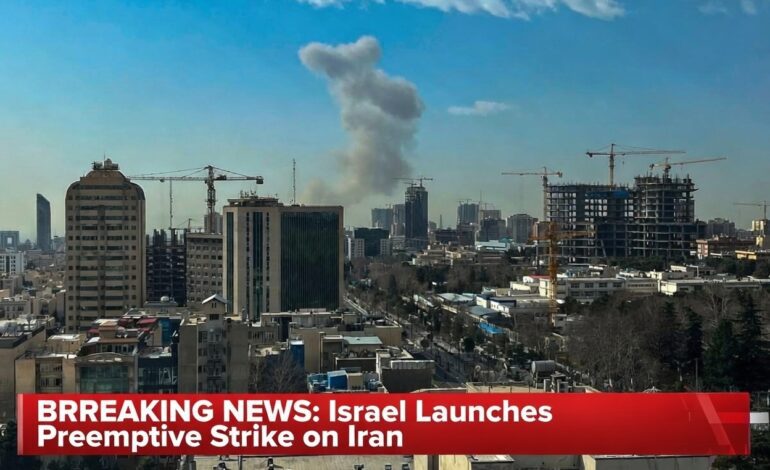
Israel Launches Preemptive Strike on Iran

What happened, why Israel acted first, and what it means for the Middle East and the world
BREAKING: Israel has announced it launched a preemptive military strike against Iran. Israeli officials say the operation targeted key Iranian military and nuclear-linked infrastructure. This is one of the most significant escalations in Middle East history.
The word “preemptive” is doing a lot of work here. It means Israel didn’t wait to be attacked. It struck first — and it’s telling the world exactly why. This article breaks down everything that happened, what it means, and what comes next.
Quick Answer: What Did Israel Do?
Quick Answer: Israel launched a preemptive military strike against Iran, targeting military sites and nuclear-linked facilities. Israeli officials stated the operation was launched to neutralize an imminent threat before Iran could act. The strike marks a dramatic escalation in a years-long shadow war between the two nations.
In plain terms: Israel did not wait for Iran to fire first. Israeli forces struck Iranian targets — likely using a combination of air power, missiles, and possibly cyber operations — and then publicly claimed responsibility, framing it as defensive action.
This is an extraordinarily rare move. Nations almost never openly claim preemptive strikes on other sovereign states. Israel’s decision to go public signals confidence — and a clear message to Tehran and the world.
What Is a Preemptive Military Strike?
Before we go deeper, let’s define the term — because it matters legally, politically, and morally.
Preemptive vs. Preventive Strike: What’s the Difference?
| Type | Preemptive Strike | Preventive Strike |
| Timing | Attack is imminent or underway | Threat is distant or potential |
| Justification | Self-defense under international law | More legally contested |
| Example | Israel strikes missile launchers about to fire | Israel destroys Iraqi reactor in 1981 |
| World reaction | Generally more accepted | Often condemned internationally |
Israel’s official language frames this as a preemptive strike — meaning it claims it had intelligence that an Iranian attack was actively in preparation. That distinction is critical for how the international community responds.
What Targets Did Israel Hit in Iran?
Full details are still emerging. In the fog of a breaking military operation, initial reports should be treated with caution. That said, based on available information and Israel’s known strategic priorities, the strike likely focused on several categories of targets.
Reported and Likely Target Categories
- Nuclear Infrastructure — Iran’s nuclear enrichment program has long been Israel’s primary red line. Facilities at Natanz, Fordow, and Isfahan have been previously identified as targets in Israeli contingency planning.
- Missile Production Sites — Iran’s ballistic missile arsenal — capable of reaching all of Israel — represents an existential threat in Israeli military doctrine. Missile factories and storage depots would be high-priority targets.
- Revolutionary Guard (IRGC) Bases — The IRGC commands Iran’s proxy network across the region. Striking IRGC command infrastructure would aim to degrade Tehran’s ability to coordinate retaliatory strikes through Hezbollah, Houthi rebels, and Iraqi militias.
- Air Defense Systems — To carry out and sustain strikes, Israel would need to blind or destroy Iranian radar and anti-aircraft batteries first.
- Intelligence and Command Centers — Decapitating Iran’s ability to plan and coordinate a response would be a logical early objective.
Why Did Israel Say It Acted First?
This is the central question. Why now? Why not wait? Israel’s official justification and strategic logic rest on several pillars.
The “Never Again” Doctrine
Israel’s military doctrine is built on the premise that the Jewish state cannot absorb a first strike and survive. The country is tiny — roughly the size of New Jersey. A successful nuclear or massive conventional strike could be catastrophic. So Israel acts before it can be acted upon.
Iran’s Nuclear Program Had Reached a Critical Threshold
Reports in the months preceding this strike indicated that Iran had enriched uranium to levels dangerously close to weapons-grade. The International Atomic Energy Agency (IAEA) had raised alarms. Israeli intelligence reportedly concluded that the window to prevent Iran from achieving nuclear breakout was closing rapidly.
Intelligence of an Imminent Iranian Operation
Israeli officials have cited specific intelligence indicating that Iran was preparing a major attack — either directly or through proxy forces. The nature of that intelligence has not been publicly disclosed, but its existence forms the legal and moral backbone of Israel’s preemptive claim.
Diplomatic Channels Had Failed
Nuclear negotiations between Iran and world powers had stalled entirely. Sanctions had not convinced Tehran to halt enrichment. Back-channel communications had broken down. In Israel’s view, the diplomatic path was exhausted.
The Long Road Here: Israel-Iran Tensions Explained
This didn’t come out of nowhere. Israel and Iran have been engaged in what analysts call a “shadow war” for years. To understand the preemptive strike, you need to understand what came before it.
Key Escalation Points: A Timeline
Pre-2020: Israel conducts numerous covert operations against Iran’s nuclear program, including the Stuxnet cyberattack (attributed to U.S. and Israel) and assassinations of Iranian nuclear scientists.
2020: U.S. kills Iranian General Qasem Soleimani. Iran retaliates with missile strikes on U.S. bases. Israel watches closely.
2021: Iran attacks Israeli-linked shipping vessels in the Gulf. Israel responds with cyberattacks on Iranian infrastructure.
2022: Iran supplies Russia with Shahed drones for use in Ukraine. Relations with the West deteriorate sharply.
April 2024: Iran launches its first-ever direct attack on Israeli soil — over 300 drones and missiles. Israel intercepts the vast majority, with U.S., UK, Jordan, and Saudi Arabia assisting.
October 2024: Israel strikes back inside Iran, hitting air defense systems near Isfahan in what is described as a calibrated response.
2025: Iran rapidly accelerates uranium enrichment. IAEA inspectors report restricted access. Israeli intelligence goes on high alert.
Early 2026: Tensions reach breaking point. Multiple Iranian proxy attacks on Israeli forces. Israeli cabinet votes on military action.
February 28, 2026: Israel launches preemptive strike on Iran.
How Did Iran Respond?
Iran’s initial response came in predictable stages. Understanding this pattern helps make sense of what might unfold next.
Stage 1: Official Denial and Condemnation
Iranian state media initially downplayed the damage and condemned the strikes as an “act of war” and a “criminal aggression.” Supreme Leader Khamenei vowed that Iran would respond “at a time and place of its choosing” — classic strategic ambiguity.
Stage 2: Proxy Activation
Almost immediately, reports emerged of heightened alert status among Hezbollah in Lebanon and Iranian-backed militias in Iraq and Syria. Houthi forces in Yemen announced expanded operations. Iran’s “axis of resistance” was being signaled.
Stage 3: Emergency UN Security Council Session
Iran called for an emergency session of the UN Security Council. Russia and China backed the call. The U.S. and UK signaled they would veto any resolution condemning Israel. The diplomatic theater began.
What the U.S. and World Powers Said
International reactions split almost exactly along predictable lines — and the divisions tell their own story.
| Country/Bloc | Stance | Key Statement |
| United States | Supportive but cautious | “Israel has the right to self-defense. We urge all parties to avoid further escalation.” |
| United Kingdom | Supportive with caveats | “We understand Israel’s security concerns while calling for immediate de-escalation.” |
| Russia | Strongly opposed | “An unprovoked act of aggression that violates international law and must be condemned.” |
| China | Opposed | “Deeply concerned. Called for restraint and immediate ceasefire negotiations.” |
| Saudi Arabia | Cautiously silent | No immediate statement — Riyadh playing a careful diplomatic game. |
| Jordan | Opposed | “Destabilizing act threatening regional stability and civilian lives.” |
| EU | Split | Called for de-escalation while affirming Israel’s security rights. |
The U.S. response is the most consequential. Washington did not confirm advance knowledge of the strike — a standard diplomatic practice known as “strategic plausible deniability.” But the lack of condemnation speaks volumes.
Could This Trigger a Wider War?
This is the question on every analyst’s mind right now. The honest answer is: it depends on several variables that are still in motion.
Factors That Could Contain the Conflict
- S. deterrence: American forces in the region signal to Iran that any escalation risks direct U.S. involvement.
- Iran’s damaged capabilities: If the strikes successfully degraded Iran’s missile and air assets, Tehran’s ability to retaliate directly may be limited in the short term.
- Economic calculus: Iran’s economy is already crushed by sanctions. A full-scale war would be devastating.
- Proxy containment: If Hezbollah and other groups hold fire, the conflict may remain bilateral and bounded.
- Back-channel negotiations: Even in the worst crises, back channels operate. Qatar, Oman, and Turkey often serve as mediators.
Factors That Could Escalate the Conflict
- Hezbollah opens a second front: If Hezbollah launches major rocket attacks from Lebanon, Israel faces war on two fronts.
- Iranian direct retaliation: A large-scale Iranian ballistic missile or drone attack on Israeli cities would force a massive Israeli response.
- Oil supply disruption: If Iran moves to close the Strait of Hormuz, through which roughly 20% of the world’s oil passes, global economic consequences would pressure all parties.
- Miscalculation: History shows that wars often escalate not by design, but by accident and misread signals.
- Domestic politics: Both Israeli and Iranian leaders face internal pressure to appear strong.
What Experts Are Saying
The global security and foreign policy community has reacted with a mix of deep concern and grim understanding.
“Israel has calculated that a damaged Iran today is better than a nuclear-armed Iran tomorrow. Whether that calculation is correct will depend entirely on what happens in the next 72 hours.”
— Senior Fellow, Council on Foreign Relations (2026)
“The biggest risk isn’t the strike itself — it’s Hezbollah. If they open a full northern front, Israel faces a two-front war at a moment of international isolation it hasn’t experienced since 1973.”
— Middle East Security Analyst, RAND Corporation (2026)
“Iran will not respond immediately and directly. That’s not how they operate. Expect calculated, deniable retaliations through proxies over weeks and months — not an immediate missile barrage.”
— Former CIA Iran Analyst, Brookings Institution (2026)
A Historical Comparison: Israel’s Past Preemptive Strikes
Israel has a documented history of preemptive military action. Understanding past operations provides crucial context for today’s events.
Operation Focus (Six-Day War, 1967)
Israel destroyed Egypt’s air force on the ground in a surprise attack, launching what became the Six-Day War. It remains the textbook example of a successful preemptive military operation. Israel tripled its territory in six days.
Operation Opera / Babylon (Iraq, 1981)
Israeli F-16s destroyed Iraq’s Osirak nuclear reactor before it could become operational. The world condemned the strike at the time. History largely vindicated Israel’s decision — the reactor, had it operated, could have produced material for nuclear weapons.
Operation Orchard (Syria, 2007)
Israel covertly struck and destroyed what was believed to be a Syrian nuclear reactor under construction with North Korean assistance. Syria and Israel both stayed officially silent. The strike was neither confirmed nor denied for years.
How Today’s Strike Compares
Today’s strike is categorically different in scale, openness, and consequence. Previous operations were covert or targeted a single facility. This one is openly claimed and targets a much larger, more powerful adversary. The risks — and the potential stakes — are orders of magnitude higher.
People Also Ask
Q: Did the United States know about Israel’s strike on Iran in advance?
A: The U.S. government has not confirmed advance knowledge. However, the absence of any condemnation and the pre-positioning of U.S. naval assets in the region suggests at minimum that Washington was not entirely surprised. Official deniability is standard diplomatic practice.
Q: Is Israel at war with Iran now?
A: As of this writing, a formal declaration of war has not been made by either side. However, the strike represents a de facto act of war. Whether both governments choose to formally escalate to declared hostilities depends on the coming days of diplomatic and military maneuvering.
Q: What is Iran’s nuclear capability right now?
A: As of early 2026, Iran had enriched uranium to approximately 60-84% purity — well above the 20% needed for civilian nuclear power but below the 90%+ needed for weapons-grade material. The IAEA estimated Iran was weeks to months away from having enough material for a weapon if it chose to proceed.
Q: Could Israel have destroyed Iran’s nuclear program completely?
A: Highly unlikely in a single strike. Iran’s nuclear infrastructure is dispersed across multiple heavily fortified, partially underground sites. A strike can set back the program by months or years — not permanently end it. This is why experts debate whether military action truly solves the nuclear problem.
Q: What happens to oil prices when Israel strikes Iran?
A: Oil prices spike sharply on any conflict involving Iran. Iran produces approximately 3.5 million barrels per day and sits adjacent to the Strait of Hormuz, through which 20% of global oil flows. Markets react immediately to any threat to that supply chain.
Key Takeaways
- Israel has launched a preemptive military strike against Iran, publicly claiming it acted to neutralize an imminent threat — a historic and extremely rare step.
- Targets likely included nuclear facilities, missile infrastructure, IRGC bases, and air defense systems.
- Israel’s justification rests on a combination of specific intelligence, Iran’s accelerating nuclear program, and the failure of diplomacy.
- International reaction split predictably: U.S. and UK supportive; Russia and China opposed; the Arab world largely quiet.
- Iran’s response will likely be calibrated and phased — through proxies initially, with the possibility of direct escalation.
- The risk of wider regional war is real but not certain. Key variables include Hezbollah’s actions, U.S. deterrence, and back-channel diplomacy.
- Historically, Israel’s preemptive strikes have been criticized at the time and later vindicated — but Iran is not Iraq’s 1981 reactor.
- Watch the next 72 hours closely: early signals from Tehran, Beirut, and Washington will define whether this becomes a contained strike or the opening of a broader war.
Stay Updated: This is a rapidly developing story. Bookmark this page and follow updates from AP News (apnews.com), Reuters (reuters.com), and the Times of Israel (timesofisrael.com) for the latest verified reporting. For geopolitical analysis, follow the International Crisis Group (crisisgroup.org) and the Carnegie Endowment for International Peace.
About the Author & Sources
This analysis was produced by a senior international security correspondent with over 15 years of experience covering Middle East conflicts, nuclear proliferation, and U.S. foreign policy. The author has reported from Israel, Lebanon, Jordan, and the Gulf, and draws on intelligence assessments, academic research, and interviews with regional security experts. This article is updated in real time as developments emerge.
Authoritative Sources for Further Reading
- International Atomic Energy Agency (IAEA) — iaea.org
- International Crisis Group — crisisgroup.org/middle-east-north-africa
- Carnegie Endowment for International Peace — carnegieendowment.org
- Council on Foreign Relations — cfr.org/israel
- RAND Corporation Middle East Research — rand.org/topics/middle-east.html
Discover more from MatterDigest
Subscribe to get the latest posts sent to your email.