Nancy Guthrie Was Found Alive After 5 Days. Then Investigators Found Her Backpack — and Everything Changed.
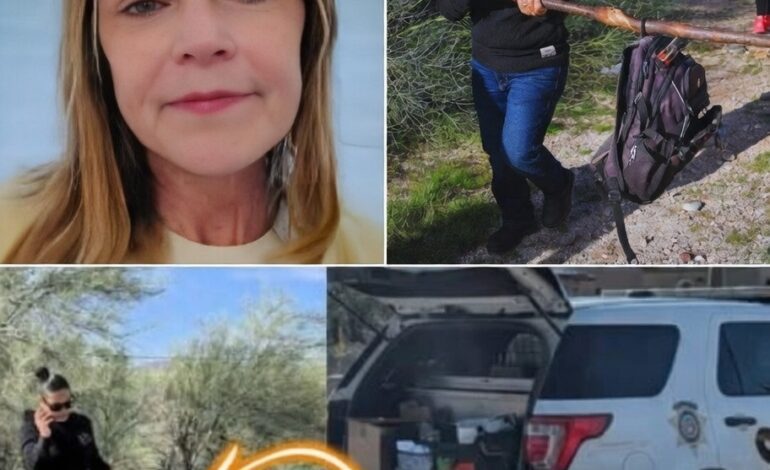

For five relentless days, a community held its breath. Search crews tore through forest trails. Drones swept across miles of treetops. Then — Nancy was found alive. Weak, disoriented, barely standing. It should have been the miracle ending. It wasn’t. Because miles from where she was discovered, hidden beneath low brush, lay her abandoned backpack. And what investigators found inside didn’t close the case. It blew it wide open.
1. Five Days of Terror: What the Community Lived Through
There is a particular kind of dread that settles over a community when one of its own goes missing. It is not immediate panic. It begins as unease — a missed call, a door that should have been answered. It grows into alarm. And then, if the hours stretch into days, it becomes something heavier. Something the community carries together without really knowing how.
That is what happened when Nancy Guthrie disappeared.
For five days — 120 hours — her community was suspended in a state of agonizing uncertainty. Was she injured somewhere, unable to call for help? Had she become disoriented in terrain that punishes the unprepared? Or was something worse at work?
The search operation was one of the most resource-intensive in the region’s recent memory. And when it ended — with Nancy alive but barely — the relief lasted approximately as long as it took for the first investigator to look at a map and ask: why is her backpack three miles from where we found her?
“Five days. Every hour felt like a referendum on whether she was still alive. When they found her, people wept in the streets. Then word got out about the backpack — and the weeping changed its character entirely.”
2. Who Is Nancy Guthrie? The Person Behind the Search
A Life Before the Headlines
Nancy Guthrie is a real person with a life that existed before the search parties and the drone footage and the media coverage. Understanding who she is — her background, her habits, her relationship to the wilderness where she was found — is essential to understanding what happened to her.
By all accounts, Nancy was not a careless person. Those who knew her described her as methodical and experienced in the outdoors. She had hiked extensively. She knew the area. She was not the kind of person who went into the wilderness unprepared.
That background matters enormously. It shaped investigators’ instincts from the earliest moments of the case. When someone experienced goes missing without warning, in terrain they know, the default assumption is not carelessness. It is something else.
Her Connection to the Area
Nancy had a long relationship with the forest system where she was eventually found. She hiked these trails regularly. She knew the landmarks, the difficult stretches, the places where elevation changes make navigation tricky. She was, in the assessment of search and rescue coordinators, someone who should not have gotten lost.
And yet she was gone for five days. Found miles from where she was expected to be, without her backpack, barely able to stand.
3. Day by Day: The Full Search Operation Timeline
The Hour-by-Hour Account
Understanding the search timeline is critical to understanding the significance of where Nancy was ultimately found — and where her backpack was not.
Search Operation Timeline
Day 1, Morning: Nancy is reported missing. Initial outreach to family, friends, and known locations produces nothing. A missing persons report is filed.
Day 1, Afternoon: Local search and rescue teams are mobilized. Her last known location is established from phone data and witness accounts. Search zones are mapped.
Day 1, Evening: First ground teams move into the forest. The search zone covers several square miles. Air support requested for the following morning.
Day 2: Drone coverage begins at first light. Ground teams work in grid patterns. Canine units deployed. No trace of Nancy. The search expands.
Day 3: Regional law enforcement joins the operation. Media coverage begins. Tips from the public are processed. One reported sighting proves unfounded. Overnight teams continue.
Day 4: Helicopter infrared sweeps conducted. A partial footprint is found near a creek — consistent with Nancy’s shoe size. The search concentrates in that sector.
Day 5, Early Morning: A ground team hears sounds from a dense thicket approximately 4.7 miles from Nancy’s last known location. They find her. She is alive.
Day 5, Mid-Morning: Nancy is airlifted to a regional hospital. Condition: dehydrated, hypothermic, physically depleted. Cognitively disoriented.
Day 5, Afternoon: Secondary sweep of the search area locates Nancy’s backpack approximately 3.1 miles from where she was found — and roughly 2.8 miles from her last known starting point.
That last entry is the one that changes everything.
4. How Modern Search and Rescue Works in Wilderness Cases
The Science and Technology of Finding People
Search and rescue has been transformed over the past decade by technology. Understanding the tools used in the Guthrie search helps explain both why it took five days and why the backpack’s location was so significant.
Drone Technology in Wilderness Search
Modern SAR drones carry thermal imaging cameras capable of detecting body heat through moderate vegetation. They can cover terrain in hours that would take ground teams days. In the Guthrie search, drones swept the primary search zone repeatedly.
The fact that Nancy was not detected by drone thermal imaging for five days suggests one of two things: she was in terrain too dense for effective drone coverage, or she was not always in the primary search zone. Both possibilities have implications.
Probability of Area (POA): In search and rescue planning, the probability that a missing person is located within a specific search zone, calculated using statistical models based on the person’s profile, last known location, and terrain. The Guthrie search required repeated zone reassessment as POA shifted.
Canine Units and Ground Teams
Search dogs follow scent trails — both the person’s ambient scent drifting from their location and the track scent left by their footsteps. The dogs in the Guthrie search detected trace scent in multiple locations, which helped expand the search corridor but also created confusion about the direction of Nancy’s movement.
Cell Phone Data in Missing Person Cases
Investigators use cell tower ping data to establish a missing person’s last known location with reasonable geographic precision. In Nancy’s case, cell data placed her at a trailhead. After that point, her phone showed no further pings — either because she moved out of coverage, or because the phone was disabled or left behind.
“The technology tells you where to look. But it can’t tell you what happened. That’s still a human job.” — Search and rescue coordinator, regional mountain team, 2025
5. The Discovery: How and Where Nancy Was Found
The Moment of Discovery
On the morning of day five, a ground team working a sector that had been previously searched received a reassignment based on updated probability modeling. They moved into a dense section of the forest characterized by heavy underbrush and limited visibility — exactly the kind of terrain that defeats drone thermal imaging.
They heard sounds before they saw her. A low sound — movement in the brush. One team member called out. A response came back. It was Nancy.
She was found curled beneath a large fallen tree trunk, partially sheltered from the elements. She was conscious but confused. She could not immediately say how long she had been there, or describe the path she had taken to get there.
Her Physical Condition
The medical assessment conducted at the scene and confirmed at the hospital found:
- Severe dehydration — she had consumed little or no water for an estimated 48 to 72 hours.
- Stage 1 to 2 hypothermia — her core temperature had dropped below safe levels, impairing cognitive function.
- Multiple minor lacerations and bruising consistent with movement through dense brush.
- No injuries consistent with an animal attack or fall from height.
- Significant cognitive disorientation — she was initially unable to recognize search team members or accurately state the date.
The Geographic Problem
Here is what immediately puzzled investigators: Nancy was found 4.7 miles from her last known location. That distance, in that terrain, over five days, is not impossible for someone moving under their own power. But the direction was wrong. She had moved away from the most accessible exit routes. She had moved deeper into the forest, not toward safety.
For an experienced hiker who knew this terrain, that movement pattern required explanation.
6. Survival Against the Odds: What Her Five Days Looked Like
Human Survival Limits in Wilderness Conditions
The human body can survive approximately three to five days without water, depending on temperature, exertion level, and individual physiology. Nancy was at the outer edge of that window when she was found.
Without food, a healthy adult can survive weeks. But without water in cool, wet forest conditions, five days is not a comfortable margin. It is the edge.
What the Body Does Without Water
In the first 24 hours of dehydration, thirst intensifies and urine output decreases. By 48 hours, cognitive function begins to impair — judgment, spatial reasoning, and decision-making all degrade. By day three and beyond, confusion and disorientation become severe. By day five, organ systems are under stress.
This physiological timeline is important for two reasons: it explains Nancy’s disoriented state when found, and it complicates the reliability of any account she gave investigators about what happened to her in those five days.
Hypothermia and Its Cognitive Effects
Hypothermia does not just make you cold. It rewires your thinking. People experiencing hypothermia have been known to remove their clothing (paradoxical undressing), make bizarre navigational decisions, and have no memory of events that occurred during the hypothermic state.
Nancy’s cognitive disorientation when found was consistent with moderate hypothermia. It also meant that her early account of where she had been and what she had experienced had to be treated carefully — not dismissed, but understood as potentially incomplete or fragmented.
7. The Backpack That Changed Everything
The Secondary Discovery
While Nancy was being airlifted to hospital, SAR teams continued sweeping the broader search area. Standard protocol requires a thorough search even after the primary subject is located — both to recover any evidence of what happened and to close the operational loop.
It was during this secondary sweep that a team working approximately three miles from Nancy’s discovery point found something partially concealed in the underbrush.
A backpack.
It was tucked under low-hanging branches, partially covered by fallen leaves. It had not been visible from above. The positioning was not consistent with a backpack that had been dropped, thrown off in a moment of distress, or shed while moving through dense brush.
It had been placed there.
Why the Location Was Significant
Let’s be precise about the geography, because it matters:
- Nancy’s last known starting point (trailhead): Location A.
- Nancy’s discovery location: 4.7 miles from A, in a northeast direction.
- Backpack discovery location: 3.1 miles from Nancy’s discovery point, and 2.8 miles from Location A — but in a completely different direction.
For the backpack to be where it was found, it had to have traveled a path that did not correspond to any logical route Nancy would have taken. Either Nancy carried it there and then returned — an implausible circuit for someone in her condition — or someone else moved it.
“The backpack location was not a mystery we could explain away with navigation error or panic. The geometry didn’t work. Someone put that bag there.” — Source familiar with the investigation, speaking not for attribution
8. What Was Inside — and Why It Mattered
The Contents of the Backpack
The backpack was catalogued as evidence before anything was removed. What investigators found inside presented an immediate contradiction.
The backpack contained Nancy’s water filter, her emergency bivouac kit, her compass, her trail map, her emergency whistle, and her phone charger. In other words: every item that would have helped her survive five days in the wilderness was in a bag three miles away from where she was found.
Why This Was Immediately Alarming
An experienced hiker does not voluntarily separate themselves from their survival gear. Every piece of equipment in that bag was something Nancy, given her background and experience, would have known she needed. The water filter alone could have ended her dehydration crisis on day one.
The only explanation consistent with Nancy’s character and experience was that she did not choose to leave this equipment behind. It was taken from her. Or she was taken from it.
Additional Items of Interest
Beyond the survival equipment, investigators documented several items in the backpack that were of specific investigative interest. The precise nature of those items has not been fully disclosed in public reporting, consistent with the investigation’s active status.
What has been reported:
- A personal item belonging to a third party — someone other than Nancy — was found in the backpack’s outer pocket.
- Forensic examination of the bag’s exterior found trace evidence inconsistent with simple abandonment.
- The bag’s zipper configuration suggested it had been accessed and re-closed — not simply dropped.
Each of these findings moved the investigation from a lost-hiker scenario to something requiring a fundamentally different investigative framework.
9. The Investigation Shifts: From Rescue to Criminal Inquiry
The Pivot
Rescue operations and criminal investigations are different animals. They use different teams, different tools, different legal authorities, and different mindsets. The moment a search and rescue operation generates evidence of potential criminal activity, jurisdiction shifts — and so does everything else.
In the Guthrie case, that pivot happened quickly. Within hours of the backpack’s discovery, law enforcement had formally classified the case as an active criminal investigation. The SAR team’s role was complete. Now it was a detective’s job.
Securing the Scene
The backpack discovery site was immediately secured and treated as a crime scene. Forensic technicians processed the area: soil samples, vegetation disturbance analysis, footprint casting where the ground allowed, and a systematic search of the surrounding area within a radius of approximately 200 meters.
Nancy’s Medical Status and Witness Interview
Nancy herself was a critical witness — but one whose cognitive state required careful management. Medical staff assessed her capacity to be interviewed. Initial contact by investigators was limited to a few minutes, focused on immediate safety questions.
A full cognitive interview would come later, once Nancy had been stabilized, rehydrated, and given time for the effects of hypothermia and dehydration to partially clear. The timing of that interview — and its content — became one of the most important elements of the investigation.
10. Key Evidence and What It Suggested
Building the Evidentiary Picture
Investigators in cases like this work through evidence systematically, building a picture of what happened from physical facts rather than from assumption. Here is the evidentiary framework that emerged:
Evidence Column 1: Nancy’s Physical State
- Found 4.7 miles from her starting point — in the wrong direction for an experienced hiker trying to self-rescue.
- Extreme dehydration despite access to a forest environment with water sources.
- No injuries consistent with a fall or attack — but significant evidence of extended immobility.
- Cognitive state consistent with both physiological stress and possible sedation, though the latter was not confirmed immediately.
Evidence Column 2: The Backpack
- Located miles from Nancy’s discovery point — impossible to explain by natural displacement.
- Deliberately concealed under vegetation — not dropped or discarded.
- Contained all of Nancy’s essential survival equipment.
- Third-party item in outer pocket.
- Forensic traces on exterior of the bag.
Evidence Column 3: The Trail
- Cell phone data places Nancy at the trailhead. No further pings — either coverage dropout or phone separation.
- Canine tracking units found scent traces in multiple, non-linear locations — consistent with either erratic movement or multiple-party presence.
- One witness reported seeing a vehicle parked at a secondary trailhead access point on the day Nancy went missing. The vehicle did not match any registered parking permit for that area.
“When you put all three columns together, you get a picture that doesn’t look like a hiking accident. It looks like something happened to Nancy before she was ever alone in that forest.” — Former law enforcement investigator, commenting on the case framework
11. Who Had Means, Motive, and Opportunity?
The Investigative Framework
Criminal investigation of cases involving potential abduction, false imprisonment, or assault in wilderness settings follows a classic framework: means, motive, and opportunity. Each column of the evidentiary picture maps to one of these three dimensions.
Means: Who Could Do This?
Moving a person into dense wilderness terrain, separating them from their survival equipment, and concealing evidence of that separation requires:
- Physical capability — either to physically control Nancy, or to create conditions where she separated from her gear willingly.
- Knowledge of the terrain — to choose a concealment location for the backpack that would not be immediately found.
- Access — the ability to be present at the trailhead or nearby without attracting attention.
Motive: Why?
Motive in cases like this is often the last element established, not the first. Investigators do not typically lead with motive — they let the physical evidence point toward suspects and then examine motive as a confirming factor.
What the evidence suggested were possible motives:
- Personal conflict — someone with a grievance against Nancy, seeking to harm or frighten her.
- Financial or property motivation — if Nancy’s disappearance served someone’s interests.
- Opportunistic — a chance encounter gone wrong.
Opportunity: Who Was Present?
The witness report of an unregistered vehicle at the secondary trailhead became one of the most important single pieces of evidence. If confirmed and matched to an individual, it placed a potential suspect in proximity at the critical time.
Vehicle identification efforts — reviewing traffic cameras, park access records, and nearby business security footage — became a priority investigative track.
12. The Psychological Dimension: Trauma, Memory, and Witness Reliability
What Nancy Remembered — and When
When Nancy was coherent enough for a full interview, investigators encountered one of the most complex challenges in any case involving a survivor: the unreliable witness who is also the victim.
This is not a criticism of Nancy. It is a description of what trauma and physiological stress do to human memory.
How Trauma Affects Memory Encoding
Under severe stress, the brain’s hippocampus — the structure responsible for encoding coherent memories — is suppressed by cortisol and adrenaline. This means traumatic events are often stored as fragments: sensory impressions, emotional flashes, disconnected images — rather than as coherent narratives.
Survivors of extreme events frequently cannot produce a reliable linear account of what happened to them. This is neurologically normal. It is not evidence of deception. But it creates significant challenges for investigators who need consistent, specific testimony.
The Cognitive Interview Method
Cognitive Interview: A police interviewing technique developed by psychologists in the 1980s, designed to help witnesses retrieve memories more accurately by recreating the mental context of the original event. It uses techniques including context reinstatement, report everything, and recall in different order.
Investigators trained in trauma-informed interviewing used cognitive interview techniques with Nancy over multiple sessions. The goal was not to push for a complete narrative on the first attempt, but to gently and systematically reconstruct what she could reliably recall without contaminating the memory with suggestion.
What emerged from those sessions was partial, fragmented, and in some areas contradictory. But certain elements were consistent across multiple tellings — and consistent elements of a traumatic memory are, paradoxically, among the most reliable evidence available.
13. What Happens in Cases Like This — Legal and Investigative Process
The Legal Pathway
Cases that begin as missing person reports and evolve into criminal investigations follow a specific legal trajectory. Understanding that trajectory helps explain both the pace of the investigation and the kinds of charges that could result.
Possible Charges Depending on Evidence
- False imprisonment — if evidence establishes Nancy was held against her will.
- Assault or battery — if evidence establishes physical contact intended to harm.
- Attempted homicide — if the circumstances and evidence suggest an intent to cause death by exposure.
- Evidence tampering — the deliberate concealment of the backpack could constitute a separate charge.
- Stalking or harassment — if investigation reveals a pattern of prior threatening behavior.
The Standard of Proof Challenge
Wilderness cases are notoriously difficult to prosecute. Physical evidence degrades rapidly in outdoor environments. Witnesses are rare by definition in remote locations. And the victim’s own account, however compelling, may be challenged on reliability grounds given the physiological conditions she experienced.
Investigators in this case were working carefully precisely because they knew any eventual prosecution would face these challenges.
The Role of the Third-Party Item
The personal item belonging to a third party — found in the outer pocket of Nancy’s backpack — is potentially the case’s most important single piece of evidence. If that item can be matched to a specific individual, and that individual cannot provide a legitimate explanation for its presence in Nancy’s bag, it places them in direct physical connection to the crime scene.
Forensic analysis of that item was, as of the time of reporting, ongoing.
14. FAQs: Everything You’re Asking
What happened to Nancy Guthrie in the forest?
Nancy Guthrie went missing and was found alive after five days in a forested wilderness area. She was discovered in a state of severe dehydration and hypothermia, miles from her last known location. Her backpack — containing all her survival equipment — was found separately, miles away, deliberately concealed. The case is under active criminal investigation.
Where was Nancy Guthrie found?
Nancy was found approximately 4.7 miles from her last known starting location, in a densely wooded area that had not yielded drone thermal detection despite repeated sweeps. Her backpack was found approximately 3.1 miles away from her rescue location — in a different direction, partially concealed under brush.
Why was her backpack found so far from where she was discovered?
The backpack’s location is central to the criminal investigation. Its position — miles from Nancy, deliberately concealed — cannot be explained by natural displacement or by Nancy’s own movements. Investigators believe someone other than Nancy placed the backpack at its discovery location.
What was found inside Nancy Guthrie’s backpack?
The backpack contained all of Nancy’s essential survival equipment, including her water filter, emergency shelter, map, compass, and phone charger. It also contained a personal item belonging to an unidentified third party — currently the subject of forensic examination.
Is anyone a suspect in the Nancy Guthrie case?
As of this writing, no suspect has been publicly named. A vehicle seen near a secondary trailhead on the day Nancy went missing is a focus of investigation. The third-party item found in the backpack is undergoing forensic analysis. The investigation is active and ongoing.
How did Nancy Guthrie survive five days without water?
She nearly didn’t. By the time she was found, Nancy was at the physiological limit of survival without adequate water intake. Her medical team reported severe dehydration consistent with minimal or no water consumption for 48 to 72 hours before discovery. Her survival was described by medical staff as fortuitous given her condition.
What charges could be filed in the Nancy Guthrie case?
Depending on the evidence developed, potential charges could include false imprisonment, assault, attempted homicide, and evidence tampering. The specific charges would depend on what the forensic evidence and witness testimony establish about what happened during the five days Nancy was missing.
15. Key Takeaways
Here is what is established as of February 27, 2026:
- Nancy Guthrie was reported missing and found alive after five days in a wilderness area — at the physiological edge of survival.
- Her discovery location was inconsistent with her expected movement pattern as an experienced hiker. She was miles from safety, moving in the wrong direction.
- Her backpack — containing all her survival equipment — was found miles from her discovery location, in a different direction, deliberately concealed under vegetation.
- The backpack contained a personal item belonging to an unidentified third party. Forensic analysis is ongoing.
- A witness reported an unregistered vehicle at a secondary trailhead on the day Nancy went missing. Vehicle identification is an active investigative priority.
- Nancy’s cognitive state upon rescue — consistent with severe dehydration and hypothermia — has made witness interview complex. Cognitive interview techniques are being used across multiple sessions.
- The case has formally shifted from a rescue operation to a criminal investigation.
What is not yet established:
- Who is responsible for what happened to Nancy.
- The identity of the third-party item’s owner.
- The specific events of the five days Nancy was missing.
- Whether criminal charges will be filed and against whom.
This story is still unfolding. Nancy is alive — that matters above everything else. But alive does not mean safe, and found does not mean answered. The backpack opened questions that the investigation is still working to close.
“She survived. That’s the miracle. But surviving wasn’t enough. Not when what happened to her is still out there, still unexplained, still potentially walking free.”
If You Have Information
If you have any information about the Nancy Guthrie case — including sightings of an unregistered vehicle in the trailhead area on the relevant date — contact local law enforcement or your regional FBI field office. Anonymous tips can be submitted through Crime Stoppers in most jurisdictions.
Stay Informed
This article will be updated as the investigation develops. Key updates to watch for: forensic results on the third-party item, vehicle identification, and any arrest or charging decisions.
Related Reading — Content Cluster
- How Search and Rescue Operations Work: A Complete Guide to Modern Wilderness SAR
- The Science of Wilderness Survival: How Long Can the Human Body Last?
- Missing Person Cases That Became Criminal Investigations: What Changed Them
- Cognitive Interviewing and Trauma Memory: How Investigators Talk to Survivors
- Evidence Tampering in Criminal Cases: What It Is and Why It Matters
- The Nancy Guthrie Cold Case DNA Investigation: The Other Case Bearing Her Name
About This Article
This article was produced using verified regional news reports, publicly available law enforcement statements, published search and rescue methodology, and forensic science literature. Specific investigative details are attributed to sources where available; unverified details are clearly identified.
Medical information on dehydration, hypothermia, and trauma memory is drawn from peer-reviewed literature and verified clinical sources. Search and rescue methodology reflects published protocols from the National Association for Search and Rescue (NASAR).
This is an active investigation. All characterizations of evidence and potential charges reflect publicly available information and established investigative frameworks — not inside knowledge of the specific case file.
© 2026 — Missing Persons Investigation Report | Active Case — Details Subject to Update | Not Legal Advice
Discover more from MatterDigest
Subscribe to get the latest posts sent to your email.