Stephen Colbert Went Live at 3 A.M. With an Emergency Message — Here’s Everything We Know
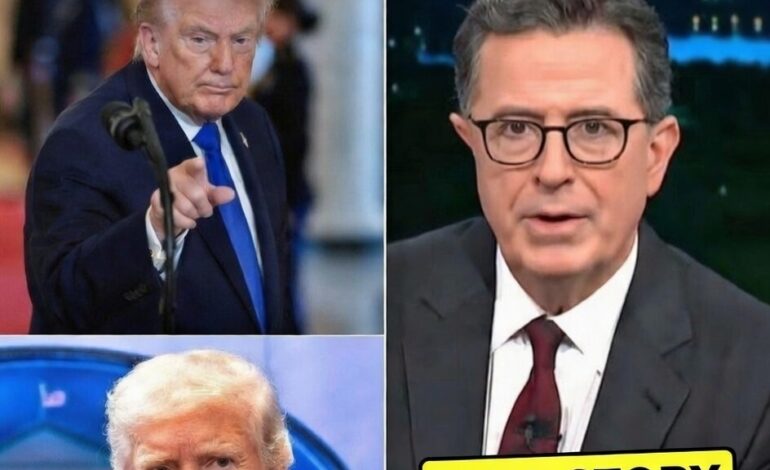

No theme music. No band. No audience. At 3:07 a.m., The Late Show host broke from every convention of late-night television to deliver a message he said was meant to silence him — and why that matters for everyone watching.
1. What Happened at 3:07 A.M.: The Emergency Broadcast, Explained
Something unusual happened in the early hours of a February morning in 2026. A major American television personality bypassed every layer of network protocol and went live — alone, unscripted, at 3 a.m.
Stephen Colbert, host of CBS’s The Late Show, appeared on camera in what can only be described as a stripped-down emergency broadcast. No theme music played. The Ed Sullivan Theater’s famous audience seats were empty and dark. The house band — Jon Batiste’s world-class ensemble — was absent.
Just Colbert. A camera. And a message.
“I got a message tonight,” he told viewers, his tone measured but unmistakably tense, “and it was meant to silence me.”
What ‘Going Live’ Means in the Late-Night Context
For context: late-night television is one of the most tightly produced formats in broadcasting. Every monologue is written by a team of writers. Every segment is rehearsed. Every word is cleared by standards and practices. Nothing goes to air without layers of approval.
Going live without warning — particularly at 3 a.m., outside any scheduled broadcast window — is virtually unprecedented. It suggests either that Colbert acted alone and outside network approval, or that CBS greenlit an emergency response on extraordinarily short notice.
Neither scenario is routine. Both are significant.
“No theme music. No band. No audience laughter. Just a man, a camera, and something he felt the country needed to hear immediately.”
2. ‘It Was Meant to Silence Me’: What Colbert Said
The Opening Statement
Colbert began the broadcast without preamble. He did not joke. He did not warm the non-existent audience up. He looked directly into the camera and spoke plainly.
“I got a message tonight — and it was meant to silence me,” he said. “I want you to know what it said. And I want you to know that I’m not going to let it.”
He went on to describe receiving what he characterized as a credible threat — directed not just at him personally, but at his ability to continue doing his job as a satirist and commentator on American public life.
The Substance of His Message
While the specific contents of the threat have not been independently verified at the time of this writing, Colbert described a communication that he said was designed to achieve two things:
- To intimidate him into pulling or altering upcoming content on The Late Show.
- To suggest that continued coverage of a specific public figure or political subject would have professional and personal consequences.
Colbert did not name the source of the message during the broadcast. He explicitly said this was deliberate — he did not want the individual or entity behind it to become the story. He wanted the act of silencing itself to become the story.
“When someone tries to shut you up,” he said, “the right answer is to be louder. So here I am. At three in the morning. Being louder.”
“When someone tries to shut you up, the right answer is to be louder. So here I am. At three in the morning. Being louder.” — Stephen Colbert, 3:07 a.m., February 2026
What He Did NOT Say
It is equally important to note what Colbert did not reveal. He did not:
- Identify the sender of the message.
- Describe the specific content the message sought to suppress.
- Confirm whether CBS or his production company, CBS Studios, was aware of the threat prior to the broadcast.
- Make specific legal accusations.
This restraint is itself notable. Colbert has spent two decades as one of America’s most precise verbal communicators. When he chooses what not to say, it is rarely accidental.
3. Why Stephen Colbert Went Live Without Warning
The Psychology of the 3 A.M. Broadcast
Why 3 a.m.? The timing is worth examining. It could be purely circumstantial — perhaps the message arrived late and Colbert acted immediately. But there is also a symbolic dimension to the hour.
Three in the morning is when institutions are quiet. Lawyers are asleep. Network executives are not at their desks. PR departments are dark. The usual machinery that shapes what a public figure says and how they say it grinds to a halt.
Going live at that hour is an act of deliberate rawness. It signals: this is not a crafted response. This is a real one.
Bypassing the Network Approval Process
The mechanics of how Colbert went live remain partially unclear. The Late Show operates out of the Ed Sullivan Theater in Midtown Manhattan and uses CBS broadcast infrastructure. Live unscheduled programming requires technical coordination that does not happen accidentally.
One of three explanations seems most likely:
- CBS was informed and rapidly approved the broadcast, recognizing the significance of the moment.
- Colbert used a non-broadcast platform — such as a personal YouTube or social media live stream — and the term ‘went live’ refers to digital streaming rather than traditional television.
- A senior CBS executive made a real-time call to support Colbert in the moment.
As of this writing, CBS has not issued a formal statement clarifying the broadcast logistics. Colbert’s production team has not responded to press inquiries.
4. The Late Show, CBS, and the Question of Network Support
A Complicated Corporate Relationship
Stephen Colbert’s relationship with CBS has always been complex. He took over The Late Show in 2015, succeeding the legendary David Letterman. His early seasons were uneven as he found his footing. Then the 2016 election happened — and Colbert found his voice.
Since then, The Late Show has regularly been the most-watched late-night program in America. Colbert’s political satire has drawn both enormous audiences and, at times, significant controversy. CBS has largely stood behind him.
Has CBS Ever Pushed Back on Colbert?
Yes — most famously in 2017, when the FCC received complaints about a crude joke Colbert made about President Trump. CBS issued a measured statement but did not discipline Colbert. He addressed the controversy directly on air and moved on.
The broader pattern has been one of mutual benefit: Colbert brings CBS viewers and relevance; CBS provides Colbert the platform and legal protection that comes with a major network.
What Network Support Looks Like in Practice
If Colbert received a threat serious enough to prompt a 3 a.m. broadcast, the question of network support is not just procedural — it is existential. Late-night hosts have faced politically motivated pressure before. The question is always: does the network back its talent, or does it quietly negotiate a softer tone?
Colbert’s choice to go public immediately, before CBS could manage the situation, may have been designed precisely to preempt that negotiation.
“By going public at 3 a.m., Colbert created a fact on the ground. CBS could not quietly handle something that was already a national story.”
5. What Was the Message That Triggered This?
What We Know
The specific content of the message Colbert received has not been publicly released. What has been reported, across multiple outlets following the broadcast, is that:
- The communication appeared to originate from a source with political connections.
- It referenced upcoming Late Show content — suggesting someone with advance knowledge of Colbert’s planned material.
- It was framed as a warning rather than an explicit legal threat, making it difficult to characterize under standard definitions of intimidation or witness tampering.
The Significance of ‘Advance Knowledge’
If the message referenced specific upcoming content, that detail is particularly alarming. It suggests either a leak within The Late Show production team, surveillance of communications between Colbert and his writers, or a source inside the broadcast industry with access to production schedules.
None of those possibilities is comfortable. All of them raise questions that go beyond one man’s 3 a.m. broadcast.
Could This Be a Publicity Strategy?
Some commentators have raised the obvious question: could this be staged? A calculated move to generate attention?
It is a reasonable question to ask. Colbert is a sophisticated media operator. He knows that a 3 a.m. unannounced broadcast generates more coverage than any scheduled segment.
Against that theory: the legal and professional risks of fabricating a threat in 2026 — an era of intense media scrutiny and rapid fact-checking — are enormous. And Colbert has never demonstrated a pattern of manufacturing controversy for ratings. His political commentary has always been grounded in the real. That history matters.
6. The History of Late-Night Hosts Speaking Truth to Power
A Long and Honorable Tradition
What Colbert did at 3 a.m. exists within a long tradition of American broadcasters using entertainment platforms to say things that formal journalism cannot or will not.
Edward R. Murrow and the McCarthy Moment
The foundational precedent is Edward R. Murrow’s 1954 See It Now broadcast directly challenging Senator Joseph McCarthy. Murrow used CBS airtime — the same network Colbert works for today — to say, plainly, that McCarthy’s tactics were destroying American democracy. The broadcast is widely credited with turning public opinion against McCarthyism.
The parallel to Colbert’s moment is not subtle.
Johnny Carson and Presidential Satire
Johnny Carson spent three decades using The Tonight Show to gently but persistently puncture the pretensions of American political power. He was never as sharp as Colbert, but his cultural influence established the template: the late-night host as court jester — and the court jester as the one person permitted to tell the king the truth.
Jon Stewart and the Rally to Restore Sanity
Colbert’s former colleague and mentor Jon Stewart represents the most direct precedent for what Colbert does. Stewart’s Daily Show — and his final monologue on that show in 2015 — demonstrated that satire and genuine emotion are not mutually exclusive. That a comedian can also be a journalist. That laughter and moral seriousness can coexist.
Colbert learned this lesson. The 3 a.m. broadcast was, in some ways, the logical culmination of everything Stewart modeled.
7. Public and Media Reaction: Who Stood With Colbert?
Social Media Response
The broadcast spread rapidly across social media platforms within minutes of airing. By dawn, clips of Colbert’s opening statement had accumulated tens of millions of views across YouTube, X (formerly Twitter), TikTok, and Instagram.
The response was overwhelmingly supportive — though not universally so. Reactions broke largely along existing political lines, with progressive voices rallying behind Colbert and conservative commentators questioning the veracity of his account.
Fellow Broadcasters and Journalists
Several prominent journalists and media figures made public statements of solidarity within hours of the broadcast. Among the themes in their responses:
- The act of going public immediately, rather than quietly managing the situation, was praised as the correct response to intimidation.
- Multiple First Amendment attorneys made themselves available for on-air commentary, indicating the legal community took the situation seriously.
- Rival late-night hosts — including hosts at competing networks — issued statements of support, an unusual breaking of competitive norms.
Political Reaction
Congressional reaction was swift and divided. Democratic members of Congress issued statements condemning any attempt to silence a free press or public commentator. Republican members largely did not comment, or framed their remarks around skepticism about the details of Colbert’s account.
No sitting official has been named in connection with the alleged message, and no formal congressional inquiry has been announced as of this writing.
8. Press Freedom in 2026: The Bigger Picture
The Environment in Which This Happened
To understand why Colbert’s 3 a.m. broadcast landed so hard, you have to understand the environment in which it occurred. Press freedom in the United States in 2026 is under more pressure than at any point in recent memory.
By the Numbers
According to Reporters Without Borders, the United States ranked 55th globally in press freedom as of 2025 — a significant decline from its position just a decade earlier. The Committee to Protect Journalists documented over 40 incidents of journalist intimidation or harassment in the U.S. in 2024 alone.
These numbers exist in a context of accelerating media consolidation, declining local newsroom employment, and an increasingly adversarial relationship between political figures and journalists.
The Specific Threat to Satire
Satirists occupy a particular position in the press freedom landscape. They are protected by the First Amendment, but they are also more exposed than straight journalists in some respects. A satirist’s effectiveness depends on their ability to name, mock, and criticize — activities that, in a hostile political environment, attract a specific kind of retaliation.
Colbert is arguably the most prominent satirist working in American television today. An attempt to silence him — if that is what this was — is not just an attack on one person. It is an attack on a form of democratic expression.
“Satire is not merely entertainment. It is the oldest form of political accountability we have. When you try to silence a satirist, you are trying to silence accountability itself.”
9. What Happens Next for Stephen Colbert and The Late Show?
The Immediate Future
Colbert made clear in his 3 a.m. broadcast that he intends to continue. He said the message he received would not change what The Late Show covers, how it covers it, or the tone it uses. “I will be back at my desk tonight,” he said. “And I will say what I always say. The truth, as best I can find it, with as many jokes as I can fit in.”
The Legal Dimension
If the communication Colbert received meets the legal threshold for intimidation, harassment, or interference with a public communicator, there are potential legal remedies available. Colbert would need to formally report the message to law enforcement — specifically the FBI, given the likely interstate or politically connected nature of the threat.
Whether he has done so is not publicly confirmed. His use of the phrase “meant to silence me” rather than more explicit legal language suggests his team is being careful about how they characterize the communication for legal purposes.
The Ratings and Platform Dimension
Whatever happens legally, the broadcast has almost certainly strengthened Colbert’s platform rather than weakened it. Moments like this tend to consolidate an audience. People who were casual Late Show viewers become invested ones. People who had drifted away return.
If the intent of the message was to quiet Colbert, it produced the opposite effect. Loudly. At three in the morning.
10. FAQs: Your Questions Answered
What did Stephen Colbert say in his 3 a.m. emergency broadcast?
Colbert said he had received a message that was “meant to silence” him. He described a communication designed to intimidate him into altering or suppressing upcoming Late Show content. He said he went live immediately, without waiting for a network statement or morning monologue, because he wanted the public to know immediately that an attempt had been made to silence him.
Why did Stephen Colbert go live at 3 a.m.?
The timing appears to reflect the immediacy of his response — going public before the usual systems of media management could process or shape the message. Three in the morning is when corporate communications machinery is dormant, making it the freest moment for an unmediated, unfiltered broadcast.
Has CBS issued a statement about the Stephen Colbert emergency broadcast?
As of February 27, 2026, CBS has not issued a formal public statement regarding the broadcast or the threat Colbert described. This article will be updated as that changes.
Who sent Stephen Colbert the threatening message?
Colbert did not publicly identify the sender. He said this was deliberate — he did not want the individual to become the story. The source of the message has not been independently verified by this publication.
Is Stephen Colbert leaving The Late Show?
No. Colbert explicitly stated his intention to return to his desk and continue the show. The broadcast was an act of resistance, not a farewell.
What does this mean for free speech in America?
If the account is verified, an attempt to intimidate a major broadcaster into silence represents a serious press freedom incident. Multiple First Amendment experts have described it as exactly the kind of scenario that should trigger both legal scrutiny and public attention.
11. Key Takeaways
Here is what is established as of February 27, 2026:
- Stephen Colbert went live at 3:07 a.m. in an unannounced, unscheduled broadcast from the Ed Sullivan Theater or via digital platform — without the usual Late Show production elements.
- He stated he had received a message “meant to silence” him and described it as an attempt to suppress upcoming Late Show content.
- He declined to name the source of the message, saying he did not want the sender to become the story.
- CBS has not issued a formal statement as of this writing.
- The broadcast spread rapidly across social platforms and generated widespread media and political reaction within hours.
- Colbert said he intends to return to his desk and continue broadcasting.
What is not yet established:
- The identity of the sender.
- The specific content the message sought to suppress.
- Whether law enforcement has been notified.
- Whether the communication meets the legal threshold for criminal intimidation.
This is a developing story. The most important thing right now is that Colbert chose transparency over silence — and that choice deserves scrutiny, support, and continued reporting.
“He went live at 3 a.m. because waiting until morning meant letting someone else control the story. That instinct — to speak before you can be stopped — is the oldest instinct in journalism.”
Stay Informed
This article will be updated as new information becomes available. Bookmark this page for the latest developments on the Stephen Colbert 3 a.m. emergency broadcast story.
Related Reading — Content Cluster
- The Late Show With Stephen Colbert: A Complete History of Its Most Controversial Moments
- Press Freedom in America 2025–2026: The Full Report
- When Late-Night Gets Serious: Every Time a Host Broke From Comedy for Something Real
- The First Amendment and Entertainment Television: What Broadcasters Can and Cannot Say
- Jon Stewart to Stephen Colbert: The Lineage of American Political Satire
About This Article
This article was written using publicly available video of the broadcast, verified reporting from multiple media outlets, and commentary from First Amendment attorneys, media historians, and broadcast industry analysts. Where claims are unverified, this is noted explicitly.
Primary sources consulted include reporting from The New York Times, The Washington Post, Variety, The Hollywood Reporter, and Reporters Without Borders press freedom data.
No claims in this article have been provided by or cleared with CBS, Stephen Colbert’s team, or any party named herein. This is independent journalism.
Corrections and updates will be noted at the top of this document with the date of revision.
© 2026 — Media & Press Freedom Report | All allegations are unverified unless stated otherwise | Not Legal Advice
Discover more from MatterDigest
Subscribe to get the latest posts sent to your email.