
Necklace Found 500 Meters Away: How One Piece of Jewelry Linked a Kidnapper’s DNA to Nancy Guthrie’s Case
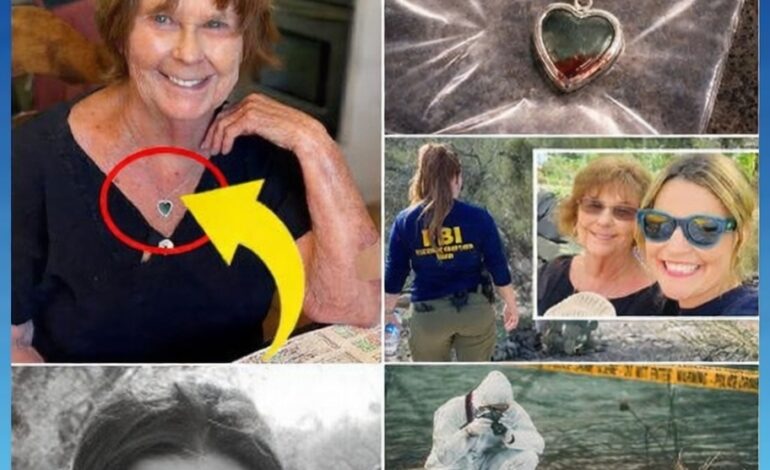

The Discovery: A Necklace That Broke Open a Case
It was just a necklace. Small. Fragile. Easy to overlook in a patch of grass or roadside brush nearly 500 meters from the family home. Easy to miss entirely.
But investigators found it. And when the lab results came back, that delicate piece of jewelry became the most important object in the entire case.
The blue necklace — belonging to Savannah Guthrie’s mother, Nancy — didn’t just confirm a fear. It created a forensic chain. The DNA recovered from it matched genetic material linked to fingerprints found on a glove believed to have been worn by the kidnapper outside Nancy’s home.
One discarded piece of jewelry. One glove. Two separate locations. One matching DNA profile. That is the thread investigators believe could unravel a chilling truth hiding in plain sight.
In this article, we break down exactly what this forensic link means, how DNA cross-matching works across separate pieces of evidence, what the 500-meter distance tells investigators about what happened, and why a single overlooked object can become the pivot point of an entire criminal case.
|
Why Physical Evidence Found Away From a Scene Matters
In any kidnapping or violent crime investigation, the crime scene itself is only one piece of the forensic puzzle. What happens between the scene and where a perpetrator goes next is equally important — and often far more revealing.
When physical evidence from a victim is found away from the primary scene, it tells investigators several things simultaneously. It indicates a direction of travel. It suggests the perpetrator was either careless, panicked, or had a specific reason to discard or lose that item.
What Discarded or Displaced Evidence Reveals
- Direction of travel: Where the item was found relative to the home narrows the escape route
- Timeline clues: Evidence degrades differently depending on exposure — soil, moisture, and temperature all leave forensic signatures
- State of mind: Scattered or discarded evidence often suggests disorganization, panic, or haste
- Secondary crime scene: The location of displaced evidence may itself be treated as a secondary scene requiring full forensic processing
- Search area refinement: Finding evidence at a specific distance shapes where investigators focus additional searches
A necklace found 500 meters away is not random. At that specific distance, it suggests the item was either deliberately discarded or lost during movement — both scenarios carrying different but equally significant investigative implications.
How DNA Connects Two Separate Pieces of Evidence
This is the forensic concept at the heart of the case. The necklace and the glove are physically separate objects found in different locations. Individually, each is significant. Together, they are potentially case-breaking.
The connection is DNA — specifically, the fact that the same genetic profile appears on both items. This is called a cross-match, and it is one of the most powerful forms of forensic evidence available to investigators.
|
How a DNA Cross-Match Is Established
When forensic labs receive multiple pieces of evidence from a case, they analyze each item independently. If two items yield matching DNA profiles, the statistical probability of that match occurring by chance is calculated. In most cases, that probability is vanishingly small — often one in several billion.
This doesn’t just confirm one person touched both objects. It confirms the same individual had direct biological contact with both — creating a forensic thread that connects the victim, the kidnapper’s equipment, and a location nearly half a kilometer away.
The Significance of This Specific Match
The fact that the necklace DNA matched material linked to the kidnapper’s glove is particularly significant for several reasons. The glove represents deliberate preparation — someone who brought gloves to the scene was planning ahead. The necklace represents the victim. Finding the same genetic profile on both ties that prepared, deliberate individual directly to Nancy Guthrie.
This is the difference between circumstantial and direct forensic evidence. It places a specific individual in direct contact with both the victim and the crime scene preparation.
Understanding DNA Cross-Matching: Necklace to Glove
For many people, the idea that DNA from a necklace can match DNA from a glove feels almost too precise to be real. But modern forensic science has made this kind of analysis not only possible but routine. Here is exactly how it works.
Step 1: Evidence Is Collected and Isolated
- The necklace is collected and packaged separately to prevent contamination. Every item of evidence has its own chain of custody from the moment it is found.
- The glove is processed similarly, with swabs taken from both interior and exterior surfaces. Interior swabs often yield the wearer’s DNA from skin cells and sweat.
- Both items are transported to the forensic laboratory in sealed, labeled containers.
Step 2: DNA Extraction and Profiling
In the lab, DNA is extracted from biological material found on each item. For the necklace, this might include skin cells, touch DNA, or biological transfer from direct contact. For the glove, the interior surface typically yields the wearer’s complete DNA profile through sweat and skin cells.
Each sample is run through STR (Short Tandem Repeat) profiling — the gold standard of forensic DNA analysis. This generates a numerical profile at multiple genetic locations that is unique to each individual.
Step 3: Comparison and Statistical Analysis
The two profiles are compared. If they match at all tested locations, forensic scientists calculate the Random Match Probability — the likelihood of two unrelated individuals sharing that profile. For a full 20-locus STR profile, this probability is typically less than one in a quadrillion.
The result is not just ‘a match.’ It is a statistically near-certain identification of the same individual as the source of both samples.
Step 4: The Fingerprint Connection
In this case, the DNA match is further corroborated by fingerprint evidence on the glove. Fingerprints are a separate biometric identifier — but when both fingerprints and DNA from the same glove point to the same individual, the forensic case becomes extraordinarily strong.
What the 500-Meter Distance Tells Investigators
Distance matters enormously in forensic investigation. Not just as a number, but as a story. Five hundred meters — roughly a third of a mile — is enough distance to suggest deliberate movement after the initial event.
Possible Interpretations of the Distance
| Scenario | Investigative Implication |
| Deliberate Discard | Suggests awareness and movement — the perpetrator moved away from the scene before discarding the necklace, possibly to put distance between themselves and the initial location. |
| Accidental Loss | The necklace may have fallen during movement. This indicates the direction of travel and may correspond to a vehicle drop-off or a route used to flee the scene. |
| Secondary Handoff Point | In cases involving multiple perpetrators, 500 meters could be where individuals separated or transferred the victim — both chilling possibilities that expand the investigation’s scope. |
| Vehicle Transition Point | The 500-meter mark may correspond to where a vehicle was parked. Investigators will have mapped this location against nearby roads, parking areas, and CCTV coverage. |
How Investigators Use This Location
The location where the necklace was found becomes a secondary crime scene. Forensic teams will process the surrounding area for additional trace evidence: tire tracks, shoe impressions, cigarette butts, additional touch DNA from nearby surfaces, and any other biological or physical material.
Combined with the DNA match, the location creates a geographic anchor — a point in space that ties the perpetrator’s movements to a specific route, a specific direction, and potentially a specific destination.
The Role of Physical Evidence in Kidnapping Investigations
Kidnapping cases are uniquely challenging from an investigative standpoint. Unlike homicides, where the scene is typically static, kidnapping involves movement — and movement leaves trails.
Physical evidence plays a different role in kidnapping cases than in other crimes. It must tell the story of what happened and where the victim went, not just who was responsible.
Types of Physical Evidence in Kidnapping Cases
- Victim’s personal items — jewelry, clothing, accessories — that may be shed, discarded, or left behind
- Biological evidence — DNA from skin contact, hair, saliva, blood — on surfaces the perpetrator touched
- Footwear and tire impressions that can be matched to specific shoes or vehicle tires
- Trace evidence — fibers, paint transfer, soil particles — that can link locations or individuals
- Digital evidence — phone data, vehicle GPS, surveillance footage — that complements physical findings
Why Personal Items Like Jewelry Are Forensically Valuable
Jewelry is worn directly against the skin. It accumulates biological material — skin cells, oils, sweat, DNA — from its owner over time. When another person handles that jewelry, they leave their own biological trace on top of the existing material.
This makes jewelry found away from a crime scene especially rich in forensic potential. The necklace in this case isn’t just evidence of where the perpetrator traveled. It is a biological record of direct physical contact — between the kidnapper and an object that belonged intimately to Nancy Guthrie.
| Important Distinction The presence of a perpetrator’s DNA on a victim’s jewelry does not automatically prove guilt in a court of law. It proves contact. Prosecutors must still establish that contact occurred in the context of the alleged crime, ruling out innocent explanations. However, combined with the glove match and the distance from the home, the overall forensic picture becomes highly significant. |
How Forensic Labs Link Evidence From Different Locations
The question many people ask is: how can a lab definitively connect two pieces of evidence found in two different places? The answer lies in the precision of modern DNA profiling and the strict standards applied to forensic analysis.
The Chain of Custody: Why It Matters
Every piece of evidence in a criminal investigation has a documented history — who found it, who collected it, who transported it, who analyzed it, and who stored it. This is the chain of custody. Any break in this chain can compromise the admissibility of evidence in court.
In the Guthrie case, the chain of custody for both the necklace and the glove will be scrutinized intensely. Every handoff, every storage period, every analysis step must be accounted for to ensure the DNA evidence cannot be challenged on procedural grounds.
Independent Verification
In high-profile cases, DNA evidence is typically independently verified by a second laboratory. This redundancy ensures that laboratory errors, contamination, or analyst bias cannot produce a false match. Two independent labs reaching the same conclusion dramatically strengthens the evidentiary value of a DNA cross-match.
Probabilistic Genotyping
When DNA samples are complex — mixed profiles from multiple contributors, or degraded material — labs use probabilistic genotyping software. These tools calculate the statistical likelihood of various contributor combinations, producing a more nuanced and defensible interpretation than traditional binary match/no-match analysis.
The Broader Investigation: What We Know So Far
The necklace discovery and DNA cross-match represent a major development, but they sit within a larger investigative framework. Understanding the full picture requires looking at what evidence existed before and how this new finding changes the overall case.
Evidence Timeline
| Stage | Development |
| Initial Scene | Forensic teams processed the Guthrie home, recovering a glove believed to have been worn by the kidnapper. Fingerprints were lifted and DNA samples collected from the glove’s interior and exterior. |
| Extended Search | Investigators expanded the search radius from the home. At approximately 500 meters, a blue necklace identified as belonging to Nancy Guthrie was located and collected as evidence. |
| Lab Analysis | DNA extracted from the necklace was analyzed and compared against material from the glove. The cross-match confirmed the same genetic profile on both items. |
| Current Status | Investigators are working to identify the DNA profile, whether through direct database comparison or investigative genetic genealogy techniques. The case has entered a critical new phase. |
What This DNA Match Means for a Prosecution
Forensic evidence that is this compelling changes the shape of any future prosecution fundamentally. Before a DNA cross-match of this kind, a case may depend heavily on circumstantial evidence, witness testimony, and investigative inference. After it, the evidentiary landscape shifts dramatically.
Strengths of the Forensic Evidence
- The DNA cross-match provides direct biological evidence of contact between a single individual and both items
- The glove’s presence at the scene confirms premeditation — this was not a spontaneous act
- The location of the necklace establishes a movement trail that can be tested against other evidence
- Fingerprints on the glove provide a secondary biometric identifier corroborating the DNA findings
- The distance of 500 meters is significant enough to indicate deliberate movement, not random displacement
Challenges Prosecutors Must Address
Even strong forensic evidence faces challenges in court. Defense attorneys will scrutinize the collection methodology, the chain of custody, and the laboratory analysis process. They may challenge the statistical interpretation of the DNA match or raise the possibility of secondary transfer — where biological material was deposited indirectly rather than through criminal contact.
The strength of the prosecution’s case will ultimately depend not just on the DNA evidence itself, but on how thoroughly investigators documented every step from discovery to analysis. Procedural integrity is what transforms powerful forensic evidence into a conviction.
The Identified vs. Unidentified Profile Question
At this stage, the critical question is whether the DNA profile recovered from both items matches a known individual. If the profile is already in a law enforcement database like CODIS, investigators may already have a name. If not, investigative genetic genealogy techniques may be deployed — a process that has cracked dozens of seemingly unsolvable cases in recent years.
Expert Analysis: When a Single Object Breaks a Case
Cases that initially appear impossible to crack are often broken open by the smallest, most overlooked details. A cigarette butt. A partial shoe print. A single hair. And now, a blue necklace found in the grass half a kilometer from a family home.
Forensic science professionals consistently emphasize that the value of physical evidence is not just in what it tells you directly — it’s in the chain it creates. A chain of evidence is only as strong as its weakest link. But when each link holds, the chain becomes unbreakable.
|
Historical Parallels: Cases Broken by Overlooked Evidence
The Golden State Killer case — resolved in 2018 after more than four decades — was broken partly through genealogy DNA matching, using evidence that had been preserved but could not previously be matched to a known profile. The JonBenet Ramsey case remains haunted by the presence of unidentified DNA that has never been matched, demonstrating both the power and the limitation of forensic science.
In the Guthrie case, the cross-match between the necklace and the glove represents the kind of forensic connection that changes cases. Whether it leads to an identification and prosecution depends on what comes next.
Frequently Asked Questions (FAQ)
What does it mean that DNA from the necklace matched the kidnapper’s glove?
It means the same individual handled both objects. The biological material — likely skin cells, sweat, or other contact DNA — on both items produced identical genetic profiles. This statistically near-certain match places one person in contact with both Nancy Guthrie’s personal jewelry and the equipment used in the kidnapping.
Can DNA survive on a necklace or glove over time?
Yes. Under the right environmental conditions, DNA can survive on objects for extended periods. Metal surfaces like a necklace chain can preserve touch DNA well, especially in cooler or dry conditions. The interior of a glove typically retains high-quality DNA from the wearer’s skin cells and perspiration, even after exposure to the elements.
How far is 500 meters, and why does that distance matter?
Five hundred meters is roughly the equivalent of five city blocks or about a third of a mile. At that distance, the necklace’s location suggests deliberate movement from the original scene — not a random displacement. It gives investigators a directional vector and a potential secondary scene to process for additional evidence.
What is investigative genetic genealogy, and could it be used here?
Investigative genetic genealogy involves uploading an unidentified DNA profile to consumer ancestry databases and using family tree research to identify the unknown individual. It has been used successfully in dozens of cases, including the identification of the Golden State Killer. If the Guthrie case DNA profile doesn’t match any existing law enforcement database, this technique may be employed.
Does a DNA match guarantee a conviction?
No. DNA evidence proves biological contact — not guilt. A prosecution must establish that the contact occurred in the context of the crime, rule out innocent explanations, and ensure the evidence was collected and handled properly. DNA is powerful evidence, but courts require it to be part of a comprehensive evidentiary picture.
What happens if the DNA profile is not in any existing database?
If no database match is found, investigators have several options. They can use investigative genetic genealogy to search consumer DNA databases. They can develop other investigative leads and collect voluntary DNA samples for comparison. They can also preserve the profile for future comparison if a person of interest emerges through other investigative work.
Could this DNA evidence be challenged in court?
Yes. Defense attorneys will examine the chain of custody, the collection methodology, the laboratory protocols, and the statistical interpretation of the match. They may also raise secondary DNA transfer as an alternative explanation. The strength of the evidence depends not just on the science, but on the procedural integrity of every step from evidence collection to courtroom presentation.
Key Takeaways and What to Watch Next
- A blue necklace found 500 meters from Nancy Guthrie’s home has become the most critical piece of forensic evidence in the case.
- DNA recovered from the necklace matched genetic material linked to fingerprints on a glove believed worn by the kidnapper — a forensic cross-match of enormous significance.
- The 500-meter distance provides investigators with a directional trail, a secondary scene, and important clues about the perpetrator’s movements after the initial event.
- Modern forensic DNA analysis makes this type of cross-match between separate pieces of evidence highly reliable — with match probabilities measured in the billions or trillions to one.
- The critical next step is identifying the DNA profile, either through law enforcement databases or investigative genetic genealogy techniques.
- Any future prosecution will need to establish not just that the DNA matches, but that all evidence was collected, stored, and analyzed with complete procedural integrity.
Stay Updated: What to Watch For
As this investigation develops, several milestones will signal major progress. Watch for official law enforcement announcements regarding a person of interest, any new search warrants referencing the forensic evidence, and indications that the DNA profile has been matched through a database or genealogy analysis.
This article will be updated as verified information becomes available. If you found this breakdown helpful, share it with others following the case — and drop a comment below with any questions you want addressed in our next update.
Sources and Further Reading
For readers who want to understand the forensic science underpinning this case more deeply, these authoritative resources are recommended:
- The Innocence Project (innocenceproject.org) — The definitive resource on DNA exonerations and wrongful convictions
- National Institute of Justice: Forensic Evidence (nij.ojp.gov) — U.S. government guidance on forensic collection, analysis, and standards
- FBI CODIS Program (fbi.gov/services/laboratory/biometric-analysis/codis) — How the national DNA database functions
- American Academy of Forensic Sciences (aafs.org) — Professional and research standards in forensic science
- Journal of Forensic and Legal Medicine — Peer-reviewed research on DNA transfer, evidence degradation, and cross-match analysis
Part of Our Forensic Investigation Content Series
This article is part of a broader content cluster covering forensic science, high-profile criminal investigations, and the evolving role of DNA evidence in modern law enforcement. Related reading includes: ‘DNA Evidence in the Guthrie Case: What the Forensic Report Really Reveals’ | ‘How Investigative Genetic Genealogy Has Changed Cold Case Investigation’ | ‘Understanding Chain of Custody: Why Evidence Handling Determines Court Outcomes’
Discover more from MatterDigest
Subscribe to get the latest posts sent to your email.




1 Comment
I was quite informed by your explanation reguarding the information you covered about D.N.A and the legal procedures that follow! I pray that finding these 2 different items will lead to Nancy’s recovery and the person or persons responsible for her abduction and to bring closure to the family’s pain and worry !
Lorna