51-Foot Fin Whale Dead at Barnegat Light: Vessel Strike Suspected After Necropsy
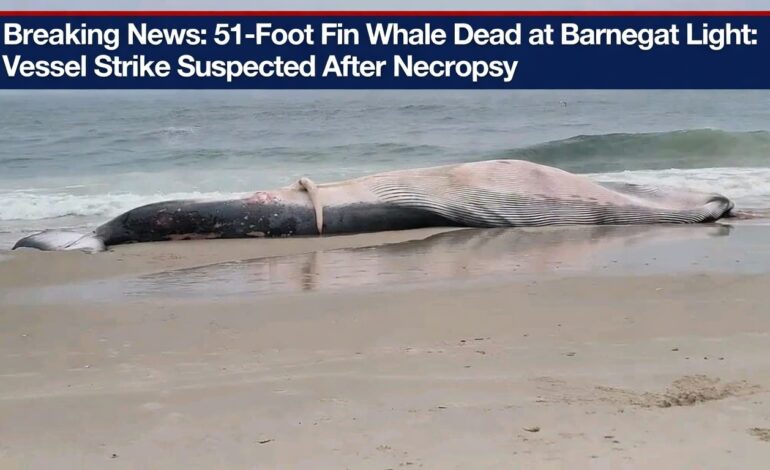

| UPDATE (February 22, 2026): The necropsy is complete. Preliminary findings confirm the whale was likely struck by a vessel. The whale has been buried on the beach ahead of the Sunday storm. Full details in Section 5. |
1. What Happened: The Complete Story at a Glance
|
| Key Detail | Confirmed Information |
| Date Found | Friday, February 20, 2026, approximately 1:30 p.m. |
| Location | Surf at Barnegat Light, northern end of Long Beach Island, Ocean County, NJ |
| Species | Fin whale (Balaenoptera physalus) |
| Sex / Age | Young male |
| Exact Length (necropsy) | 51 feet, 1.5 inches |
| Estimated Weight | 25 tons |
| Necropsy Performed By | Marine Mammal Stranding Center (MMSC) + Cornell University |
| Necropsy Date | Saturday, February 21, 2026 |
| Preliminary Cause of Death | Vessel strike (suspected based on blunt force trauma, left side) |
| Additional Finding | Evidence of prior entanglement near base of tail |
| Current Status | Buried on beach; tissue samples sent for histopathologic analysis |
| NJ Fin Whale Strandings Since 1978 | 35 total (per MMSC) |
| NJ Whale Strandings in 2024 | 9 |
| NJ Whale Strandings in 2025 | 4 |
| Conservation Status | Endangered (NOAA / IUCN) |
2. The Discovery: Friday Afternoon at Barnegat Light
It was a Friday afternoon in February, and the surf at Barnegat Light was doing something unusual. The north end of Long Beach Island — a narrow barrier island in Ocean County, NJ, best known for its lighthouse and its quiet off-season character — had a visitor. A massive one.
At approximately 1:30 p.m. on February 20, 2026, the Marine Mammal Stranding Center received reports of a large deceased whale in the surf. MMSC’s Stranding Coordinator responded to the scene and made the identification: a male fin whale, approximately 50 feet in length, dead in the surf. The exact measurement would come the next day — 51 feet, 1.5 inches.
Scientists, officials, and beachgoers gathered. The scene was exactly what you’d imagine: the enormous grey form of one of the ocean’s largest creatures, motionless in the winter surf. Fin whales are the second-largest animal species on earth. Seeing one — even a young one — is extraordinary. Seeing one this way is sobering.
The MMSC Stranding Coordinator stayed on scene until sunset, working with local agencies — including the Borough of Barnegat Light, NJ Fish & Wildlife Conservation Officers, and T & K Marine Construction — to develop a recovery plan. The team also had a deadline: a coastal storm was forecast for Sunday. Whatever needed to be done had to happen by Saturday evening.
3. What Is a Fin Whale? A Species Profile
Before going further into what happened to this whale, it’s worth understanding what was lost.
The Second-Largest Animal on Earth
The fin whale (Balaenoptera physalus) is the second-largest species of whale — and by extension, the second-largest animal ever known to have lived on earth. Only the blue whale is larger. Adults reach 75–80 feet in length and weigh up to 80 tons. The Barnegat Light whale, at 51 feet and 25 tons, was a young animal. If it had survived to adulthood, it could have grown another 25+ feet.
What Makes Fin Whales Distinctive
- Speed: Fin whales are sometimes called the ‘greyhounds of the sea’ — they can sustain speeds of 20–25 mph, making them among the fastest large whales
- Asymmetrical coloring: Uniquely among whales, fin whales have asymmetrical jaw coloration — white on the right side, grey on the left. Scientists believe this may be an adaptation to hunting behavior
- Feeding: They are baleen whales — they filter krill, small fish, and squid through baleen plates, consuming up to 2 tons of food per day
- Sound: Fin whales produce some of the lowest-frequency vocalizations of any animal — 20 Hz calls that can travel hundreds of miles through the ocean
- Lifespan: An estimated 80–90 years in the wild
Conservation Status: Endangered
Fin whales are listed as Endangered under the U.S. Endangered Species Act and by NOAA Fisheries. They were severely depleted by commercial whaling in the 19th and 20th centuries — hundreds of thousands were killed before commercial whaling was largely banned. The global population has recovered somewhat since the moratorium, but the North Atlantic population faces ongoing pressure from vessel strikes and entanglement.
| Fin Whale Fast Fact | Detail |
| Scientific name | Balaenoptera physalus |
| Maximum adult length | 75–80 feet (blue whale exceeds 100 ft) |
| Maximum weight | Up to 80 tons |
| Diet | Krill, capelin, herring, squid — up to 2 tons/day |
| Typical lifespan | 80–90 years |
| Conservation status | Endangered (NOAA, IUCN) |
| Primary threats | Vessel strikes, entanglement in fishing gear, climate change impacts on prey |
| Habitat range | All major oceans; North Atlantic population distinct |
| NJ strandings since 1978 | 35 cases responded to by MMSC |
4. The Necropsy: What Scientists Found
On Saturday, February 21 — with a coastal storm arriving the following day — a team from the Marine Mammal Stranding Center and Cornell University performed a necropsy on the Barnegat Light whale. The examination had to be completed before the nor’easter hit. They succeeded.
What a Whale Necropsy Involves
A whale necropsy is a massive undertaking. The carcass of a 25-ton animal requires heavy equipment, specialized cutting tools, and a team of trained biologists working in careful, methodical coordination. Scientists examine the external body first — looking for wounds, abrasions, entanglement marks, or visible trauma. Then they move inside: examining organs, blubber thickness, stomach contents, muscle tissue, and the skeletal structure.
The goal is to establish cause of death — and, where possible, when the death occurred and whether it was related to any human activity. Every finding is documented and photographed.
Preliminary Findings: Vessel Strike
The necropsy findings were clear enough for a preliminary conclusion: the whale likely died as a result of a vessel strike.
- Blunt force trauma was found on the left side of the whale’s body — the signature pattern of a ship collision
- The trauma was described by Shore News Network as ‘clear signs of blunt force trauma consistent with a vessel strike’
- Scientists also found evidence of a prior entanglement near the base of the whale’s tail — indicating the animal had previously encountered fishing gear or marine debris and survived it, before ultimately dying from what appears to be a ship strike
Shore News Network: “The young male whale, measuring 51 feet 1.5 inches and weighing an estimated 25 tons, showed clear signs of blunt force trauma to the left side of its body. Experts say the injuries are consistent with a vessel strike, a leading cause of death among large whales along the East Coast.”
What Comes Next: Histopathologic Analysis
Preliminary findings tell part of the story. The tissue and organ samples collected during the necropsy have been sent to pathology labs for histopathologic analysis. This deeper examination of tissue under a microscope will help determine the timing of the injuries — specifically, whether the vessel strike and the entanglement occurred before or after the whale’s death. That distinction matters scientifically: a pre-mortem strike is cause of death; a post-mortem strike could mean the whale died of other causes and was struck while floating.
Results from histopathologic analysis typically take several weeks to months. Updates will be posted at mmsc.org/current-cetacean-data when available.
5. What Is a Vessel Strike? The Leading Cause of Large Whale Deaths
Vessel strikes — collisions between ships and whales — are one of the most significant drivers of whale mortality in coastal waters worldwide. Understanding them is essential context for this case.
How Vessel Strikes Happen
Large commercial vessels — cargo ships, tankers, cruise ships, ferries, and container ships — travel at speeds of 12–20+ knots (roughly 14–23 mph). Fin whales often feed near the surface, especially at dawn and dusk, when they’re targeting schools of fish and krill. A whale resting or feeding near a major shipping lane may simply not have time to detect and avoid an incoming vessel. Ships, in turn, often can’t detect a whale in their path until it’s too late.
The strike itself typically doesn’t kill the whale immediately. More often, the animal is struck by the bow or propeller of the vessel, sustaining internal trauma, broken ribs, collapsed lungs, or spinal injury. The animal may swim away — or appear to — and die hours or days later. This is why struck whales often wash ashore some distance from where the impact actually occurred.
Why Fin Whales Are Especially Vulnerable
NOAA Fisheries specifically identifies fin whales as particularly vulnerable to vessel strikes. The reasons are biological and behavioral:
- Fin whales feed near the surface, placing them directly in the path of passing vessels
- They are fast enough to evade some strikes — but not when vessels approach from certain angles or at high speeds
- Their range overlaps heavily with major East Coast shipping lanes running from the Gulf of Maine through Delaware Bay and Chesapeake Bay
- The Mid-Atlantic Bight — the area of shallow continental shelf between Cape Hatteras and Cape Cod — is both productive feeding habitat and heavily trafficked shipping corridor
NOAA’s Speed Rule and Vessel Strike Reduction
In 2008, NOAA Fisheries implemented a seasonal speed rule along portions of the East Coast, requiring vessels 65 feet or longer to travel at 10 knots or less in designated Seasonal Management Areas during peak whale migration periods. Studies have shown the rule reduces strike probability — but compliance is imperfect, and the rule covers only portions of the migration corridor.
A stricter proposed update to the vessel speed rule has been in regulatory development for years. The fate of that update under recent administrations has been uncertain. Conservation groups cite vessel strikes as the most immediate threat facing North Atlantic right whales and a serious secondary threat to fin whales.
6. The Prior Entanglement: A Second Threat to Fin Whales
The necropsy team found something beyond the vessel strike evidence: signs of a prior entanglement near the base of the whale’s tail. This matters.
Entanglement in fishing gear — lobster pot lines, gillnets, and other fixed gear — is the second-leading cause of large whale mortality after vessel strikes. When a whale becomes entangled, it may drag the gear for months, causing wounds, infection, stress, reduced feeding efficiency, and death. In severe cases, the rope cuts through the whale’s body; in others, the animal eventually breaks free — but not without lasting scars.
The Barnegat Light whale appears to have survived a prior entanglement, based on the healed or scarred tissue found near its tail. That the animal was young — estimated at a small fraction of a fin whale’s potential 80-year lifespan — and had already survived an entanglement before dying in what appears to be a vessel collision, is a stark illustration of the gauntlet that large whales must navigate in the heavily trafficked waters of the East Coast.
From the MMSC’s statement: ‘Examiners also noted signs of a prior entanglement near the base of the tail, suggesting the animal had previously encountered fishing gear or marine debris.’ — Shore News Network, February 22, 2026
7. The Race Against the Storm: How the Response Team Worked
The timing of this stranding created a specific and pressing logistical challenge: a coastal storm was forecast for Sunday, February 22. If the necropsy wasn’t completed and the carcass secured before the storm arrived, the storm surge and surf could scatter the body, contaminate samples, and make future examination impossible.
The MMSC team assembled quickly. The Stranding Coordinator was on scene from 1:30 p.m. Friday until sunset, developing the recovery plan. A necropsy team was assembled that evening and arrived Saturday morning.
The full team included the Marine Mammal Stranding Center, Cornell University biologists, NJ Fish & Wildlife Conservation Officers, the Borough of Barnegat Light, and T & K Marine Construction — who provided heavy equipment for the carcass handling. That combination of scientific expertise, local government, and practical equipment is what made a successful same-day necropsy possible.
After the examination was complete, the whale was buried on the beach. This is the standard disposal method for large whale carcasses that cannot be towed offshore: a deep beach burial, which allows the remains to decompose and eventually return nutrients to the coastal ecosystem. Tissue and organ samples were collected and packaged for laboratory analysis before burial.
SOJO 104.9 (South Jersey radio): “The Center’s volunteers and others did a lot of great work in examining the whale and making sure it was buried before the blizzard hit. We salute them on a job well done!”
8. NJ Whale Strandings: The Bigger Picture
The Barnegat Light fin whale is not an isolated event. New Jersey has seen a significant number of large whale strandings in recent years — part of a broader pattern along the Mid-Atlantic coast that has drawn both scientific and public attention.
| Year | NJ Whale Strandings | Notable Events | Primary Suspects |
| 2022 | 12+ | Multiple humpback and fin whale deaths | Vessel strikes, entanglement |
| 2023 | 9+ | North Atlantic right whale deaths | Vessel strikes, entanglement, disease |
| 2024 | 9 | Continued elevated stranding rate | Vessel strikes, entanglement |
| 2025 | 4 | Decline from 2024 peak | Vessel strikes, entanglement |
| 2026 (through Feb.) | 1 confirmed (this case) | Fin whale at Barnegat Light | Vessel strike (preliminary) |
MMSC data shows that New Jersey has recorded 35 fin whale strandings since the organization began systematic recordkeeping in 1978. The current case is stranding 35 — or close to it, depending on final case counting.
The broader context involves the Unusual Mortality Events declared by NOAA for multiple large whale species along the East Coast. Humpback whales, for example, have been under a NOAA UME declaration since 2016. Each new stranding is added to a database that researchers use to look for patterns — in timing, location, cause, and population impact.
Vessel strikes and entanglement remain the two leading anthropogenic (human-caused) threats to large whales along the East Coast. Climate change is a growing concern, as it affects the distribution of prey species and may push whales into new shipping corridors. For a species listed as Endangered — with a population that has never fully recovered from the whaling era — each individual death matters at the population level.
9. The MMSC: Who Responded and Why They Matter
The Marine Mammal Stranding Center, based in Brigantine, NJ, is one of the most active stranding response organizations on the East Coast. Since 1978, it has responded to thousands of strandings — sick, injured, or dead marine mammals washed ashore along New Jersey’s 130+ miles of coastline.
For large whale cases like this one, the MMSC serves as the first responder, the scientific investigator, and the communications hub. They identify the animal, assess the situation, coordinate with local authorities, assemble necropsy teams, collect samples, and communicate findings to the public and to NOAA Fisheries.
The organization works on a combination of government funding, grants, and private donations. For a case like the Barnegat Light fin whale — which required rapid assembly of a multi-agency team in advance of a major storm — the MMSC’s experience and network were indispensable. Updates from the organization are posted at mmsc.org and through their social media channels.
10. What Happens to the Samples Collected?
Tissue and organ samples collected during a whale necropsy don’t just answer questions about one animal’s death. Over time, they contribute to a body of scientific knowledge that shapes conservation policy, regulatory decisions, and our understanding of how large whale populations are doing.
Histopathologic Analysis
The samples from the Barnegat Light whale have been sent for histopathologic analysis — examination of tissue under a microscope to assess cellular damage, disease processes, and the timing of injuries. In this case, the key question is whether the blunt force trauma found on the left side of the body occurred before or after death. That determination shapes whether this is formally classified as a vessel strike mortality.
Genetics and Population Studies
Genetic samples collected during necropsies allow scientists to identify individual whales, assess population connectivity, and track reproductive status. If this whale had ever been photographically identified before — catalogued by researchers who track individual fin whales by their distinctive coloring and dorsal fin shape — that data could be cross-referenced to understand the animal’s history.
Toxicology and Contaminant Screening
Blubber and liver samples are routinely screened for pollutants: PCBs, heavy metals, microplastics, and other contaminants. Large whales are apex-level consumers who accumulate toxins through the food chain. Tracking contaminant loads over time provides a broader picture of ocean health.
Results from this whale’s samples are expected in weeks to months. They will be posted at mmsc.org/current-cetacean-data.
11. Frequently Asked Questions (FAQ)
What happened to the whale at Barnegat Light?
A 51-foot, 25-ton young male fin whale was found dead in the surf at Barnegat Light, NJ on February 20, 2026. A necropsy performed by the Marine Mammal Stranding Center and Cornell University on February 21 found blunt force trauma on the left side of the body consistent with a vessel strike. The whale also showed signs of a prior entanglement near its tail. The carcass was buried on the beach after the necropsy. Tissue samples are being analyzed.
What is a fin whale?
The fin whale (Balaenoptera physalus) is the second-largest animal species on earth, after the blue whale. Adults reach 75–80 feet in length and can weigh up to 80 tons. They are baleen whales that feed on krill, herring, and other small prey — consuming up to 2 tons per day. They are listed as Endangered by NOAA Fisheries and the IUCN. They can live up to 80–90 years.
What killed the whale at Barnegat Light?
Preliminary necropsy results point to a vessel strike as the likely cause of death. Scientists found blunt force trauma on the left side of the whale’s body consistent with a ship collision. Tissue samples collected during the necropsy will undergo further histopathologic analysis to confirm the timing and mechanism of the injuries. Final results are expected in weeks to months.
What is a necropsy and who performed it?
A necropsy is a postmortem examination — the animal equivalent of an autopsy. For large whales, it involves an external examination of the body for wounds and trauma, followed by internal examination of organs, tissue, and skeletal structure. The Barnegat Light necropsy was conducted by the Marine Mammal Stranding Center and Cornell University on February 21, 2026, completed ahead of a coastal storm.
How many fin whales have stranded in New Jersey?
Since the Marine Mammal Stranding Center began systematic recordkeeping in 1978, New Jersey has recorded 35 fin whale strandings, including this case. MMSC data shows New Jersey recorded 9 total whale strandings in 2024 and 4 in 2025. The Barnegat Light fin whale is the first confirmed NJ whale stranding of 2026.
What is a vessel strike and how does it kill whales?
A vessel strike is a collision between a ship or boat and a whale. Large vessels traveling at 12–20+ knots can fatally injure a whale that is feeding or resting near the surface. The impact typically causes blunt force trauma — broken ribs, internal bleeding, collapsed lungs, or spinal injury. The whale may swim away after the strike and die hours or days later, washing ashore at some distance from the impact location.
Why was the whale buried on the beach?
Beach burial is the standard disposal method for large whale carcasses in NJ when the body cannot be towed offshore. A deep beach burial allows the remains to decompose safely and return nutrients to the coastal ecosystem. In this case, the whale was buried Saturday, February 21, ahead of a coastal storm forecast for Sunday, February 22. Tissue samples were collected before burial.
Where can I follow updates on this case?
The Marine Mammal Stranding Center posts updates on whale strandings and necropsy results at mmsc.org/mmsc-media-center and mmsc.org/current-cetacean-data. You can also follow their official social media accounts. Histopathologic results from this case are expected in weeks to months.
12. Key Takeaways
- A young male fin whale — 51 feet, 1.5 inches long and 25 tons — was found dead in the surf at Barnegat Light, NJ on Friday, February 20, 2026 at approximately 1:30 p.m.
- The Marine Mammal Stranding Center (MMSC) and Cornell University performed a necropsy on February 21, completing it ahead of a Sunday coastal storm.
- Preliminary findings indicate the likely cause of death was a vessel strike: blunt force trauma consistent with a ship collision was found on the left side of the whale’s body.
- Examiners also found evidence of a prior entanglement near the base of the tail, indicating the animal had previously survived a fishing gear interaction.
- The whale was buried on the beach after the necropsy. Tissue samples have been sent for histopathologic analysis; results are expected in weeks to months.
- Fin whales are the second-largest animals on earth and are listed as Endangered. Adults can reach 75–80 feet; this young whale had decades of potential life ahead.
- New Jersey has recorded 35 fin whale strandings since 1978. The state recorded 9 whale strandings in 2024 and 4 in 2025.
- Vessel strikes and entanglement remain the leading human-caused threats to large whales along the East Coast.
- Updates will be posted at mmsc.org/current-cetacean-data as laboratory results become available.
Sources
- Marine Mammal Stranding Center (MMSC): Official Facebook statement, February 20–21, 2026 (primary source)
- Shore News Network: ‘Dead 51-foot fin whale found in Barnegat Light struck by vessel’ (February 22, 2026) — key source for necropsy results
- Jersey Shore Online: ‘Vessel Strike Suspected in LBI Whale Death’ (February 22, 2026) — necropsy detail
- Jersey Shore Online: ‘Whale Found Dead Along LBI’ (February 20, 2026) — initial discovery reporting
- Hoodline: ’50-Foot Fin Whale Slams Ashore on LBI’ (February 21, 2026)
- org: ‘Dead Whale Washes Up on the Beach in Barnegat Light’ (February 21, 2026)
- Breaking AC: ‘Large Whale Found Dead in Barnegat Light’ (February 20, 2026)
- SOJO 104.9: ‘Huge Whale Lands Jersey Shore Beach’ (February 22, 2026)
- com: Additional reporting on discovery (February 20, 2026)
- NOAA Fisheries: Fin whale species profile and vessel strike information (noaa.gov)
| About This Article
This article was researched and written using official statements from the Marine Mammal Stranding Center, and reporting from Shore News Network, Jersey Shore Online, Hoodline, TomsRiver.org, Breaking AC, SOJO 104.9, and NJ.com — all published February 20–22, 2026. Necropsy findings cited are preliminary. Histopathologic analysis results are pending and not yet available. NOAA Fisheries species information used for the fin whale profile section. Last updated: February 22, 2026. |
Discover more from MatterDigest
Subscribe to get the latest posts sent to your email.