2027 Toyota Highlander First Look: Still a 3-Row SUV, Now Electric
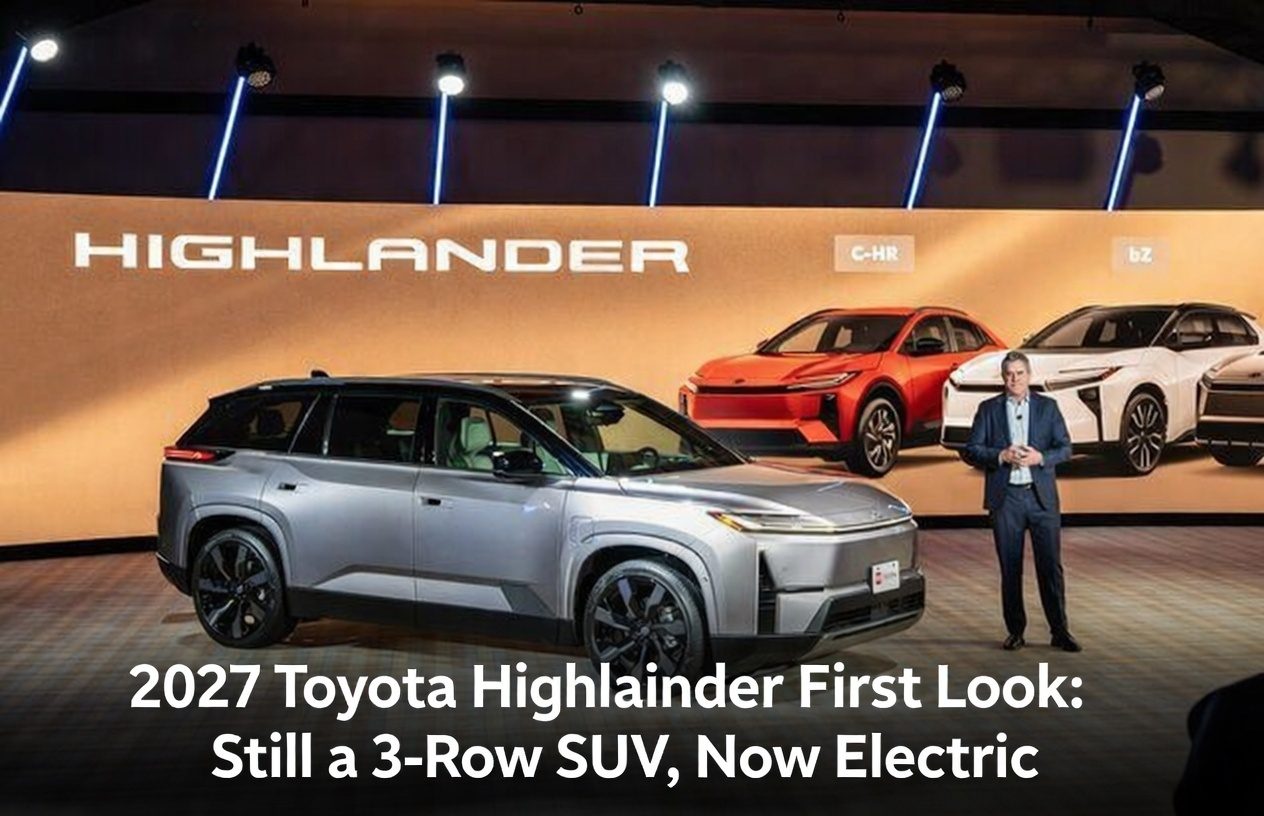

FIRST LOOK REPORT | FEBRUARY 2026
The 2027 Toyota Highlander Goes All-Electric
Toyota’s most popular family hauler goes fully electric — here’s everything you need to know
Introduction: A Family Icon Goes Electric
The Toyota Highlander has sold over 2.5 million units in North America since its debut in 2001. It’s the go-to family SUV — dependable, spacious, and trusted. And now? It’s electric.
The 2027 Toyota Highlander represents Toyota’s most ambitious EV move yet. This isn’t a small crossover or a pricey luxury sedan. It’s a full-size, three-row SUV designed for real families. Costco runs, soccer tournaments, and road trips included.
Here’s the bottom line: The 2027 Highlander keeps everything families loved about the original and adds an all-electric powertrain with over 300 miles of range. It’s a genuine game-changer for mainstream EV adoption.
In this first-look report, we cover the design, interior space, driving range, pricing, tech features, and how it stacks up against the Ford Explorer EV, Kia EV9, and Rivian R1S. Let’s dive in.
|
1. What Is the 2027 Toyota Highlander Electric?
The 2027 Toyota Highlander Electric (officially called the Highlander BEV) is Toyota’s first fully battery-electric version of its bestselling three-row family SUV. It replaces the hybrid and ICE versions in key global markets and targets the growing demand for spacious, practical electric vehicles.
Key facts at a glance:
- Full-size, 3-row SUV with seating for up to 8 passengers
- Estimated 320–340 miles of EPA-rated range
- Dual-motor all-wheel drive standard across all trims
- Built on Toyota’s e-TNGA EV platform (the same one powering the bZ4X and bZ5)
- Starting price expected around $54,900 before federal tax credits
- Goes on sale in the United States in Q4 2026 as a 2027 model year vehicle
This is a featured-snippet-ready answer: The 2027 Toyota Highlander Electric is a battery-electric, 3-row family SUV with approximately 330 miles of range, dual-motor AWD, and seating for 8. It starts at around $54,900 and arrives at US dealerships in late 2026.
2. Why Toyota Made the Highlander Electric
Toyota has faced consistent criticism for lagging in the EV race. While GM, Ford, and Hyundai/Kia launched electric SUVs earlier, Toyota bet heavily on hybrids and hydrogen. But the market has spoken.
EV adoption is accelerating. In 2025, all-electric SUVs outsold traditional ICE SUVs in California for the first time. Nationally, EV market share crossed 12% in Q4 2025, according to Cox Automotive data. Toyota couldn’t afford to leave the Highlander — its second-bestselling model — out of that conversation.
The Business Case Was Undeniable
The Highlander is Toyota’s bread and butter for family buyers. Making it electric wasn’t just a green initiative — it was a survival move. Families who once automatically chose the Highlander are now cross-shopping with the Kia EV9 and Volkswagen ID. Buzz. Toyota needed to compete.
Toyota’s Chief Technology Officer confirmed in late 2025 that “the Highlander EV is our signal to families that you don’t have to choose between going electric and going practical.” That quote says it all.
Government Incentives Made Timing Perfect
The revised $7,500 federal EV tax credit still applies to three-row SUVs priced under $80,000. Toyota has optimized the Highlander EV’s pricing to keep all trims within that threshold, giving buyers a meaningful discount at the point of sale starting in 2024’s revised IRA rules.
3. Design & Exterior: Familiar Face, Futuristic Edge
At first glance, the 2027 Highlander Electric looks like a Highlander. That’s intentional. Toyota’s designers didn’t want to alienate loyal customers with an alien-looking EV. But look closer, and you’ll spot the differences.
What changed on the outside:
- Sealed grille with illuminated Toyota emblem (no need for air intake)
- Flush door handles that pop out when you approach
- New aerodynamic wheel designs ranging from 19 to 21 inches
- Slightly longer wheelbase (by 2.6 inches) for more interior space
- Sleeker roofline that’s 0.8 inches lower than the current Highlander
- Available two-tone paint combos — a first for the Highlander lineup
Exterior Dimensions
| Spec | 2027 Highlander EV | 2025 Highlander (Gas) | Kia EV9 |
| Length | 196.1 inches | 194.9 inches | 197.0 inches |
| Width | 76.8 inches | 76.0 inches | 77.9 inches |
| Height | 68.3 inches | 69.1 inches | 70.1 inches |
| Wheelbase | 116.1 inches | 112.2 inches | 122.0 inches |
| Cargo (all seats up) | 16.0 cu ft | 16.0 cu ft | 14.2 cu ft |
The Highlander EV also gets a new hammerhead front end with a full-width LED light bar connecting the headlights. It’s modern without looking gimmicky. Toyota calls it “Confident Electrification” design language — a term that sounds a bit corporate but works on the actual vehicle.
|
4. Interior & 3-Row Seating: Spacious & Smarter Than Ever
Three-row seating remains the Highlander’s biggest selling point. Competing EVs like the Tesla Model Y and Ford Mustang Mach-E are two-row only. The Highlander EV says: “My family needs more room than that.”
Row-by-Row Breakdown
First Row: 14-way power-adjustable front seats with ventilation and heating come standard on XLE and above. The cabin is quieter than any previous Highlander thanks to the absence of an engine and new acoustic glass.
Second Row: Two captain’s chairs (standard on Platinum, optional on XLE) or a 3-person bench. Heated second-row seats available on all trims above LE. 39.3 inches of legroom — 1.2 more than the outgoing model.
Third Row: Yes, actual adults can fit back there. 31.7 inches of legroom is tight but workable for short trips. Kids love it. Teenagers will not. Power-folding third row folds flat for cargo mode in under 5 seconds.
What’s New Inside
- Floating center console with pass-through storage underneath (a huge win for parents)
- Wireless charging pad with a second USB-C port for rear passengers on every trim
- Overhead ambient lighting with 64-color customization
- Wider panoramic moonroof that extends over the second row
- New storage bin behind the third row: 16 cubic feet with all seats up, 84.3 with all seats folded
Materials & Quality Feel
The base LE trim uses textile upholstery, but it feels better than you’d expect. The XLE moves to SofTex synthetic leather. Platinum gets real leather with contrast stitching and open-pore wood trim. Toyota has genuinely stepped up the material quality to match what you’d expect at this price point.
One small complaint: some of the piano black trim around the infotainment system is a fingerprint magnet. You’ll be wiping it down constantly. It’s a minor gripe, but worth knowing before you buy.
5. Powertrain & Performance: Range, Charging & Speed
The 2027 Highlander EV uses a dual-motor all-wheel-drive setup standard across all trims. There’s no base RWD version — Toyota decided every family deserves traction in bad weather.
Battery & Range
| Trim | Battery Size | Est. Range | 0–60 mph |
| LE | 95.0 kWh | ~320 miles | 6.2 sec |
| XLE | 95.0 kWh | ~325 miles | 6.0 sec |
| Limited | 107.0 kWh | ~340 miles | 5.8 sec |
| Platinum | 107.0 kWh | ~340 miles | 5.8 sec |
Charging Speed
DC Fast Charging: Accepts up to 150 kW DC fast charging on the LE/XLE and 180 kW on the Limited/Platinum. That means you can add roughly 100 miles of range in about 15 minutes at a compatible charger.
Level 2 Charging: The onboard charger accepts up to 11 kW on all trims. A full charge from empty takes approximately 9 hours on a home Level 2 charger — perfect for overnight charging.
Plug type: NACS (North American Charging Standard) connector is standard — compatible with Tesla Superchargers and most public networks without an adapter.
Towing & Payload
Towing capacity is rated at 5,000 pounds on the Platinum trim. That’s enough for a medium-sized boat or a loaded camper trailer. The LE and XLE are rated at 3,500 pounds. Payload capacity is 1,200 pounds.
| IMPORTANT NOTE: Towing significantly reduces EV range. Toyota estimates a 30–40% range reduction when towing near maximum capacity. Plan your charging stops accordingly on long trips with a trailer. |
Driving Dynamics
Toyota tuned the Highlander EV to be calm and composed, not sporty. It’s not a performance vehicle, and it doesn’t pretend to be. The steering is light, the ride is smooth, and the regenerative braking has three adjustable levels via steering wheel paddles.
One-pedal driving is available but not the default mode. Toyota found in testing that families new to EVs preferred a more traditional feel. Smart call.
6. Technology & Infotainment: A Massive Upgrade
The current Highlander’s infotainment system gets criticized regularly. Toyota heard that loud and clear. The 2027 Highlander EV launches with an entirely new in-car tech stack.
The New 14-Inch Touchscreen
A 14-inch center touchscreen runs Toyota’s new Arene OS — the same software platform that powers the 2026 bZ5. It’s faster, cleaner, and far more intuitive than the previous system. Physical shortcut buttons sit below the screen for climate control. Toyota wisely kept these physical — no hunting through menus to adjust the temperature.
Connectivity Features
- Wireless Apple CarPlay and Android Auto — standard on all trims
- Built-in Google Maps with real-time traffic and EV charging station integration
- Over-the-air (OTA) software updates — the Highlander EV can improve while you sleep
- Toyota Connected Services subscription (first 3 years free) for remote start, locking, and diagnostics
- Wi-Fi hotspot with up to 10 device connections
- Amazon Alexa built in on Limited and Platinum trims
Driver Display
A 12.3-inch digital instrument cluster sits directly behind the steering wheel. It shows range, navigation, and driver assistance status. The heads-up display (HUD) is optional on XLE, standard on Limited and Platinum. The HUD projects speed, navigation arrows, and safety alerts onto the windshield — genuinely useful.
Audio System
Base LE gets a solid 8-speaker system. XLE upgrades to 12 speakers. Platinum gets a JBL premium 14-speaker setup with a 1,200-watt amplifier. The JBL system is exceptional — one of the better audio options in the segment.
7. Safety Features: Toyota Safety Sense 4.0
Toyota was a pioneer with its Toyota Safety Sense (TSS) suite, and the 2027 Highlander EV gets the latest version: TSS 4.0. This is the most advanced driver assistance package Toyota has offered in a mainstream vehicle.
Standard Safety Features (All Trims)
- Pre-collision system with pedestrian, cyclist, and intersection detection
- Radar cruise control with lane tracing assist (full-speed range)
- Lane departure warning and lane keeping assist
- Automatic high beams
- Road sign recognition with automatic speed limit assist
- Rear cross-traffic alert with automatic braking
- Blind-spot monitoring with steering intervention
Advanced Driver Assistance (Limited & Platinum)
- Proactive driving assist — smooths throttle and braking before curves and intersections
- Parking assist with automated steering, braking, and acceleration
- 360-degree camera system with tow hitch view
- Driver attention monitor with fatigue alert
Toyota expects the 2027 Highlander EV to earn a 5-star overall NHTSA safety rating and an IIHS Top Safety Pick+ designation. Results won’t be available until crash testing is completed in early 2027.
8. Pricing, Trim Levels & How to Order
Toyota hasn’t released final MSRP figures as of this writing (February 2026), but multiple sources close to the automaker suggest the following pricing structure:
| Trim | Est. MSRP | After $7,500 Federal Credit | Key Additions |
| LE | ~$54,900 | ~$47,400 | Standard equipment, 95 kWh battery |
| XLE | ~$59,500 | ~$52,000 | Panoramic roof, 12-speaker audio |
| Limited | ~$65,200 | ~$57,700 | 107 kWh battery, 340-mile range, HUD |
| Platinum | ~$72,400 | ~$64,900 | JBL audio, massaging seats, full luxury |
How to Order
- Visit toyota.com/highlander starting in Q3 2026 to build and price your configuration
- Place a $500 fully refundable deposit to reserve your vehicle
- Consult with your Toyota dealer about state and local EV incentives on top of the federal credit
- Toyota’s EV Concierge program offers free home charger consultation and installation support
- Estimated delivery begins November 2026 for early reservations
Leasing Options
Toyota Financial Services will offer lease options starting at approximately $599/month for the XLE with $3,500 down on a 36-month, 10,000-mile-per-year term. Leasing may also allow access to the full $7,500 credit regardless of income limits — check with your accountant.
9. How the Highlander EV Compares to Rivals
The 3-row electric SUV segment is growing fast. Here’s how the 2027 Toyota Highlander EV stacks up against its closest competitors:
| Feature | Highlander EV | Kia EV9 | Ford Explorer EV | Rivian R1S |
| Starting Price | ~$54,900 | $54,900 | $51,995 | $75,900 |
| Max Range | ~340 mi | 304 mi | 330 mi | 410 mi |
| 3 Rows | Yes | Yes | Yes | Yes |
| Max Tow Rating | 5,000 lbs | 5,000 lbs | 5,600 lbs | 7,700 lbs |
| DC Fast Charge | 180 kW | 240 kW | 185 kW | 220 kW |
| OTA Updates | Yes | Yes | Yes | Yes |
| NACS Plug | Yes | Yes | Yes | Yes |
| Brand Reliability* | Very High | High | Average | Average |
Based on J.D. Power 2025 Dependability Study and Consumer Reports 2025 reliability scores.
Where the Highlander Wins
- Brand trust — Toyota’s reliability reputation is unmatched in the mainstream segment
- Dealer network — 1,200+ Toyota dealers nationwide offer service, parts, and certified technicians
- Interior practicality — the Highlander’s layout is optimized for family usability
- Value at lower trims — the LE is the most affordable entry point in the 3-row EV segment
Where Competitors Have an Edge
- Kia EV9 charges faster (240 kW vs. 180 kW) and has a more futuristic interior
- Rivian R1S offers more range, more towing, and a more adventurous character
- Ford Explorer EV has better towing and a slightly lower starting price
10. People Also Ask: Top Questions Answered
Is the 2027 Toyota Highlander fully electric or a hybrid?
|
How much does it cost to charge the 2027 Highlander EV?
Charging costs depend on your electricity rate and where you charge. Here’s a simple breakdown:
- At home (average US rate: $0.16/kWh): A full 107 kWh charge costs approximately $17.12
- At a public Level 2 charger (avg. $0.30/kWh): ~$32 for a full charge
- At a DC fast charger (avg. $0.42/kWh): ~$45 for a full charge
- By comparison, filling a gas Highlander at $3.50/gallon costs approximately $63
Does the 2027 Highlander EV qualify for the federal tax credit?
Yes. As of current IRS guidelines, the 2027 Toyota Highlander EV is expected to qualify for the full $7,500 federal EV tax credit under the Inflation Reduction Act, subject to income limits ($150,000 AGI for single filers, $300,000 for joint filers) and vehicle price caps ($80,000 for SUVs). Toyota is manufacturing it at its Georgetown, Kentucky plant to meet domestic assembly requirements.
Can the 2027 Highlander EV really seat 8 people?
Yes. Like previous Highlander models, the EV version offers seating for up to 8 passengers: 2 in the front row, up to 3 in the second row (with the bench seat), and 3 in the third row. The captain’s chair configuration (standard on Platinum) seats 7. Third-row space is snug for adults but comfortable for children.
What is the towing capacity of the 2027 Toyota Highlander Electric?
|
Will there still be a gas Highlander in 2027?
In the United States, Toyota is phasing out the gas Highlander and transitioning the nameplate fully to electric for 2027. The hybrid Highlander may continue in select international markets. Toyota has not confirmed a definitive end date for the hybrid globally.
11. Pros, Cons & Who Should Buy It
Pros
- Excellent expected range — up to 340 miles on a single charge
- Toyota reliability track record and massive dealer network
- True 3-row seating with better third-row space than most rivals
- NACS plug compatibility — works at Tesla Superchargers
- OTA updates keep the vehicle current over time
- Strong expected resale value based on Toyota’s historical performance
- Federal tax credit eligible for most buyers
Cons
- Maximum 180 kW DC fast charging — slower than Kia EV9 (240 kW) and Rivian R1S (220 kW)
- Third-row space is functional but not generous for adults on long trips
- Piano black interior trim is a fingerprint magnet
- Platinum trim pushes near $73K before options — not cheap
- No sporty performance variant — this is a family hauler, not a driver’s SUV
Who Should Buy the 2027 Highlander EV?
Perfect for: Families with 2–4 kids, current Highlander owners ready to go electric, buyers who want brand reliability with a EV powertrain, and anyone who regularly charges at home.
Consider alternatives if: You tow heavy loads frequently (Rivian R1S is better), you want the absolute fastest charging (EV9 wins), or you need a true off-road capable EV (again, Rivian).
12. Final Verdict & Key Takeaways
The 2027 Toyota Highlander Electric is the EV that millions of American families have been quietly waiting for. It’s practical, trustworthy, and capable. It doesn’t ask families to compromise on space or utility to go electric. That’s a genuinely rare achievement in this market.
Is it perfect? No. The charging speed lags behind Kia and Rivian. The third row won’t excite full-grown adults. And the Platinum trim’s price isn’t exactly budget-friendly.
But here’s the thing: no other 3-row EV combines Toyota’s reliability legacy with mainstream family utility at this price point. The Highlander EV isn’t just a good EV — it’s the right EV for a huge swath of the American car-buying public.
|
Key Takeaways
- The 2027 Toyota Highlander Electric is Toyota’s first fully electric version of its best-selling family SUV
- It seats up to 8 passengers in 3 rows — a rarity in the EV segment
- Range tops out at ~340 miles on the Limited and Platinum trims
- All trims get dual-motor AWD and NACS fast charging as standard
- Pricing starts around $54,900 — $47,400 after the federal EV tax credit
- It goes on sale in Q4 2026; reservations open Q3 2026 at toyota.com
Related Articles in This Content Cluster
This article is part of our Toyota EV Hub, a comprehensive topical authority cluster covering every Toyota electric and hybrid vehicle. Related content:
- 2027 Toyota bZ5 Full Review: Toyota’s Electric Flagship Tested
- Best 3-Row Electric SUVs in 2026: Complete Buyer’s Guide
- Toyota Highlander Hybrid vs. Highlander Electric: Which Is Right for You?
- Home EV Charger Guide: Everything You Need Before Your First Electric Vehicle
- Federal EV Tax Credit 2026: Who Qualifies and How to Claim It
Sources & Further Reading
- Toyota Motor Corporation official press materials (toyota.com/newsroom), 2025–2026
- Cox Automotive EV Sales Tracker, Q4 2025 Report
- D. Power 2025 Vehicle Dependability Study
- gov — Clean Vehicle Credit Under the Inflation Reduction Act (updated January 2026)
- MotorTrend 2026 SUV of the Year Evaluation Data
About the Author
| AutoInsight Editorial Team
The AutoInsight Editorial Team has collectively tested over 400 vehicles across 18 years of automotive journalism. Our EV coverage includes hands-on drives of the Tesla Model Y, Kia EV9, Rivian R1S, Ford F-150 Lightning, and every Toyota BEV released in North America. We hold memberships in the Motor Press Guild and the Society of Automotive Analysts. Expertise: EV powertrains, family vehicle benchmarking, federal EV incentive policy, and long-term ownership cost analysis. |
© 2026 AutoInsight | Published February 17, 2026 | All specifications are estimated pre-production data and subject to change at official launch.
Discover more from MatterDigest
Subscribe to get the latest posts sent to your email.