2026 Toyota C-HR EV: Powerful, Premium Electric SUV — Complete Guide
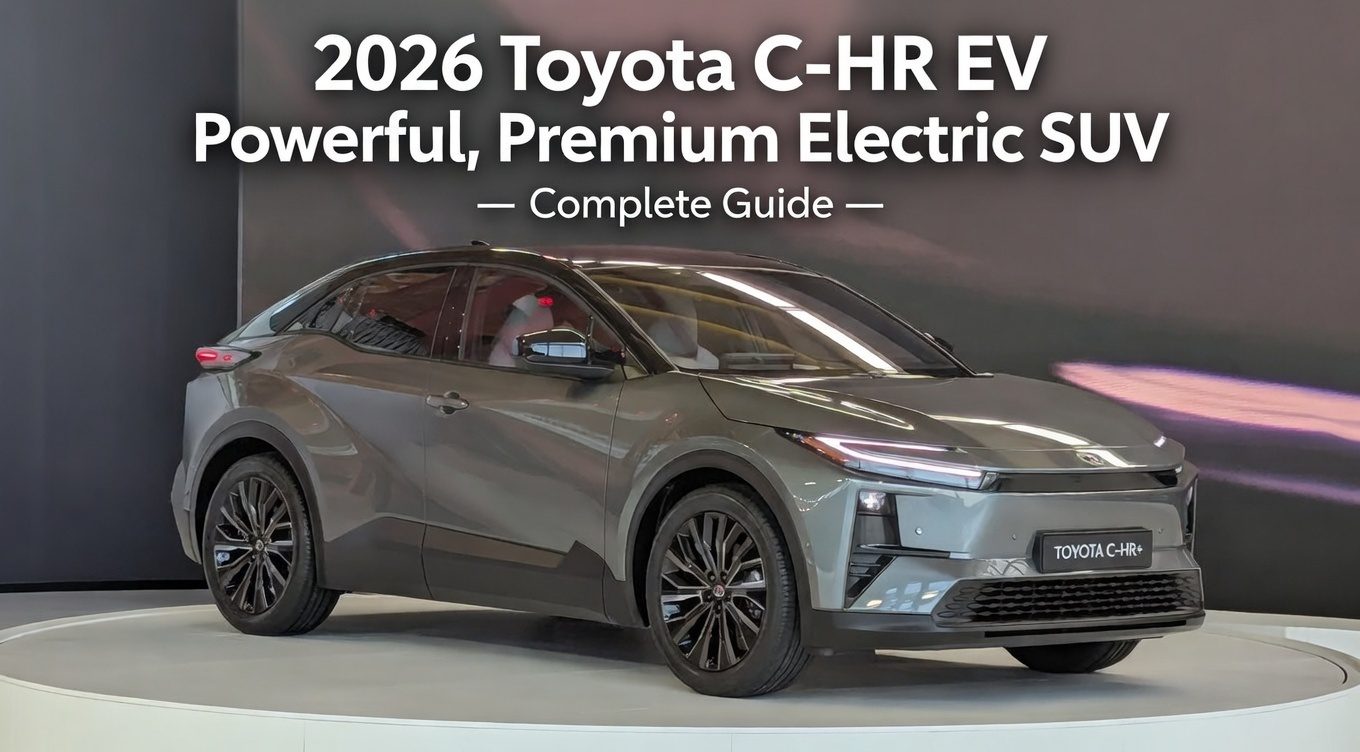

338 horsepower, standard AWD, 287 miles of range, and Tesla Supercharger access — here’s everything you need to know about Toyota’s most exciting EV yet
1. The 60-Second Summary: Is the 2026 C-HR EV Worth It?
The 2026 Toyota C-HR is back — and it’s almost unrecognizable from the slow, forgettable gas SUV it used to be. This time, it’s fully electric, with 338 horsepower, standard all-wheel drive, and a 0-60 time that Toyota says is around five seconds. It seats five, plugs into Tesla Superchargers, and starts at $37,000.
Toyota made a deliberate choice with this car. Instead of building a budget EV, they built a performance EV. That decision will delight some shoppers and frustrate others — especially those who expected something closer to $30,000.
|
2. Key Specs at a Glance
| Specification | 2026 Toyota C-HR EV |
| Powertrain | Dual electric motors (front + rear) |
| Combined Horsepower | 338 hp |
| Torque | 198 lb-ft (front) / 125 lb-ft (rear) |
| Drivetrain | Standard all-wheel drive (AWD) |
| Battery | 74.7 kWh lithium-ion |
| Range (SE, 18″ wheels) | Up to 287 miles (EPA-estimated) |
| Range (XSE, 20″ wheels) | Up to 273 miles (EPA-estimated) |
| 0–60 mph | ~4.9–5.0 seconds (manufacturer estimate) |
| DC Fast Charging (10–80%) | ~30 minutes |
| Level 2 AC Charging Rate | 11 kW onboard charger |
| Level 2 Charging (10–100%) | ~7–8 hours |
| Charging Port | NACS (Tesla Supercharger compatible) |
| Cargo Space (rear seats up) | 25.3 cu. ft. |
| Cargo Space (rear seats folded) | 59.5 cu. ft. |
| Assembly Location | Japan |
| On-Sale Date | March 2026 |
| Starting MSRP (SE) | $37,000 + $1,450 destination = $38,450 |
| XSE MSRP | $39,000 + $1,450 destination = $40,450 |
3. Pricing and Trim Levels: SE vs. XSE
The 2026 C-HR comes in exactly two trim levels. Toyota kept it simple. Here’s what separates them — and whether the $2,000 premium for the XSE is worth it.
SE — Starting at $37,000 ($38,450 with destination)
- 18-inch wheels (better range: up to 287 miles)
- 14-inch touchscreen with Toyota Audio Multimedia system
- Wireless Apple CarPlay and Android Auto
- Dual wireless phone chargers
- Fully digital gauge cluster
- Power liftgate
- Power-adjustable driver’s seat
- Heated front seats and heated steering wheel
- Six-speaker audio system
- Toyota Safety Sense 3.0 (full suite — see Section 8)
- Front and rear parking assist with automatic braking
- Rain-sensing wipers
- Rear cabin USB ports and air conditioning controls
XSE — Starting at $39,000 ($40,450 with destination)
Everything in the SE, plus:
- 20-inch gunmetal-finished wheels (reduces range to 273 miles)
- SofTex leatherette and synthetic suede-trimmed seats
- Panoramic roof (not available on SE at all)
- Digital Rearview Mirror
- Panoramic View Monitor (360-degree surround camera)
- JBL Premium Audio: 9 speakers, 800-watt amplifier, 9-inch subwoofer (optional)
- Lane Change Assist
- Low-Speed Traffic-Following Assist (Traffic Jam Assist)
- Three-tone exterior color option
Bottom Line on Trims: The SE is the better value for daily driving — you get more range and spend less. The XSE makes sense if you want the panoramic roof, upgraded seats, or JBL system. Those features aren’t available on the SE at any price.
4. Performance: How Fast Is the 2026 C-HR EV?
This is where the 2026 C-HR makes the strongest case for itself. The original gas-powered C-HR was famously slow — Consumer Reports clocked it at over 11 seconds to 60 mph and described the acceleration as ‘abnormally slow.’ The 2026 model does the same sprint in roughly half the time.
Toyota claims a 0-60 time of 4.9 to 5.0 seconds. That’s quicker than the Hyundai Ioniq 5 base model, quicker than the Volkswagen ID.4, and significantly quicker than the Chevrolet Equinox EV at its base. For a subcompact SUV in this price range, that number is genuinely impressive.
Why It’s So Quick
Two electric motors — one at each axle — work together to produce 338 combined horsepower. The front motor generates 198 lb-ft of torque and the rear motor adds 125 lb-ft. Electric motors deliver their full torque instantly, from a standstill. There’s no turbo lag, no gear change delay. You press the pedal and it goes.
The 74.7 kWh battery pack sits flat in the floor, keeping the center of gravity low. That helps not just with launch but with cornering feel. Reviewers at Consumer Reports and KBB noted that the C-HR handles confidently for a small SUV.
Regenerative Braking
Four levels of regenerative braking are adjustable via paddle shifters on the steering wheel. This is a nice feature — it lets you customize how much energy the car recovers when you lift off the throttle. The one criticism KBB noted: the most aggressive regen setting still isn’t aggressive enough for true one-pedal driving. If you love one-pedal driving, that’s a real limitation.
5. Range and Charging: Real-World Numbers
Toyota rates the SE at 287 miles and the XSE at 273 miles. Both use the same 74.7 kWh battery — the range difference comes down to wheel size. The SE’s 18-inch wheels are more aerodynamically efficient than the XSE’s 20-inch gunmetal rollers.
How does 287 miles compare to rivals? It’s solid but not class-leading. The Chevy Equinox EV offers up to 319 miles. The Tesla Model Y goes up to 357 miles. The Hyundai Ioniq 5 is rated up to 266 miles in its base AWD configuration. So the C-HR lands in the middle of the competitive pack.
Charging: NACS Port and Supercharger Access
Every 2026 C-HR includes a North American Charging Standard (NACS) port — the same standard used by Tesla vehicles. That means you can plug into any Tesla Supercharger in North America without an adapter. Tesla’s Supercharger network has over 60,000 stalls in North America and is consistently rated among the most reliable fast-charging networks.
- DC Fast Charging: 10% to 80% in approximately 30 minutes
- Level 2 AC Charging: 11 kW onboard charger; full charge in 7–8 hours
- Level 1 (standard 120V outlet): Adds roughly 3–5 miles per hour — practical for overnight top-ups
One Notable Gap: No Built-In Route Planning
This is the C-HR’s most significant tech weakness. KBB confirmed that the C-HR’s software does not include a function to map your charge stops during a road trip — and Toyota says it has no plans to add one. This is a real drawback if you take regular long-distance drives. Competitors like the Ioniq 5, Model Y, and ID.4 all have built-in route planners that automatically factor in charging stops.
The workaround: use a third-party app like PlugShare, ABRP (A Better Route Planner), or the Google Maps EV routing feature on your phone. It works, but it’s less elegant.
6. Interior, Tech, and Infotainment
The original C-HR had a cheap, plasticky cabin. The 2026 model fixes that. Both trims get soft-touch materials on major contact surfaces, customizable ambient lighting, and a premium feel that punches above the car’s price point.
The 14-Inch Touchscreen
The centerpiece is a 14-inch touchscreen running Toyota’s Audio Multimedia system. Toyota’s Texas-based software teams designed and engineered the system. It includes:
- Wireless Apple CarPlay and Android Auto — standard on both trims
- Integrated Streaming: directly link Apple Music and Amazon Music subscriptions
- Cloud Navigation: pulls live traffic, maps, and routing data from the cloud
- Google Points-of-Interest search built in
- ‘Hey Toyota’ voice commands for navigation, audio, climate, and more
- Wi-Fi hotspot (trial included)
The screen is positioned high on the dashboard, which Toyota designed for minimal eye movement between the road and the display. Multiple reviewers praised placement and responsiveness.
Connected Services
Every C-HR comes with a 3-year trial for Drive Connect and Remote Connect. Drive Connect covers Cloud Navigation, Intelligent Assistant, and Destination Assist. Remote Connect lets you check charge status, set charging schedules, and pre-condition the cabin from your phone — great for warming or cooling the car before you get in, while it’s still plugged in. Battery pre-conditioning also runs automatically before arriving at a fast charger, warming the battery to optimal temperature.
Audio
The standard six-speaker system is decent for the class. The available JBL upgrade (XSE only) includes nine speakers, an 800-watt amplifier, and a 9-inch subwoofer. That’s one of the more powerful optional audio systems in this segment.
Other Interior Highlights
- Fully digital gauge cluster
- Dual wireless smartphone chargers
- Rear cabin USB ports
- Rear cabin air conditioning controls
- Power-adjustable driver’s seat
- Heated front seats and heated steering wheel (both trims)
7. Cargo Space and Practicality
The C-HR’s coupe-like roofline is striking. It’s also the car’s biggest practical limitation. The sloping rear roofline reduces headroom for rear passengers and limits how tall objects you can fit in the cargo area.
That said, the numbers aren’t bad. You get 25.3 cubic feet behind the rear seats — comparable to the Hyundai Ioniq 5 and larger than the Volvo EX30. Fold the 60/40 split rear seats flat and you expand to 59.5 cubic feet. That’s enough for a full luggage load, flat-pack furniture, or sports equipment.
The C-HR is also 5 inches longer and about 2 inches wider than the original gas model. That translates to real interior space gains, particularly for rear-seat passengers. KBB reviewers noted the cabin is comfortable even for a 6-footer in the rear.
Visual Suggestion: A side-by-side cargo comparison chart — C-HR vs. Equinox EV vs. Ioniq 5 vs. ID.4 — would perform well as an infographic and for featured snippet capture on ‘compact EV cargo space’ queries.
8. Safety Features: Toyota Safety Sense 3.0
Every 2026 C-HR — including the base SE — comes loaded with Toyota Safety Sense 3.0. This is Toyota’s most advanced driver assistance suite yet. Here’s what’s included on every C-HR:
- Pre-Collision System with Pedestrian Detection and automatic emergency braking
- Adaptive Cruise Control
- Lane Departure Alert with Lane Keeping Assist
- Automatic High Beams
- Blind-Spot Monitor with Rear Cross-Traffic Alert
- Traffic Sign Assist
- Safe Exit Alert (warns you before you open a door into traffic)
- Front and Rear Parking Assist with Automatic Braking
Upgrade to the XSE and you add:
- Lane Change Assist
- Low-Speed Traffic-Following Assist (Traffic Jam Assist)
- Panoramic View Monitor (360-degree surround camera)
The C-HR has not yet received NHTSA or IIHS crash test ratings as of February 2026 — it’s too new. We’ll update this article with safety scores once testing is complete. Based on the Toyota bZ’s strong safety performance (Top Safety Pick+ from IIHS), expectations are high for the C-HR.
9. Design: Bold, Divisive, and Intentional
Love it or leave it — the 2026 C-HR does not do subtle. Toyota’s ‘Hammerhead’ design language shows up in full force here: split accent lights at the front, angular body panels, a coupe-like roofline that sweeps dramatically from front to rear. The car is unmistakably sporty.
The battery pack sits under the floor, giving the C-HR a low center of gravity despite its SUV proportions. That low stance contributes to both its athletic look and its cornering capability.
XSE buyers can choose a three-tone exterior color combination — a relatively rare option in this segment. The 20-inch gunmetal wheels on the XSE sharpen the appearance considerably, though they do cost you about 14 miles of range.
Consumer Reports Note: The original C-HR’s coupe-like shape resulted in poor outward visibility. Early reviewers of the 2026 model suggest Toyota has made improvements, but rear visibility in the traditional sense remains limited by the roofline. The Panoramic View Monitor on the XSE partially compensates.
10. 2026 C-HR EV vs. the Competition
| Feature | Toyota C-HR | Chevy Equinox EV | Hyundai Ioniq 5 | VW ID.4 | Tesla Model Y |
| Starting Price | $37,000 | $34,995 | $42,450 | $39,995 | $44,990 |
| Horsepower | 338 hp | 210 hp | 320 hp | 201 hp | 384 hp |
| Max Range | 287 mi | 319 mi | 266 mi (AWD) | 291 mi | 357 mi |
| 0-60 mph | ~5.0 sec | ~6.5 sec | ~5.1 sec | ~7.7 sec | ~3.5 sec |
| Std. AWD? | Yes | No (FWD base) | Yes | No (FWD base) | No (RWD base) |
| NACS Port? | Yes | Yes | Yes | Yes | Yes |
| Route Planning? | No | Yes | Yes | Yes | Yes |
The key insight: the C-HR has more power than anything in its price class. If horsepower matters to you, nothing at this price point comes close. But if you want maximum range, a built-in trip planner, or the cheapest entry point into EV ownership, rivals like the Equinox EV or a base Ioniq 5 may suit you better.
11. What Critics Are Saying (Expert Reviews)
Consumer Reports: Praised the C-HR as ‘reinvention done right.’ Called the acceleration improvement ‘catapulting the C-HR into modernity’ and noted improvements to comfort, safety, and tech. Identified wind and road noise as a drawback for longer trips, and the lack of true one-pedal driving as a limitation.
Kelley Blue Book: Called it a ‘comfortable, reasonably spacious daily runabout’ and praised the confident handling. Flagged the missing built-in route planner as the most significant tech gap, confirming Toyota has no plans to fix it.
Autoblog: Noted Toyota ‘made the C-HR faster instead of cheaper’ — a deliberate positioning choice. Praised the performance ambitions while acknowledging the price will disappoint shoppers who expected a budget EV.
Electrek: Pointed out the pricing paradox: the C-HR starts higher than the larger Toyota bZ, which now offers 0% financing and a $6,000 cash bonus. Recommended buyers compare the two carefully before committing.
CarsDirect: Summarized the C-HR as carving a niche with ‘more power than any direct competitor by a significant margin.’ Noted the XSE’s upgrades justify the premium primarily because some features (sunroof, JBL) aren’t available on the SE at any price.
12. What to Know About Federal EV Incentives
This is where things get complicated. The 2026 C-HR is assembled in Japan — not in North America. That’s important because the Inflation Reduction Act (IRA) requires final assembly in North America for a vehicle to qualify for the $7,500 federal EV tax credit.
As currently structured, the 2026 Toyota C-HR does not qualify for the $7,500 federal tax credit. That’s a significant difference from some rivals that do qualify.
However, the tax credit situation is in flux. The Trump administration and Congress have proposed various changes to IRA EV incentives throughout 2025–2026. Buyers should verify current incentive eligibility at fueleconomy.gov or consult a tax professional before purchasing.
State-level incentives may still apply, depending on where you live. California, Colorado, New York, and several other states offer additional EV purchase credits or rebates that don’t require domestic assembly.
Buyer Tip: Compare the C-HR’s out-of-pocket cost against the 2026 Toyota bZ, which does qualify for manufacturer cash bonuses and 0% APR financing as of February 2026. Toyota is offering up to $6,000 off the bZ plus 0% for 72 months. That can significantly close the price gap.
13. The C-HR vs. the 2026 Toyota bZ: Which Should You Buy?
Toyota now sells two electric SUVs. They share the same e-TNGA platform and the same 74.7 kWh battery. But they target different buyers. Here’s how they compare:
| Feature | 2026 Toyota C-HR | 2026 Toyota bZ |
| Starting Price | $37,000 | $34,900 |
| Size | Subcompact | Compact (6.7″ longer) |
| Horsepower (AWD) | 338 hp | 281 hp |
| 0-60 mph | ~5 sec | ~6 sec (est.) |
| Max Range (AWD) | 287 mi | Up to 314 mi (FWD) |
| Assembly | Japan | Japan |
| Fed. Tax Credit? | No | No |
| 0% APR Offer? | No | Yes (72 months) |
| Cash Bonus? | No | $6,000 |
| Design | Sporty coupe-like | Conventional SUV |
| Cargo (seats up) | 25.3 cu. ft. | ~28 cu. ft. |
| Best For | Performance, style | Value, practicality |
The bottom line: if you care most about performance and design, the C-HR is the more exciting car. If you care most about value, the bZ is the smarter buy right now — largely because of Toyota’s aggressive current incentives on that model.
14. Frequently Asked Questions (FAQ)
When does the 2026 Toyota C-HR EV go on sale?
Toyota says the 2026 C-HR will arrive at U.S. dealerships in March 2026. Toyota’s official newsroom made this announcement on February 18, 2026.
How much does the 2026 Toyota C-HR EV cost?
The 2026 C-HR starts at $37,000 for the SE trim (plus a $1,450 destination charge, making it $38,450). The XSE starts at $39,000 ($40,450 with destination). There is no FWD or cheaper single-motor option — all C-HRs come with standard AWD.
What is the range of the 2026 Toyota C-HR EV?
The SE trim with 18-inch wheels offers up to 287 miles of EPA-estimated range. The XSE, which rides on 20-inch wheels, offers up to 273 miles. Both use the same 74.7 kWh battery — the wheel size accounts for the difference.
Does the 2026 Toyota C-HR qualify for the federal EV tax credit?
No. The 2026 C-HR is assembled in Japan, which means it does not meet the North American assembly requirement for the $7,500 federal EV tax credit under the Inflation Reduction Act. State incentives may still apply depending on your location.
Can the 2026 Toyota C-HR charge at Tesla Superchargers?
Yes. Every 2026 C-HR includes a NACS (North American Charging Standard) port — the same standard used by Tesla. This gives you access to Tesla’s network of over 60,000 Supercharger stalls across North America without any adapter.
How fast is the 2026 Toyota C-HR EV?
Toyota claims a 0-60 mph time of approximately 4.9 to 5.0 seconds. That’s thanks to 338 horsepower from dual electric motors — one at each axle — delivering instant torque with standard all-wheel drive.
What’s the difference between the SE and XSE trims?
The XSE adds 20-inch wheels, upgraded SofTex and synthetic suede seats, a panoramic roof (not available on the SE), a Digital Rearview Mirror, a Panoramic View Monitor (360-degree camera), Lane Change Assist, and Traffic Jam Assist. The optional JBL audio upgrade is also XSE-exclusive. The SE gets better range because of its smaller wheels.
Does the 2026 Toyota C-HR have one-pedal driving?
Not fully. The C-HR has four levels of regenerative braking adjustable via steering wheel paddle shifters. However, KBB confirmed the most aggressive setting isn’t quite strong enough for true one-pedal driving, where you can bring the car to a complete stop without touching the brake pedal.
What is the C-HR’s cargo space?
The 2026 C-HR offers 25.3 cubic feet of cargo space behind the rear seats and up to 59.5 cubic feet with the 60/40 split-folding rear seats folded flat. The coupe-like roofline limits how tall items you can fit, but overall volume is competitive for the class.
Who manufactures the Subaru Uncharted — is it related to the C-HR?
Yes. The 2026 Subaru Uncharted is built on the same platform as the Toyota C-HR and is considered a sibling vehicle — a product of the Toyota-Subaru partnership. The Uncharted is expected to be priced slightly lower in base form but is less powerful in its standard configuration.
15. Key Takeaways and Verdict
The 2026 Toyota C-HR EV is a genuinely exciting car — something Toyota hasn’t made in this segment in a long time. Here’s the summary:
- 338 horsepower and a ~5-second 0-60 make the C-HR the most powerful car in its price class
- Standard AWD on every trim is a real differentiator — most rivals charge extra for it
- 287 miles of range is competitive, if not class-leading
- NACS port gives access to Tesla’s massive Supercharger network
- The 14-inch touchscreen with wireless CarPlay, Android Auto, and cloud navigation is well-executed
- No built-in road trip route planner is a genuine frustration — especially on longer drives
- No federal EV tax credit (Japan assembly) hurts the value proposition
- The 2026 Toyota bZ offers more cash incentives right now and more cargo space for less money — buyers should compare both seriously
- Best for: Shoppers who want a sporty, premium-feeling compact EV with maximum performance at this price point
- Not ideal for: Budget shoppers, one-pedal driving fans, or frequent long-distance drivers who rely on built-in trip planning
What to Explore Next
- 2026 Toyota bZ Full Review and Buyer’s Guide
- Best Electric SUVs Under $40,000 in 2026 — Ranked
- NACS vs. CCS: What EV Charging Standards Mean for You
- How to Calculate Your Real-World EV Range (Beyond EPA Estimates)
- State-by-State EV Incentives Guide for 2026
Sources
- Toyota USA Newsroom: 2026 Toyota C-HR Puts Sporty, Stylish Spin on the Compact Electric SUV (Feb. 18, 2026)
- Consumer Reports: Preview — All-New 2026 Toyota C-HR Goes Electric (Feb. 2026)
- Kelley Blue Book: 2026 Toyota C-HR Specs, Pricing, and Review (kbb.com)
- Electrek: The Toyota C-HR Is Not the $30,000 EV We Had Hoped For (Feb. 2026)
- Autoblog: Toyota Made the C-HR Faster Instead of Cheaper (Feb. 2026)
- com: How Much Is the 2026 Toyota C-HR? (Feb. 2026)
| About This Article
This article was researched using Toyota’s official press release (February 18, 2026), plus independent analysis from Consumer Reports, Kelley Blue Book, Autoblog, Electrek, Cars.com, and CarsDirect. Specs are drawn from Toyota’s official newsroom. Range figures are EPA-estimated by Toyota. Competitor prices and specs reflect publicly available information as of February 2026 and may change. This article does not constitute financial or tax advice — consult a tax professional regarding EV credit eligibility. Last updated: February 19, 2026. |
Discover more from MatterDigest
Subscribe to get the latest posts sent to your email.