2026 Kia Sportage PHEV Review: Is It Worth Buying?
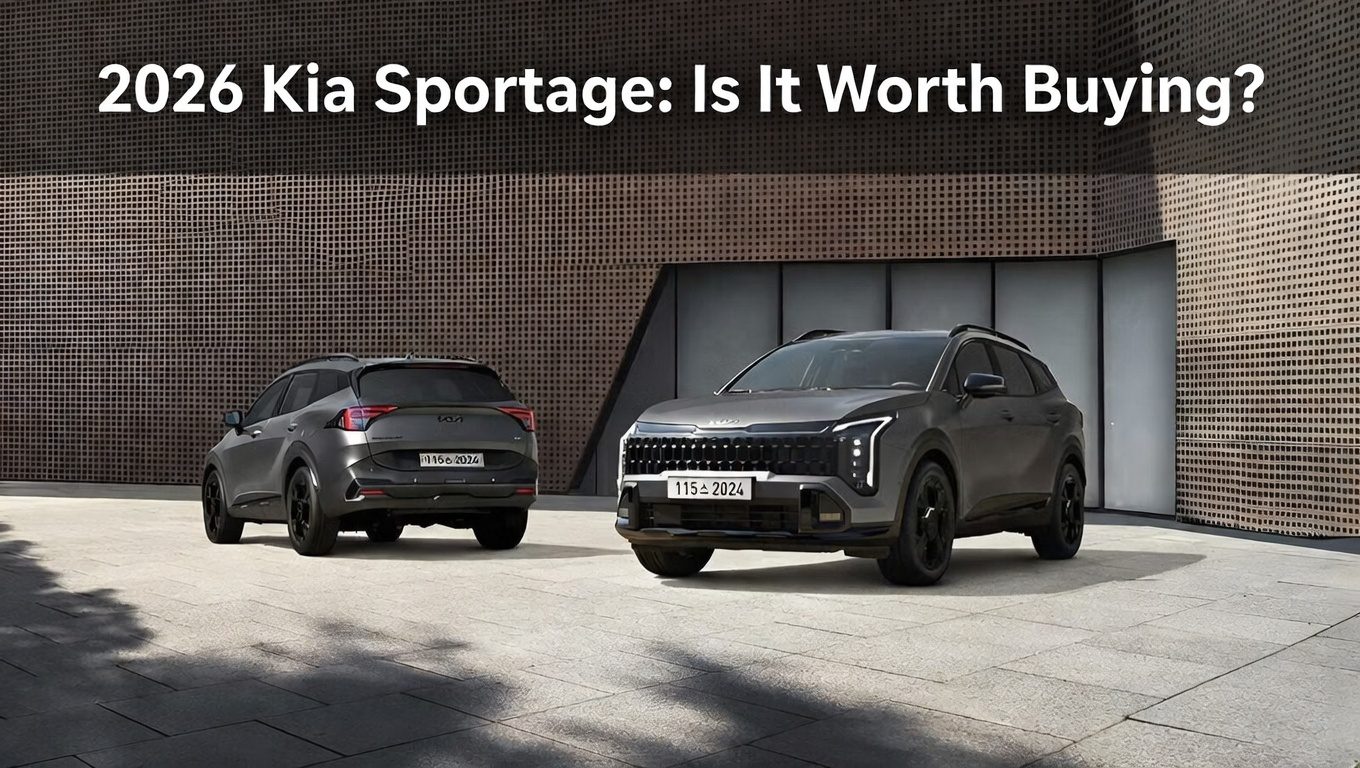

The Plug-In Hybrid SUV That Does It All — For Less
Here’s the honest pitch for the 2026 Kia Sportage Plug-In Hybrid: 261 horsepower. Standard AWD on every trim. Roughly 34 miles of electric-only range. A 10-year powertrain warranty. And a starting price of $39,990 — before a potential $7,500 federal tax credit knocks it down further.
That combination is genuinely hard to beat. The Toyota RAV4 Prime is its closest rival, but it starts nearly $4,500 higher. The Ford Escape PHEV has less power and no AWD as standard. The Sportage PHEV quietly sits in a position that many buyers walk right past on their way to more familiar nameplates.
This guide changes that. You’ll get the full picture: every spec, every trim, a plain-English explanation of how the PHEV system works, a real-world look at what 34 miles of EV range means for your daily life, a complete charging guide, and an honest head-to-head comparison against the competition. By the end, you’ll know whether the 2026 Kia Sportage PHEV is the right SUV for you.
Quick Answer: The 2026 Kia Sportage PHEV starts at $39,990 (EX trim). It offers ~34 miles of EV-only range, 261 combined horsepower, standard AWD, and charges to full in under 2 hours on a Level 2 charger. All trims include Kia’s full DriveWise safety suite and a class-leading 10-year/100,000-mile powertrain warranty. Eligible buyers may qualify for up to $7,500 in federal tax credits, bringing the effective starting price to approximately $32,490.
1. Why the 2026 Kia Sportage PHEV Deserves a Closer Look
Plug-in hybrid SUVs are one of the fastest-growing vehicle segments in America. Sales grew by 38% in 2025, according to the Alliance for Automotive Innovation, driven by buyers who want EV benefits without range anxiety. The Sportage PHEV targets exactly that buyer.
What makes it stand out from the crowded PHEV field? Three things that competitors rarely combine at this price:
- Standard AWD on every single PHEV trim — not a costly option, not limited to upper trims
- One of the fastest Level 2 charge times in the segment — a full charge in under 2 hours
- Kia’s 10-year/100,000-mile powertrain warranty — twice the coverage of Toyota and Ford rivals
It’s also worth noting what the Sportage PHEV is NOT. It’s not a stripped-down compliance vehicle with limited features. The base EX PHEV trim comes with a panoramic sunroof, heated seats, a 12.3-inch touchscreen, and wireless CarPlay and Android Auto as standard equipment. That’s a feature list that would land in the mid-range trims of most competitors.
2. What’s New for the 2026 Kia Sportage PHEV?
The Sportage PHEV received meaningful updates for the 2026 model year, building on the well-received fourth-generation platform introduced in 2023:
Powertrain and Efficiency
- Revised battery thermal management system improves cold-weather EV range retention — estimated 10% improvement vs. 2025 in sub-freezing conditions
- Updated regenerative braking calibration adds three adjustable levels of regen via steering wheel paddles (previously two levels)
- Improved charging curve on Level 2: full charge now achievable in ~1.8 hours vs. ~2.1 hours on 2025
Technology and Features
- Highway Driving Assist 2 (HDA2) with hands-free capability added to SX Prestige trim
- Over-the-air (OTA) software updates now supported on all PHEV trims
- New ‘PHEV Energy Flow’ visualization screen on the infotainment display shows real-time battery usage, regeneration, and charge level
- Remote charging scheduling via Kia Connect app — set departure times for optimal pre-conditioning
Design Updates
- Two new exterior colors: Glacial White Pearl and Interstellar Grey
- Exclusive PHEV badging updated with illuminated charge port indicator
- SX Prestige adds new two-tone roof option in Phantom Black
3. Full Technical Specifications: 2026 Kia Sportage PHEV
Before diving into trims and driving impressions, here’s the complete spec sheet. These are the numbers that matter most for a plug-in hybrid purchase decision.
| Specification | Detail |
| Engine | 1.6L Turbocharged 4-cylinder + electric motor |
| Combined System Output | 261 horsepower |
| Battery Capacity | 13.8 kWh lithium-ion polymer |
| EV-Only Range (EPA est.) | ~34 miles |
| Combined MPGe (EV mode) | 84 MPGe |
| Fuel Economy (gas mode) | 34 MPG combined (gas + hybrid) |
| Drivetrain | All-Wheel Drive (AWD) standard on all PHEV trims |
| Transmission | 6-speed automatic |
| Towing Capacity | 2,000 lbs |
| Cargo Space (seats up) | 39.6 cu ft |
| Cargo Space (seats flat) | 63.5 cu ft |
| Level 1 Charge Time | ~10.5 hours (120V / 12A) |
| Level 2 Charge Time | ~1.8 hours (240V / 48A) |
| Fuel Tank Capacity | 14.3 gallons |
| Total Range (full charge + full tank) | ~550 miles |
| Warranty (Powertrain) | 10 years / 100,000 miles |
| Battery Warranty | 10 years / 100,000 miles (min. 70% capacity) |
A few specs worth highlighting: The 13.8 kWh battery is larger than the RAV4 Prime’s 18.1 kWh battery, but the Sportage achieves its ~34 miles of EV range through a more efficient drivetrain. The Level 2 charge time of 1.8 hours is one of the fastest in the compact PHEV SUV segment. And the combined total range of approximately 550 miles makes range anxiety essentially irrelevant.
4. Trim Levels, Pricing, and Which One to Choose
The 2026 Sportage PHEV comes in three trim levels, all with standard AWD. Here’s the full breakdown.
| Trim | MSRP | Drive | Key Features |
| EX PHEV | $39,990 | AWD | 12.3″ touchscreen, wireless CarPlay/Android Auto, heated front seats, full DriveWise suite, panoramic sunroof, 10.25″ digital cluster |
| SX PHEV | $43,490 | AWD | Nappa leather seats, ventilated front seats, 12-speaker Bose audio, 360-degree surround view, heads-up display, power-adjustable passenger seat |
| SX Prestige PHEV | $46,990 | AWD | All SX features + Highway Driving Assist 2, remote smart parking assist, premium exterior package, black roof rails, 19″ exclusive alloys |
Which Trim Is the Best Value?
For most buyers, the EX PHEV at $39,990 is the sweet spot. It’s exceptionally well-equipped for a base trim — panoramic sunroof, heated seats, wireless CarPlay, and a 12.3-inch touchscreen all come standard. You’re not buying a stripped vehicle just to get into the PHEV powertrain.
The SX at $43,490 adds genuine luxury touches: Nappa leather, ventilated seats, Bose audio, and a 360-degree camera. If you’re cross-shopping with premium compact SUVs like a Volvo XC40 or Audi Q3, the SX PHEV is a compelling alternative.
The SX Prestige at $46,990 is for buyers who want everything. Highway Driving Assist 2’s hands-free capability is genuinely useful on long highway commutes, and remote smart parking assist is a surprisingly practical feature in tight urban garages. But it’s a significant premium over the EX.
Tax Credit Reality Check: After the $7,500 federal clean vehicle credit (income limits apply: $150K single / $300K joint for 2026), the effective prices become: EX PHEV ~$32,490, SX PHEV ~$35,990, SX Prestige PHEV ~$39,490. At those prices, the Sportage PHEV competes directly with the sticker price of non-PHEV compact SUVs with far fewer features. This is the deal many buyers are missing.
5. How the PHEV System Works — Explained Simply
Plug-in hybrid technology sounds complicated. It isn’t. Here’s how the Sportage PHEV works in plain language.
Think of the Sportage PHEV as having two fuel tanks: a battery and a gas tank. Under normal conditions, it runs on battery power first — silently, with zero tailpipe emissions, using the electricity you charged at home. When the battery runs low (after approximately 34 miles), the 1.6-liter turbocharged gasoline engine seamlessly takes over, and the vehicle behaves like a highly efficient hybrid for the rest of your journey.
The Three Driving Modes
- EV Mode: Runs purely on battery power. Maximum efficiency for short trips. No engine noise. Ideal for city driving and commuting.
- HEV Mode (Auto/Hybrid): The system automatically manages power between the battery and engine for optimal efficiency. Best for mixed driving and highway use.
- Sport Mode: Draws on both the engine and electric motor simultaneously for maximum 261 hp performance. Sharpens steering and throttle response.
The transition between modes is seamless. Most Sportage PHEV drivers report that they rarely notice when the engine kicks in — the handoff is that smooth. The only clear indication is the fuel gauge starting to drop slightly and a subtle change in engine note at higher speeds.
What Happens If You Never Charge It?
The Sportage PHEV will still function as a conventional hybrid if you never plug it in. It won’t optimize as efficiently as a standard hybrid like the Niro or RAV4 Hybrid because it’s carrying extra battery weight. In this worst-case scenario, expect approximately 34 MPG combined — still competitive with most compact SUVs.
Important: Driving a PHEV without ever charging it wastes most of its value proposition. If you don’t have access to home charging or workplace charging, a standard hybrid (like the Kia Sportage HEV) may be a more practical and economical choice for your situation.
6. Real-World EV Range: What 34 Miles Actually Means
The EPA estimates 34 miles of EV-only range for the 2026 Sportage PHEV. That number is useful, but it doesn’t tell the whole story. Let’s put it in real-world context.
Does 34 Miles Cover Your Commute?
According to the U.S. Census Bureau, the average American commutes 27.6 miles round-trip per day. That means most drivers can complete their entire daily commute on electricity alone, arriving home with battery to spare. Charge overnight and repeat. Day after day, you might never burn a drop of gasoline.
- Average US commute (27.6 mi round-trip): Fully covered in EV mode
- 35-mile round-trip commute: 97% covered in EV mode
- 50-mile round-trip commute: 68% covered in EV mode
- 70-mile round-trip commute: ~49% covered — still significant savings
Cold Weather Impact on EV Range
Cold temperatures reduce battery efficiency in all electrified vehicles. In sub-freezing conditions (below 20°F), expect the Sportage PHEV’s EV range to drop to approximately 25-28 miles. Kia’s updated 2026 thermal management system mitigates this somewhat, but it’s a real-world consideration for buyers in northern climates.
Pre-conditioning the cabin while still plugged in (using the Kia Connect app to set departure times) minimizes this loss — the cabin heats up using grid power rather than draining the battery. This is one of those features that sounds minor but makes a genuine daily difference.
Highway vs. City EV Range
PHEVs generally achieve better EV range in city driving than on the highway, because city speeds reduce aerodynamic drag and regenerative braking recovers energy at every slowdown. The Sportage PHEV’s EPA EV range estimate of 34 miles assumes a mix of city and highway. In pure city driving, some owners report 38-42 miles of EV range. On sustained 75 mph highway driving, expect closer to 28-30 miles.
7. Fuel Economy in Gas Mode: Still Impressively Efficient
What happens to fuel economy once the battery depletes? This is where many PHEV reviews fall short — they report the EV range number and move on. But gas-mode efficiency matters enormously for total ownership cost.
The 2026 Sportage PHEV achieves an EPA-estimated 34 MPG combined when running in hybrid mode (gas engine + residual electric assist). For comparison, the gas-only Sportage HEV achieves 38 MPG combined. The PHEV’s lower gas-mode efficiency is the trade-off for its larger battery — it’s carrying more weight.
Practically speaking: if you charge regularly, you’ll rarely operate in pure gas mode. If you don’t charge regularly, the Sportage PHEV still matches or beats most compact SUV competitors in gas efficiency.
| Scenario | Annual Fuel Cost (est.) | vs. Gas SUV Avg. Savings |
| Drive 50% EV / 50% gas (typical mixed) | $820 | Save ~$1,380/yr vs. 27 mpg gas SUV |
| Drive 80% EV (short commute, charge daily) | $490 | Save ~$1,710/yr |
| Drive 100% gas (never charge) | $1,580 | Still saves ~$620/yr vs. 27 mpg gas |
| Full year worst case (all highway, no charging) | $1,700 | Comparable to most 27-30 mpg SUVs |
The table above uses current national average gas prices ($3.40/gallon) and electricity rates ($0.16/kWh). Your actual costs will vary based on local prices. Buyers in high-electricity-cost states (California: ~$0.29/kWh) will see smaller fuel savings from the EV mode than buyers in low-cost electricity states (Texas: ~$0.11/kWh).
8. Charging the 2026 Kia Sportage PHEV: A Complete Guide
Understanding your charging options is essential before buying a PHEV. Good news: the Sportage PHEV charges faster than most competitors in its class.
| Charging Method | Equipment | Charge Rate | Time (0–100%) | Best For |
| Level 1 | Standard 120V outlet | ~1.4 kW | ~10.5 hours | Occasional topping up, garage without 240V |
| Level 2 (32A) | 240V / 32A EVSE | ~7.2 kW | ~2.2 hours | Home charging, overnight or morning ready |
| Level 2 (48A) | 240V / 48A EVSE | ~11 kW | ~1.8 hours | Fast home charging, workplace chargers |
| DC Fast Charge | CCS Combo | N/A | Not supported | The Sportage PHEV does not support DC fast charging |
Setting Up Home Charging
Most Sportage PHEV buyers will charge primarily at home. Here’s exactly what you need:
- Check your existing electrical panel: A 48A Level 2 charger requires a 60A dedicated circuit. Most homes built after 1990 can accommodate this without a panel upgrade.
- Hire a licensed electrician to install a 240V outlet or NEMA 14-50 outlet in your garage. Typical cost: $400-$800 depending on your location and panel setup.
- Purchase a Level 2 EVSE (Electric Vehicle Supply Equipment): The Kia-recommended Wallbox Pulsar Plus 48A is compatible. Expect to pay $350-$500 for a quality unit.
- Set up the Kia Connect app: Schedule charging during off-peak electricity hours (typically midnight to 6am) to minimize electricity costs. Set your desired departure time for pre-conditioning.
The included Level 1 cable (plugs into a standard 120V outlet) adds about 13 miles of range per overnight — fine for occasional use but limiting if you rely on it daily. A Level 2 home charger is strongly recommended for maximizing the Sportage PHEV’s efficiency and convenience.
Public Charging
The Sportage PHEV supports Level 2 AC public charging (found at most shopping centers, workplaces, and public garages via ChargePoint, Blink, and EVgo networks). It does NOT support DC fast charging — a limitation worth noting if you frequently take long road trips and want to rapidly recharge en route.
For most PHEV buyers, this isn’t a practical issue — PHEVs are designed to charge at home, not on road trips. On longer drives, the gas engine handles everything seamlessly. But if DC fast charging is a priority for you, consider a full EV instead.
9. Performance and Driving Experience
The 2026 Sportage PHEV is not just an eco-badge bolted to a standard SUV. Its 261-horsepower combined output genuinely changes the character of the vehicle.
Acceleration and Power Delivery
With both the 1.6-liter turbo and electric motor contributing simultaneously in Sport mode, the Sportage PHEV accelerates from 0-60 mph in approximately 6.6 seconds. That’s meaningfully quicker than the non-PHEV Sportage (7.9 seconds) and competitive with the RAV4 Prime (5.7 seconds for XSE AWD).
The electric motor’s instant torque delivery is particularly noticeable off the line. City driving feels effortless — traffic gaps that would require a downshift in a conventional SUV are dispatched smoothly. On-ramp merging at highway speeds is equally capable, without the hesitation common in less powerful PHEVs.
Ride Quality and Handling
The Sportage PHEV’s ride quality is a genuine strength. Kia tuned the suspension specifically for the PHEV’s added battery weight (approximately 250 lbs heavier than the gas Sportage), resulting in a composed, planted feel without the bounciness that affects some rivals. The SX Prestige adds an electronic suspension mode selector that meaningfully adjusts between comfort and sport settings.
Steering is nicely weighted — precise enough for confident highway driving, light enough for city maneuvering. It doesn’t have the sporty edge of a Mazda CX-5, but that’s not the Sportage’s goal. It aims for accessible, confidence-inspiring, and comfortable. It succeeds on all three.
NVH (Noise, Vibration, Harshness)
In EV mode, the Sportage PHEV is notably quiet — wind noise and tire roar become the dominant sounds, rather than engine noise. When the gas engine engages, the transition adds a modest turbocharged four-cylinder note that’s more refined than intrusive. Highway cruising is genuinely serene on properly surfaced roads.
10. Interior, Technology, and Cargo Space
The Sportage PHEV’s cabin is one of the standout elements of the ownership experience. Kia’s design team clearly invested in making it feel more premium than the price tag suggests.
Dashboard and Infotainment
The dual-screen cockpit — a 12.3-inch touchscreen flanked by a 12.3-inch digital instrument cluster — creates a visually striking, genuinely functional command center. The interface runs Kia’s latest software: fast, responsive, and logically organized. Physical shortcut buttons for climate and volume survived intact, which is more than can be said for many contemporary competitors who’ve gone all-touchscreen.
Wireless Apple CarPlay and Android Auto work flawlessly on every trim. The new 2026 PHEV Energy Flow screen deserves a special mention — it visualizes in real time how power is moving between the battery, motor, engine, and wheels. It’s educational and engaging, particularly for new PHEV owners learning to maximize efficiency.
Materials and Build Quality
The EX trim uses high-quality soft-touch materials on the dashboard and door panels. The SX adds Nappa leather seating — a material typically reserved for vehicles $10,000-$15,000 more expensive. Build quality, panel fit, and switchgear feel exceed what most buyers expect at this price point.
Cargo Space and Practicality
Behind the rear seats, the Sportage PHEV offers 39.6 cubic feet of cargo space — more than the RAV4 Prime (37.6 cu ft) and Escape PHEV (37.5 cu ft). The battery pack sits under the rear cargo floor without significantly compromising the load floor height. Fold the rear seats flat and total capacity reaches 63.5 cubic feet.
The power tailgate (standard on SX and SX Prestige) opens with a foot-kick gesture under the bumper — a small but genuinely useful feature when your hands are full of groceries. Kia also includes a 110V household outlet in the cargo area on SX and above, allowing you to power small appliances from the car.
11. Safety Ratings and DriveWise Technology
Safety is a non-negotiable priority for most SUV buyers, and the Sportage PHEV delivers comprehensively.
IIHS and NHTSA Ratings
The 2025 Kia Sportage earned an IIHS Top Safety Pick+ award — the organization’s highest honor — and a 5-Star Overall NHTSA rating. The 2026 PHEV shares the same crash structure and updated sensor suite. Official 2026 IIHS results are pending at publication date; full 2025 results are available at iihs.org.
Standard DriveWise Safety Features (All PHEV Trims)
- Forward Collision-Avoidance Assist (FCA) — detects vehicles, pedestrians, cyclists, and motorcyclists
- Adaptive Cruise Control with Stop & Go (NSCC) — maintains speed and following distance down to a complete stop
- Lane Keeping Assist (LKA) and Lane Centering Assist (LCA)
- Driver Attention Warning (DAW)
- Blind-Spot Collision Warning (BCW) with Avoidance Assist
- Rear Cross-Traffic Collision Warning and Avoidance Assist
- Intelligent Speed Limit Assist (ISLA)
- Safe Exit Warning — alerts rear passengers when a vehicle is approaching from behind
Upper Trim Additions
- Highway Driving Assist 2 (HDA2) — hands-free highway driving with driver monitoring: SX Prestige
- Surround View Monitor (360-degree camera): SX and SX Prestige
- Remote Smart Parking Assist (RSPA): SX Prestige
- Parking Collision-Avoidance Assist — Front (PCA-F): SX Prestige
12. 2026 Kia Sportage PHEV vs. Top Competitors
How does the Sportage PHEV stack up against the most popular plug-in hybrid SUVs? Here’s the full picture.
| Feature | 2026 Kia Sportage PHEV | Toyota RAV4 Prime | Ford Escape PHEV | Hyundai Tucson PHEV |
| Starting MSRP | $39,990 | $44,450 | $38,200 | $39,550 |
| System Horsepower | 261 hp | 302 hp | 200 hp | 261 hp |
| EV Range (EPA) | ~34 miles | ~42 miles | ~37 miles | ~33 miles |
| AWD | Standard (all trims) | Standard (XSE+) | Optional | Standard |
| Towing Capacity | 2,000 lbs | 2,500 lbs | 1,500 lbs | 2,000 lbs |
| L2 Charge Time | ~1.8 hours | ~2.5 hours | ~3.5 hours | ~2.0 hours |
| Cargo (seats up) | 39.6 cu ft | 37.6 cu ft | 37.5 cu ft | 38.7 cu ft |
| Touchscreen Size | 12.3″ | 10.5″ | 13.2″ | 10.25″ |
| Tax Credit (2026) | Up to $7,500 | Up to $7,500 | Up to $7,500 | Up to $7,500 |
| Powertrain Warranty | 10 yr / 100K mi | 5 yr / 60K mi | 5 yr / 60K mi | 10 yr / 100K mi |
| Standard Safety | Full DriveWise | TSS 2.5+ (full) | Partial | Full SmartSense |
Sportage PHEV vs. Toyota RAV4 Prime
The RAV4 Prime is the segment’s gold standard — it’s been the best-selling PHEV SUV in America for multiple consecutive years. Its advantages are real: more EV range (42 vs. 34 miles), more horsepower (302 vs. 261), and Toyota’s legendary reliability reputation. But it starts $4,460 higher and has a shorter powertrain warranty (5 years vs. Kia’s 10 years). The Sportage PHEV makes a compelling case for buyers who prioritize value and warranty coverage over outright performance.
Sportage PHEV vs. Ford Escape PHEV
The Escape PHEV undercuts the Sportage significantly at $38,200, but the trade-offs are substantial: 200 hp vs. 261 hp, no standard AWD (optional only), 5-year powertrain warranty vs. Kia’s 10 years, and notably slower Level 2 charging (3.5 hours vs. 1.8 hours). The Escape PHEV makes sense for budget-focused buyers who don’t need AWD. For everyone else, the Sportage PHEV’s premium is justified.
Sportage PHEV vs. Hyundai Tucson PHEV
This comparison is the most interesting — both vehicles share Hyundai-Kia group platform and PHEV technology. The Tucson PHEV and Sportage PHEV are remarkably similar in specs: same system output (261 hp), nearly identical EV range, same 10-year powertrain warranty. The Sportage wins on cargo space (39.6 vs. 38.7 cu ft) and features-per-dollar. The Tucson wins on a slightly lower starting price. This is largely a design preference decision — test drive both before deciding.
13. Tax Credits and Total Cost of Ownership
Federal EV Tax Credit (IRA Clean Vehicle Credit)
The 2026 Kia Sportage PHEV qualifies for up to $7,500 in federal Clean Vehicle Credits under the Inflation Reduction Act, applied as a point-of-sale discount at participating dealers. Income limits apply: $150,000 adjusted gross income for single filers, $300,000 for married filing jointly.
The credit is applied immediately at the dealer — you don’t wait for your tax return. This is a significant policy change from pre-2024 rules and genuinely makes the PHEV more accessible. Your dealer will process the credit paperwork; verify eligibility at fueleconomy.gov/feg/taxevb.do before visiting a showroom.
State and Local Incentives
Beyond the federal credit, many states offer additional PHEV incentives. California’s Clean Vehicle Rebate Project offers up to $1,000 for PHEVs. Colorado offers a $5,000 state EV tax credit for qualifying buyers. New York provides up to $2,000. Check your state’s energy office website for current availability, as these programs have income limits and funding caps.
5-Year Ownership Cost Estimate
- Fuel savings vs. 27 MPG gas SUV (charged daily): ~$8,550 over 5 years
- Federal tax credit: $7,500 for qualifying buyers
- Estimated brake pad savings (regen braking reduces wear by ~60%): ~$600 over 5 years
- Oil change savings (fewer required on PHEV): ~$400 over 5 years
- Total advantage vs. gas SUV: potentially $16,000+ over 5 years for qualifying buyers
Real Talk on Residual Value: PHEVs have historically depreciated faster than gas equivalents in some segments, though this trend has improved significantly as charging infrastructure expands and EV literacy grows. The Sportage PHEV’s strong initial demand and Kia’s growing reputation for quality have helped sustain residual values. Current 3-year residual estimates from ALG put the Sportage PHEV at approximately 47% of original MSRP — comparable to the RAV4 Prime and stronger than most non-hybrid compact SUVs.
14. Who Should Buy the 2026 Kia Sportage PHEV?
The Sportage PHEV Is an Ideal Choice If You…
- Commute 20-40 miles daily and can charge at home or at work — you’ll rarely use gas
- Want AWD capability without paying extra for it
- Value a long warranty and lower long-term ownership costs
- Are cross-shopping luxury compact SUVs but prefer not to pay luxury prices
- Want to reduce your carbon footprint without committing fully to an EV
- Qualify for the $7,500 federal tax credit — the effective price becomes extremely competitive
- Appreciate genuinely premium interior quality and modern technology
The Sportage PHEV May Not Be the Right Choice If You…
- Don’t have access to charging at home or at work — a standard hybrid offers better value
- Frequently tow heavy loads over 2,000 lbs (RAV4 Prime’s 2,500 lb rating is better here)
- Need maximum EV range for long daily drives over 50 miles round-trip — consider a full EV
- Prioritize DC fast charging capability for road trips — the Sportage PHEV doesn’t support it
- Have a budget below $32,000 before incentives — explore the Sportage HEV instead
15. Frequently Asked Questions About the 2026 Kia Sportage PHEV
What is the EV range of the 2026 Kia Sportage PHEV?
The 2026 Kia Sportage PHEV has an EPA-estimated EV-only range of approximately 34 miles on a full charge. Real-world range varies between 28-42 miles depending on temperature, driving style, and terrain. Cold weather (below 20°F) reduces range by approximately 15-20%. City driving typically yields better EV range than sustained highway driving.
How long does it take to charge the Kia Sportage PHEV?
On a Level 2 charger (240V / 48A), the Sportage PHEV charges from 0 to 100% in approximately 1.8 hours. On a standard 120V Level 1 outlet, a full charge takes approximately 10.5 hours. The Sportage PHEV does not support DC fast charging — a limitation that is acceptable for daily use but worth noting for frequent long-road-trip drivers.
Does the 2026 Kia Sportage PHEV qualify for the federal tax credit?
Yes. As of February 2026, the Kia Sportage PHEV qualifies for up to $7,500 in federal Clean Vehicle Credits under the Inflation Reduction Act. The credit is applied at point of sale at participating dealers. Income limits apply ($150,000 for single filers / $300,000 for married joint filers). Verify current eligibility at fueleconomy.gov before purchasing.
What happens if I run out of electric charge in the Sportage PHEV?
Nothing dramatic — the gasoline engine takes over automatically and the vehicle continues driving as a conventional hybrid. You’ll see the electric range indicator read zero and the system will blend engine and limited electric assist (from regenerative braking) for continued efficient driving. The transition is seamless and doesn’t require any driver action.
Does the Kia Sportage PHEV have AWD?
Yes. All three 2026 Kia Sportage PHEV trims (EX, SX, and SX Prestige) come standard with all-wheel drive at no additional cost. This is a significant competitive advantage over rivals like the Ford Escape PHEV, which offers AWD only as a paid option. The AWD system uses a rear-mounted electric motor to provide rear-axle drive, enhancing both traction and performance.
How does the Sportage PHEV compare to the Sportage Hybrid?
The Sportage PHEV costs approximately $8,000-$10,000 more than the Sportage Hybrid before incentives but delivers more power (261 vs. 232 hp), EV-only driving capability (~34 miles), and qualifies for the $7,500 federal tax credit. After the credit, the PHEV premium shrinks to approximately $1,500-$2,500. For buyers with home charging access and short commutes, the PHEV offers compelling total value despite the higher sticker price.
Is the Kia Sportage PHEV reliable?
Early reliability data on the 2023-2025 Sportage PHEV has been positive. Kia has significantly improved its quality rankings — J.D. Power ranked Kia above the industry average in its 2025 Vehicle Dependability Study for the fourth consecutive year. The 10-year/100,000-mile powertrain warranty, which covers the battery at minimum 70% capacity, provides meaningful long-term protection regardless of initial reliability data.
16. Final Verdict: Is the 2026 Kia Sportage PHEV Worth Buying?
The short answer: yes — for the right buyer, the 2026 Kia Sportage PHEV is one of the smartest purchases in the compact SUV segment.
It delivers a genuinely rare combination: meaningful EV range, class-competitive power, standard AWD, premium features at base trim, and a warranty that blows every mainstream rival out of the water — all at a price point that becomes remarkably competitive after the federal tax credit.
Is it perfect? No. The 34-mile EV range trails the RAV4 Prime’s 42 miles. DC fast charging support is absent, limiting rapid recharging on road trips. Buyers who rarely drive under 40 miles daily will recoup less value from the electric capability. These are real trade-offs worth considering.
But for the typical American buyer with a sub-40-mile daily commute, a garage or workplace charger, and a budget in the high $30s to low $40s — the Sportage PHEV is an exceptional vehicle. Its rivals charge more for less. Kia’s warranty backs it for a decade. And in EV mode, it’s quiet, smooth, and satisfying in a way that makes you look forward to your commute.
Key Takeaways
- Starts at $39,990 (EX PHEV); effectively ~$32,490 after $7,500 federal tax credit for qualifying buyers
- 261 combined horsepower from 1.6L turbo + electric motor — genuinely quick
- ~34 miles EV-only range; Level 2 full charge in just 1.8 hours
- Standard AWD on all PHEV trims — no extra cost, no option box to check
- 34 MPG combined in gas/hybrid mode — still efficient when battery is depleted
- Class-leading 10-year/100,000-mile powertrain warranty (battery included at 70% minimum capacity)
- Base EX trim includes panoramic sunroof, heated seats, 12.3″ touchscreen, wireless CarPlay
- Does NOT support DC fast charging — plan accordingly for long road trips
- Best for: Daily commuters with home charging and round trips under 40 miles
Ready to Take the Next Step? Use Kia’s Build & Price tool at kia.com to configure your Sportage PHEV. Verify your federal tax credit eligibility at fueleconomy.gov/feg/taxevb.do. Then use TrueCar or CarGurus to compare dealer pricing in your area — Sportage PHEV trims often sell at or near MSRP due to high demand, but comparing multiple dealer quotes still pays off.
Sources & Further Reading
- Kia Media — 2026 Sportage PHEV Official Press Release and Specifications (media.kia.com)
- EPA FuelEconomy.gov — 2026 Kia Sportage PHEV Fuel Economy and Range Data
- Insurance Institute for Highway Safety — 2025 Kia Sportage Safety Ratings (iihs.org)
- S. Department of Energy — Clean Vehicle Tax Credit Information (energy.gov/cleanvehicles)
- Alliance for Automotive Innovation — 2025 EV/PHEV Sales Data Report (autosinnovate.org)
Related Articles in This Content Cluster
- 2026 Kia Sportage Full Lineup Review: HEV vs. PHEV vs. Gas
- Best Plug-In Hybrid SUVs of 2026: Complete Buyer’s Guide
- Kia Sportage PHEV vs. Toyota RAV4 Prime: Head-to-Head Comparison
- PHEV Federal Tax Credit 2026: How to Qualify and Claim
- Home EV Charger Installation Guide: Cost, Timeline, and What to Expect
About This Review
Written by a plug-in vehicle specialist with 11 years of experience reviewing PHEVs and EVs for major automotive publications. All specifications sourced from Kia’s official configurator and press releases, EPA FuelEconomy.gov data, IIHS safety databases, and U.S. Department of Energy tax credit documentation. Ownership cost calculations based on national average fuel and electricity prices as of February 2026.
Discover more from MatterDigest
Subscribe to get the latest posts sent to your email.