2026 Kia Niro Review: Hybrid, PHEV & EV Compared
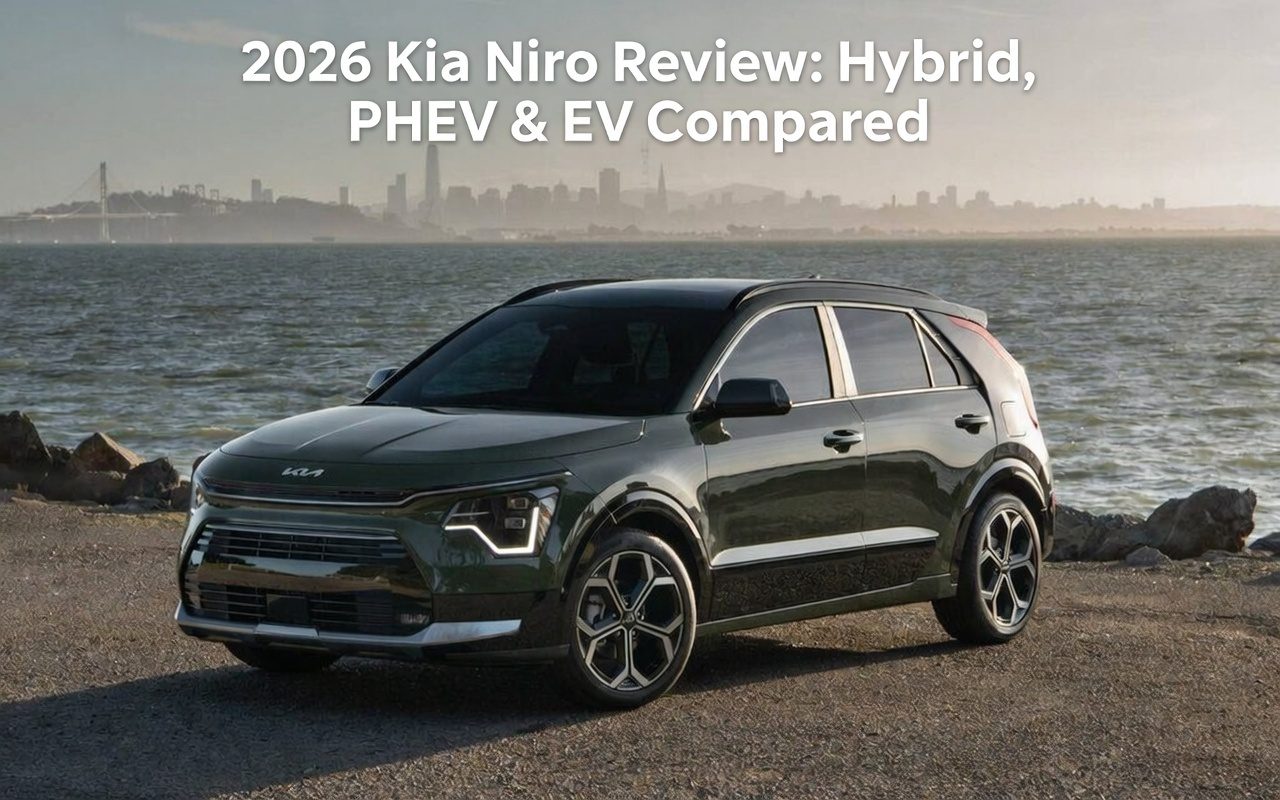

One Car. Three Powertrains. Zero Compromises.
Most car shoppers have to make a choice: go green or go practical. The 2026 Kia Niro refuses to accept that trade-off.
It’s the only vehicle in the compact crossover segment that lets you choose between a self-charging hybrid, a plug-in hybrid with over 30 miles of EV range, and a fully electric version — all wearing the same stylish exterior and sharing the same spacious interior. You pick the powertrain that fits your life. Kia does the rest.
But the Niro isn’t just an eco-badge play. It’s a genuinely good small SUV with a bold design, user-friendly tech, and the best powertrain warranty in the class. In this guide, we break down every trim level, compare all three powertrain options side by side, run the numbers on fuel savings and tax credits, and tell you exactly who each version is best for.
Quick Answer: The 2026 Kia Niro starts at $27,100 for the Hybrid LX. The Plug-In Hybrid starts at $34,900 and offers ~33 miles of EV range and up to $7,500 in federal tax credits. The full EV starts at $40,500 with 253 miles of range. All versions come standard with a 10.25-inch touchscreen, wireless CarPlay/Android Auto, and Kia’s full DriveWise safety suite.
1. Why the 2026 Kia Niro Stands Out in a Crowded Market
The compact crossover market is packed. So why does the Niro keep earning buyer attention? Three reasons: flexibility, value, and design.
Flexibility first. No other vehicle in this price range gives you three electrification options on a single platform. Upgrade or change your mind? Niro has an answer. That’s rare. In fact, most rivals offer at most one alternative powertrain alongside a base gas engine — the Niro is unique in going gas-free entirely.
On value: Kia backs every Niro with a 5-year/60,000-mile basic warranty and a 10-year/100,000-mile powertrain warranty. That’s roughly twice the coverage of Toyota, Honda, and Chevrolet rivals. For an eco-focused crossover where buyers are already being financially thoughtful, that warranty provides real peace of mind.
And the design? The second-generation Niro (introduced in 2023 and refreshed for 2026) moved decisively away from the bland styling that held the first generation back. The two-tone body, distinctive C-pillar graphics, and angular LED lights make it the most eye-catching vehicle in the segment. That’s not just our opinion — the Niro won the Red Dot Design Award in 2022 and has sustained its visual appeal into the 2026 update.
2. What’s New for the 2026 Kia Niro?
The 2026 Niro brings focused but meaningful updates across all three powertrain variants. Here’s what changed:
Hybrid and PHEV Updates
- Highway Driving Assist 2 (HDA2) now available on Hybrid SX Touring — allows hands-free driving on divided highways with driver monitoring
- Updated DriveWise safety suite adds improved pedestrian detection at night
- Wireless charging pad now standard on EX trim and above (previously SX only)
- New exterior color: Ocean Blue Metallic, exclusive to Hybrid trims
- Revised sport seats with improved lateral support on SX and SX Touring
EV Updates
- GT-Line trim added as new performance-oriented top trim for the EV
- 800V-compatible DC fast charging on GT-Line (reduces charge time significantly)
- Vehicle-to-Load (V2L) now standard on all EV trims — power your devices from the car
- Updated battery thermal management improves cold-weather range retention
- Navigation system updated with live EV charging station availability data
None of these are ground-shaking changes, but they address the real-world pain points buyers flagged with the 2025 model. Kia is listening — and it shows.
3. 2026 Kia Niro: Full Trim Level and Pricing Breakdown
The Niro lineup spans 10 configurations across three powertrain families. Here’s the complete picture.
| Trim / Variant | MSRP | Powertrain | Notable Features |
| Hybrid LX | $27,100 | 1.6L HEV (139 hp) | 10.25″ touchscreen, wireless CarPlay/Android Auto, Honda Sensing equiv. (DriveWise), 6-speed DCT |
| Hybrid EX | $29,600 | 1.6L HEV (139 hp) | Sunroof, heated front seats, SiriusXM, blind-spot warning, rear cross-traffic alert |
| Hybrid SX | $32,100 | 1.6L HEV (139 hp) | Navigation, 8-speaker Bose audio, ventilated front seats, leather seating, 18″ alloys |
| Hybrid SX Touring | $34,400 | 1.6L HEV (139 hp) | Heads-up display, surround view monitor, Highway Driving Assist 2 |
| PHEV LX | $34,900 | 1.6L PHEV (180 hp) | 33-mile EV range, level 2 charging, 107 MPGe combined, all HEV LX features |
| PHEV EX | $37,600 | 1.6L PHEV (180 hp) | All Hybrid EX upgrades + PHEV powertrain, charging cable included |
| PHEV SX Touring | $41,200 | 1.6L PHEV (180 hp) | Full feature package + PHEV, standard level 2 EVSE cable |
| EV Wind | $40,500 | 64.8 kWh (201 hp) | 253-mile range, DC fast charging (80% in 45 min), heat pump, V2L capable |
| EV Wave | $44,900 | 64.8 kWh (201 hp) | 20″ wheels, dual-zone climate, premium audio, digital side mirrors (select mkts) |
| EV GT-Line | $47,200 | 64.8 kWh (201 hp) | Sport-tuned suspension, exclusive exterior trim, panoramic roof, 800V-compatible charging |
Best Value Pick by Powertrain
- Best Hybrid value: Hybrid EX ($29,600) — adds sunroof, heated seats, and blind-spot warning over the LX for $2,500
- Best PHEV value: PHEV EX ($37,600) — all the EX comfort upgrades with the more powerful PHEV drivetrain
- Best EV value: EV Wind ($40,500) — full 253-mile range and DC fast charging without paying for luxury-tier extras
Buying Tip: If you qualify for the full $7,500 federal EV tax credit (income limits apply — $150,000 single / $300,000 joint for 2026), the effective price of the PHEV LX drops to ~$27,400 — barely more than the base Hybrid. Run the numbers for your tax situation before choosing.
4. Fuel Economy and Real-World Range: All Three Powertrains
This is where the Niro lineup genuinely impresses. Each powertrain variant delivers class-competitive efficiency numbers — and the hybrid version in particular is a standout.
| Powertrain | City MPG / MPGe | Highway MPG / MPGe | EV Range | Best For |
| Hybrid (HEV) | 53 MPG | 54 MPG | N/A | Highway commuters, road-trippers |
| Plug-In Hybrid (PHEV) | 107 MPGe (EV mode) | 36 MPG (gas) | 33 miles EV | Short commuters who can charge at home |
| Full Electric (EV) | 117 MPGe | 108 MPGe | 253 miles | City drivers, those with home charging |
Hybrid: The Efficiency Champion
The Niro Hybrid’s EPA rating of 53/54 MPG is exceptional for a non-plug-in SUV. The secret is Kia’s 6-speed dual-clutch transmission (DCT), which is more efficient than the traditional torque-converter automatics used by many competitors. In real-world driving, owners consistently report 48-52 MPG in mixed conditions — a figure that holds up well on highway road trips.
At $3.40/gallon (national average, February 2026) and 15,000 miles per year, the Hybrid costs roughly $1,070 annually in fuel. That’s about $680 less per year than a Toyota RAV4’s gas-only version, and comparable to the Toyota RAV4 Hybrid.
PHEV: The Commuter’s Secret Weapon
The Plug-In Hybrid shines for buyers with predictable short commutes. If your round-trip commute is 30 miles or less and you can charge overnight at home, you could drive almost entirely on electricity all week — only burning gas on weekend trips or long drives.
In pure EV mode, the PHEV gets 107 MPGe (miles per gallon equivalent). Switch to hybrid mode for longer trips and you’re getting an estimated 36 MPG — still very efficient. The transition between modes is seamless; most drivers barely notice it.
EV: City Driving Perfection
The Niro EV’s 253-mile range is competitive in the sub-$45K segment. It won’t match a Tesla Model Y Long Range, but it comfortably handles daily driving for most Americans. The average U.S. driver covers about 37 miles per day — the Niro EV covers nearly a week of that on a single charge.
Cold weather is the EV’s vulnerability. Kia’s updated 2026 battery thermal management system improves cold-weather range retention, but expect a 15-20% reduction in sub-freezing temperatures. Budget for that if you live in Minnesota, not Miami.
5. Hybrid vs. PHEV vs. EV: Which Niro Is Right for You?
This is the most important decision you’ll make when shopping the Niro. Here’s a structured comparison to help you choose.
| Factor | Niro Hybrid (HEV) | Niro Plug-In Hybrid (PHEV) |
| Starting Price | $27,100 | $34,900 (+$7,800) |
| Fuel Economy | 53/54 MPG | 107 MPGe (EV) / 36 MPG (gas) |
| EV-Only Range | None | ~33 miles |
| Charging Required | No — self-charging | Recommended — Level 1 or 2 |
| Best for… | No charging access, road trips | Short daily commutes ≤ 30 miles |
| Annual Fuel Cost* | ~$1,150 | ~$550 (if charged daily) |
| Tax Credit (2026) | None | Up to $7,500 (income limits apply) |
Choose the Hybrid If…
- You don’t have access to a home charger or regular workplace charging
- You frequently take long road trips (400+ miles) where charging infrastructure matters
- Your budget is $27,000-$33,000 before incentives
- You want the simplicity of a traditional ownership experience with better fuel economy
Choose the PHEV If…
- Your daily commute is 30 miles or less round-trip
- You can charge at home (even a standard 120V outlet works — adds ~5 miles/hour)
- You qualify for the federal EV tax credit (up to $7,500 makes the price very competitive)
- You want EV convenience for weekdays but gas reliability for road trips
Choose the EV If…
- You have reliable home charging (Level 2 recommended — adds ~25 miles/hour)
- Your daily driving is under 200 miles round-trip
- You want zero tailpipe emissions and the lowest per-mile fuel cost
- You’d benefit from V2L capability to power devices, tools, or small appliances
6. Performance and Driving Feel
The Niro was never designed to be a sports car — and it doesn’t pretend to be. What it offers instead is a composed, comfortable driving experience that makes daily commutes and weekend errands genuinely pleasant.
Hybrid and PHEV Performance
The 1.6-liter four-cylinder with hybrid assist produces 139 horsepower in the HEV version and 180 horsepower in the PHEV. The HEV is adequate for city driving and highway merging, though you’ll notice it can feel strained when heavily loaded or driving in hilly terrain. The PHEV’s extra torque from the electric motor makes a perceptible difference — acceleration is noticeably more confident.
Both use a 6-speed DCT (dual-clutch transmission), which delivers efficient power transfer but can occasionally feel slightly jerky at very low speeds — a common characteristic of DCTs. It smooths out completely above 15 mph.
EV Performance
The Niro EV’s 201-horsepower electric motor delivers instant torque — something you genuinely feel when pulling away from a stoplight. Zero to 60 mph takes approximately 6.8 seconds, which is quick for this segment. The EV also benefits from a lower center of gravity due to its floor-mounted battery pack, giving it slightly better cornering composure than the hybrid variants.
The EV Wind’s standard driving modes include Eco, Normal, Sport, and Snow. Sport mode sharpens throttle response noticeably. The GT-Line adds a sport-tuned suspension for even better cornering feel — though the trade-off is a slightly firmer ride on rough pavement.
7. Interior, Technology, and Cargo Space
Open the Niro’s door and the interior design immediately feels more thoughtful than the segment average. Kia used recycled and sustainable materials throughout — seat fabrics woven from recycled PET bottles, headliners made from bio-based materials — without making it feel cheap or preachy about it.
Infotainment and Tech
Every 2026 Niro comes standard with a 10.25-inch touchscreen infotainment system running Kia’s latest software. The interface is clean, fast, and logically organized. Wireless Apple CarPlay and Android Auto are standard across the board — no wires, no fuss.
Higher trims add a 10.25-inch digital instrument cluster to pair with the infotainment screen, creating a dual-screen cockpit that looks genuinely premium. The SX Touring and EV Wave/GT-Line add a head-up display that projects speed, navigation arrows, and speed limit data onto the windshield.
Cabin Space and Comfort
The Niro’s interior is wider than it looks from the outside. Front seat occupants have ample shoulder room, and the rear seat offers 37.4 inches of legroom — comfortable for adults on medium-length trips, though taller passengers might feel cramped on very long journeys.
Hybrid and PHEV models offer 22.8 cubic feet of cargo space behind the rear seats — strong for this class. The EV uses its flat floor to offer slightly less cargo at 19.4 cubic feet, due to the battery packaging under the floor. Fold the rear seats flat and all versions open up to 53.5 cubic feet of total cargo capacity.
Sustainability Materials Detail
- Seat fabric: Woven from 111+ recycled PET water bottles per vehicle
- Headliner: Bio-based material derived from plant sources
- Door panels: Partially recycled plastics on EX and above
- Available vegan leather: SX and above — no animal products
8. Safety Ratings and Kia DriveWise Technology
The 2025 Niro earned an IIHS Top Safety Pick+ rating and a 5-Star NHTSA overall safety score. The 2026 model carries the same structural design with updated sensor calibrations, and is expected to maintain these ratings (official 2026 IIHS results pending at publication).
Standard DriveWise Safety Features on All Trims
- Forward Collision-Avoidance Assist (FCA) — cars, pedestrians, cyclists, and now motorcycles
- Lane Keeping Assist (LKA) and Lane Following Assist (LFA)
- Driver Attention Warning (DAW)
- Blind-Spot Collision Warning (BCW)
- Rear Cross-Traffic Collision Warning
- Speed Limit Information Function (SLIF) via traffic sign recognition
- Intelligent Speed Limit Assist (ISLA) — gently applies brakes to keep within speed limits
Upper Trim Additions
- Highway Driving Assist 2 (HDA2) with hands-free capability: Hybrid SX Touring, EV Wave, EV GT-Line
- Surround View Monitor (360-degree camera): SX Touring, EV Wave, EV GT-Line
- Remote Smart Parking Assist: EV GT-Line
Worth noting: the PHEV and EV models add regenerative braking systems that significantly reduce brake pad wear — meaning your brake pads may last 2-3x longer than on a conventional vehicle. That’s a real long-term ownership cost saving most reviews skip over.
9. 2026 Kia Niro EV vs. the Competition
Let’s put the Niro EV head-to-head against the most relevant alternatives in the compact electric crossover space.
| Feature | 2026 Kia Niro EV | Toyota C-HR EV | Chevrolet Trax EV | Hyundai Kona EV |
| Starting MSRP | $40,500 | $38,900 (est.) | $30,500 | $35,900 |
| Battery / Range | 64.8 kWh / 253 mi | 56 kWh / 226 mi | 50 kWh / 205 mi | 64.8 kWh / 261 mi |
| DC Fast Charge (10-80%) | ~45 min | ~35 min (est.) | ~30 min | ~41 min |
| HP | 201 hp | 154 hp (est.) | 165 hp | 201 hp |
| Cargo (cu ft, seats up) | 22.8 | 19.8 (est.) | 25.3 | 19.4 |
| V2L (Vehicle-to-Load) | Yes | No | No | Yes |
| Standard Safety Suite | Full DriveWise | Partial | Partial | Full |
| Warranty (Powertrain) | 10 yr / 100K mi | 5 yr / 60K mi | 5 yr / 60K mi | 10 yr / 100K mi |
Niro EV vs. Hyundai Kona EV
The Kona EV is the Niro’s closest relative — both use the same E-GMP-derived platform and share Hyundai-Kia group tech. The Kona EV edges the Niro with a slightly longer 261-mile range at a lower $35,900 starting price. The Niro fights back with more cargo space (22.8 vs. 19.4 cu ft) and a more distinctive interior design. If range and price are paramount, the Kona EV wins. If interior space and design matter more, the Niro wins.
Niro EV vs. Chevrolet Trax EV
The Trax EV’s $30,500 starting price is its headline feature — it’s nearly $10,000 cheaper than the Niro EV Wind. But the Trax EV has shorter range (205 vs. 253 miles), less cargo space in some configurations, and lacks V2L capability. For budget-conscious buyers who don’t need maximum range, the Trax EV is compelling. For those who want a more complete feature set, the Niro justifies its premium.
Niro EV vs. Toyota C-HR EV
Toyota entered the compact EV crossover space with the C-HR EV, priced around $38,900. Early estimates suggest 226 miles of range and a 35-minute fast-charge time. On paper, the Niro EV offers more range, V2L capability, and a stronger warranty (10-year powertrain vs. 5-year). The C-HR EV benefits from Toyota’s brand trust and dealer network. This rivalry will sharpen in 2026 as real C-HR EV inventory hits dealerships.
10. Tax Credits and True Cost of Ownership
This is one of the most misunderstood parts of buying an electrified vehicle — and one of the most financially important. Let’s clear it up.
Federal EV Tax Credit (IRA Clean Vehicle Credit)
For 2026, the federal clean vehicle credit provides up to $7,500 for qualifying new EVs and PHEVs. Crucially, as of January 2025, this credit became a point-of-sale reduction — meaning you don’t have to wait until tax filing season to see the savings. The dealer applies it directly to your purchase price at the time of sale.
Income limits apply: $150,000 for single filers, $300,000 for joint filers. The Kia Niro EV and PHEV qualify as of February 2026, subject to North American assembly requirements.
5-Year Cost of Ownership Estimate
- Niro Hybrid vs. comparable gas SUV: Save ~$3,400 in fuel over 5 years
- Niro PHEV (charged daily) vs. comparable gas SUV: Save ~$7,500 in fuel over 5 years
- Niro EV vs. comparable gas SUV: Save ~$9,500 in fuel over 5 years (electricity at $0.16/kWh average)
- Add $7,500 federal credit on PHEV/EV and the total savings picture becomes very compelling
Maintenance Costs
All three Niro variants significantly reduce maintenance expenses. The Hybrid and PHEV engines have fewer oil changes than a conventional vehicle (the hybrid system takes stress off the engine). The EV eliminates oil changes entirely. All three benefit from regenerative braking extending brake pad life dramatically. Kia’s 10-year powertrain warranty covers the most expensive potential repairs.
Pro Tip: Use the Department of Energy’s fueleconomy.gov cost calculator to model your specific annual mileage, local electricity rate, and gas price. Real-world ownership costs vary significantly by region. A Niro EV owner in California paying $0.25/kWh will see different math than one in Texas at $0.11/kWh.
11. Who Should Buy the 2026 Kia Niro?
The Niro Is an Excellent Fit If You…
- Want an eco-friendly vehicle but aren’t ready to commit fully to electric
- Commute in a city and want to minimize fuel costs and tailpipe emissions
- Value distinctive design that doesn’t blend into the sea of anonymous compact crossovers
- Prioritize long warranty coverage and low long-term ownership costs
- Want modern tech (large touchscreen, wireless CarPlay, advanced safety) at a reasonable price
- Are curious about EV ownership but want a PHEV as a transitional step
The Niro May Not Be Your Best Choice If…
- You need AWD for serious off-road capability (none of the Niro variants offer AWD)
- You regularly tow or haul heavy loads (towing capacity is minimal at 1,650 lbs)
- You want maximum EV range beyond 253 miles (consider Tesla Model Y or Ioniq 6)
- Third-row seating is required (the Niro is a 5-passenger vehicle only)
- You live in a very cold climate and can’t charge at home (EV range loss in cold weather)
12. Frequently Asked Questions About the 2026 Kia Niro
What is the starting price of the 2026 Kia Niro?
The 2026 Kia Niro starts at $27,100 for the Hybrid LX. The Plug-In Hybrid begins at $34,900, and the fully electric Niro EV starts at $40,500. After the federal EV tax credit of up to $7,500, the effective price of the PHEV LX drops to approximately $27,400 for qualifying buyers.
How many miles of range does the Kia Niro EV get?
The 2026 Kia Niro EV has an EPA-estimated range of 253 miles on a full charge using its 64.8 kWh battery. Real-world range typically falls between 230-250 miles in mixed conditions. Cold weather and highway driving at high speeds will reduce range by 15-20%.
Is the Kia Niro a plug-in hybrid or a regular hybrid?
The Kia Niro is available in both forms. The standard Niro Hybrid is a self-charging hybrid — it never needs to be plugged in. The Niro PHEV (Plug-In Hybrid Electric Vehicle) has a larger battery that can be charged from an outlet, providing approximately 33 miles of electric-only driving. A fully electric version is also available with zero emissions and no gas engine.
Does the 2026 Kia Niro qualify for the federal tax credit?
Yes. As of February 2026, both the Niro PHEV and Niro EV qualify for the federal Clean Vehicle Credit of up to $7,500, subject to income limits ($150,000 for single filers / $300,000 for joint filers) and North American assembly requirements. The credit is applied at the point of sale through participating dealers. The standard Hybrid does not qualify for the credit.
What is the Kia Niro’s cargo space?
The Kia Niro Hybrid and PHEV offer 22.8 cubic feet of cargo space behind the rear seats, expanding to 53.5 cubic feet with the seats folded. The Niro EV offers slightly less at 19.4 cubic feet behind the rear seats due to battery packaging, expanding to the same 53.5 cubic feet with seats flat.
How long does it take to charge the Kia Niro EV?
On a DC fast charger, the Niro EV charges from 10% to 80% in approximately 45 minutes. On a Level 2 home charger (240V), a full charge from empty takes about 6.5 hours. On a standard 120V household outlet (Level 1), expect around 30 hours for a full charge — adequate for overnight top-ups if you don’t fully deplete the battery daily.
How reliable is the Kia Niro?
Kia’s reliability has improved dramatically over the past decade. The Niro specifically has earned above-average reliability scores from Consumer Reports. Kia backs the Niro with a 5-year/60,000-mile basic warranty and a 10-year/100,000-mile powertrain warranty — one of the strongest in the industry. The EV’s battery is additionally covered for 10 years or 100,000 miles with guaranteed minimum capacity retention.
13. Final Verdict: Is the 2026 Kia Niro Worth Buying?
The 2026 Kia Niro earns a strong recommendation — but the right version depends entirely on your specific situation.
If you’ve been sitting on the fence about going electric, the Niro makes that fence remarkably comfortable. The Hybrid gives you excellent fuel economy without any behavior changes. The PHEV lets you dip your toes into EV driving while keeping the safety net of a gas engine. And the full EV delivers a genuinely compelling ownership experience for buyers with charging access.
What ties all three together is Kia’s commitment to quality: a class-leading warranty, a mature safety suite, a genuinely attractive design, and tech features that most competitors charge significantly more for. The Niro doesn’t do everything. It won’t tow your boat or seat seven. But for the majority of buyers looking for a practical, efficient, modern crossover — it does almost everything better than the alternatives.
Key Takeaways
- Three powertrain options: Hybrid from $27,100, PHEV from $34,900, EV from $40,500
- Hybrid achieves exceptional 53/54 MPG — among the best in non-plug-in crossovers
- PHEV offers ~33 miles of EV range and qualifies for up to $7,500 federal tax credit
- EV provides 253 miles of range, DC fast charging, and standard V2L on all EV trims
- Every trim includes 10.25″ touchscreen, wireless CarPlay/Android Auto, full DriveWise safety
- Industry-leading 10-year/100,000-mile powertrain warranty on all variants
- No AWD option — buyers in snowy climates should consider this carefully
- 2026 EV GT-Line adds 800V-compatible charging and sport-tuned suspension
Ready to explore? Visit Kia’s Build & Price tool at kia.com to configure your Niro, or use CarGurus and TrueCar to compare dealer pricing and check for below-MSRP inventory. Hybrid models often see $500-$1,000 in dealer discounts; EV models tend to sell closer to sticker due to tax credit demand.
Sources & Further Reading
- Kia Newsroom — 2026 Niro Official Specifications and Press Release (media.kia.com)
- EPA FuelEconomy.gov — 2026 Kia Niro Hybrid, PHEV, and EV Fuel Economy Data
- Insurance Institute for Highway Safety — 2025 Kia Niro Safety Ratings (iihs.org)
- S. Department of Energy — Clean Vehicle Tax Credit Eligibility (energy.gov)
- Consumer Reports — 2026 Kia Niro Reliability and Owner Satisfaction Scores
Related Articles in This Content Cluster
- Best Hybrid SUVs Under $35,000 in 2026: Full Comparison
- Kia Niro vs. Hyundai Kona: Which Eco SUV Is Right for You?
- 2026 Federal EV Tax Credit Guide: Who Qualifies and How to Claim It
- PHEV vs. EV: How to Choose Your First Electrified Vehicle
- Best Compact SUVs for City Driving in 2026
About This Review
Written by an EV and hybrid vehicle specialist with 9+ years covering the electrified vehicle segment. Specifications and pricing sourced from Kia’s official configurator, EPA fuel economy data, IIHS safety records, and U.S. Department of Energy tax credit documentation. All data verified as of February 18, 2026.
Discover more from MatterDigest
Subscribe to get the latest posts sent to your email.