2026 Jeep Wagoneer 4xe: The Complete Guide
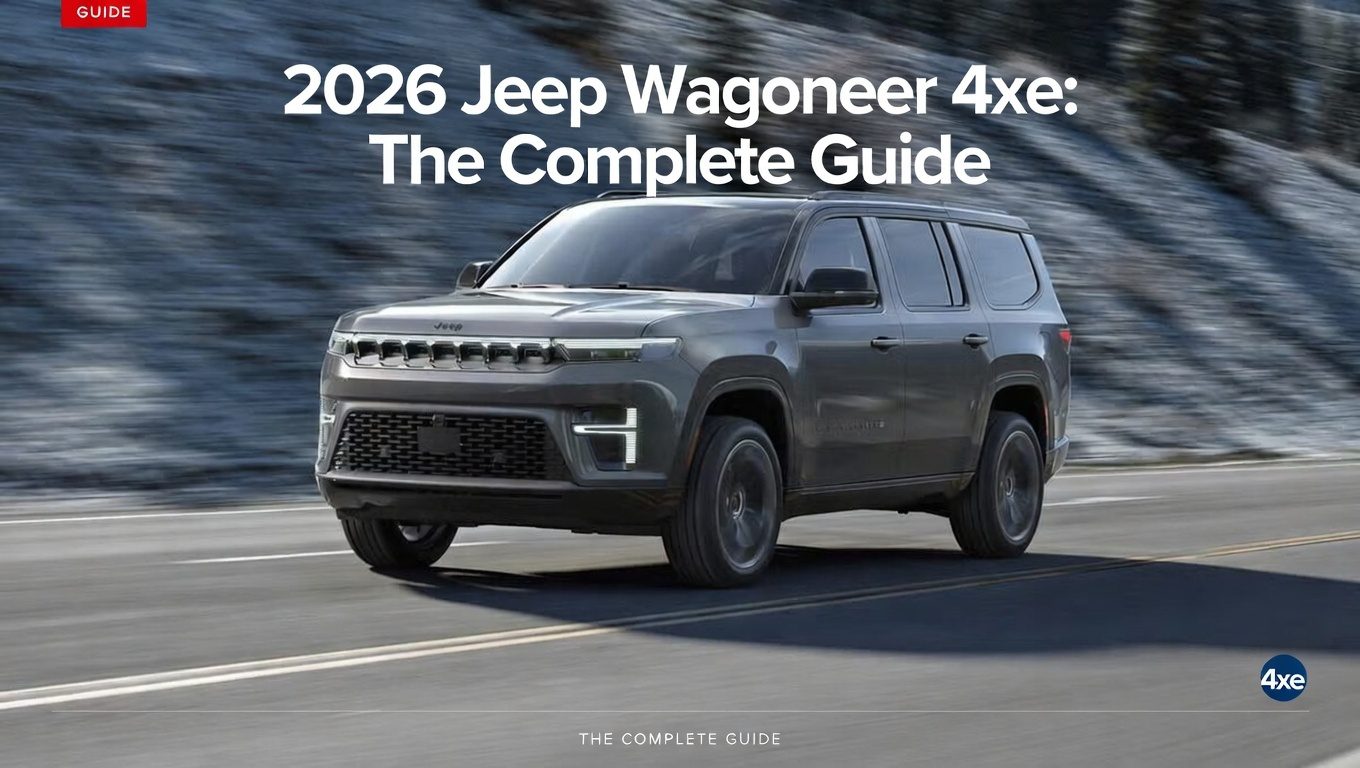

Plug-In Hybrid Luxury Meets Legendary Off-Road Capability — Everything You Need to Know Before You Buy
Quick Answer: What Is the 2026 Jeep Wagoneer 4xe?
The 2026 Jeep Wagoneer 4xe is a plug-in hybrid (PHEV) three-row luxury SUV combining a 3.0-liter turbocharged inline-6 engine with two electric motors for a combined 510 horsepower. It offers up to 38 miles of EPA-rated all-electric range, can tow up to 10,000 pounds, carries a Quadra-Trac 4WD system with off-road modes, and seats up to eight passengers in genuine luxury. Starting price is approximately $75,000 and it competes with the Lincoln Aviator Grand Touring PHEV, Volvo XC90 Recharge, and Cadillac XT6.
Introduction: The Plug-In Hybrid That Does Not Ask You to Compromise
A fully electric three-row SUV asks you to think differently about road trips. You plan charging stops. You watch the range estimate. You make calculations that gasoline drivers never have to make.
A plug-in hybrid asks you to do none of that. It charges overnight at home — cutting your daily fuel cost to nearly zero for most commuters. But on a 500-mile road trip pulling a boat trailer, it behaves exactly like any other powerful V6 luxury SUV. You stop for gas when you need to. You keep moving.
That is the Wagoneer 4xe’s proposition in 2026. It is not trying to be the most advanced vehicle on the road. It is trying to be the most practical one. And with 38 miles of electric range, 510 horsepower, 10,000 pounds of towing capacity, genuine eight-passenger seating, and a cabin that rivals the Lincoln Navigator and Cadillac Escalade on material quality — it makes a compelling case.
This guide covers everything: how the 4xe PHEV system works, honest electric range expectations, towing data, a frank competitor comparison, and the tax credit situation that could make this one of the best-value luxury PHEVs available in 2026.
Visual suggestion: Lead with a split hero image — left side shows the Wagoneer 4xe plugged in at a home wallbox at night; right side shows it towing a boat on a mountain highway. Both scenarios are equally accurate representations of the vehicle’s everyday use case.
1. Why the Wagoneer 4xe Makes Sense in 2026
The plug-in hybrid market has an image problem. People associate PHEVs with short electric ranges that feel like a marketing afterthought — a small battery bolted onto a conventional vehicle to qualify for tax credits. Early PHEVs deserved that criticism. A 10-mile electric range is not genuinely useful.
38 miles is different. According to US Department of Transportation data, the average American’s daily driving distance is approximately 37 miles. That means most Wagoneer 4xe owners can complete their entire weekday routine — school drop-off, work commute, grocery run, school pickup — on electricity alone, charging overnight from home. They may not burn a drop of gasoline Monday through Friday.
Where the Wagoneer 4xe Fits in Jeep and Stellantis
- Jeep Wrangler 4xe: Compact off-road PHEV — separate product with different buyer
- Jeep Grand Cherokee 4xe: Mid-size luxury PHEV — smaller sibling to the Wagoneer
- Jeep Wagoneer 4xe: Full-size luxury three-row PHEV — the focus of this guide
- Jeep Grand Wagoneer 4xe: Ultra-luxury, larger format PHEV — above the Wagoneer in size and price
- Jeep Recon: Fully electric off-road SUV — different use case and buyer profile
The Wagoneer 4xe sits between the Grand Cherokee 4xe and Grand Wagoneer 4xe. It is the sweet spot in the lineup — full three-row capability, serious towing numbers, and a price point that more buyers can reach than the Grand Wagoneer.
Topical authority note: This guide is part of a Jeep 4xe content cluster covering the Wrangler 4xe, Grand Cherokee 4xe, Wagoneer 4xe, and Grand Wagoneer 4xe — helping buyers understand where each plug-in hybrid fits in Jeep’s lineup.
2. Key Specs at a Glance
Complete 2026 Jeep Wagoneer 4xe specifications.
| Specification | Wagoneer 4xe (All Trims) |
| Powertrain Type | Plug-In Hybrid Electric Vehicle (PHEV) |
| Engine | 3.0-liter turbocharged inline-6 (Hurricane engine) |
| Engine Output | 420 hp / 468 lb-ft torque |
| Electric Motors | Two electric motors (integrated into transmission) |
| Combined System Power | 510 hp / 553 lb-ft torque |
| 0-60 mph (0-97 km/h) | 4.8 seconds |
| Top Speed | 130 mph (209 km/h) |
| Battery Capacity (gross) | 24.2 kWh |
| Battery Capacity (usable) | ~21 kWh |
| EPA Electric Range | 38 miles (61 km) |
| EPA Combined Fuel Economy (charge depleted) | 19 MPG combined |
| EPA MPGe (charge sustaining + electric) | 57 MPGe |
| DC Fast Charging | Not supported — AC only |
| AC Charging (max) | 7.2 kW (Level 2) |
| Level 2 Full Charge Time | ~3 hours (empty to full) |
| Level 1 (120V) Charge Time | ~12 hours |
| 4WD System | Quadra-Trac II with low range |
| Off-Road Modes (Selec-Terrain) | Auto, Snow, Sand, Mud, Rock (5 modes) |
| Ground Clearance | 9.0 inches (229 mm) |
| Water Fording Depth | 24 inches (610 mm) |
| Max Towing Capacity | 10,000 lb (4,536 kg) |
| Max Payload | 1,395 lb (633 kg) |
| Seating Capacity | 7 or 8 passengers |
| Cargo (behind 3rd row) | 27.4 cu ft (776 liters) |
| Cargo (all seats folded) | 116.7 cu ft (3,305 liters) |
| Vehicle-to-Load (V2L) | Yes — up to 1.9 kW export |
| Platform | Stellantis STLA Large (PHEV configuration) |
Important note: The Wagoneer 4xe does not support DC fast charging. Level 2 AC charging (7.2 kW) is the fastest available. A full charge from empty takes approximately 3 hours with a 240V Level 2 EVSE — meaning daily overnight charging with a standard home charger is the expected use pattern. DC fast charging is not a use case for this vehicle.
3. Understanding the 4xe PHEV System
The 4xe badge appears across Jeep’s lineup. But what does it actually mean, and how does the system work in the Wagoneer’s specific configuration?
How the Wagoneer 4xe Powertrain Works
The Wagoneer 4xe uses a parallel plug-in hybrid architecture. The 3.0-liter Hurricane inline-6 engine and two electric motors work together to drive the vehicle. The motors are integrated into the 8-speed automatic transmission — they can supplement the engine or operate independently when battery charge is available.
Unlike a series hybrid (where the engine only generates electricity and the motors always drive the wheels), the Wagoneer 4xe’s engine can drive the wheels directly. This is more efficient at highway speeds and enables the vehicle’s strong towing numbers.
Three Operating Modes
- Electric Only (E-Mode): The vehicle runs exclusively on the battery when the charge level is sufficient and speed is within electric range. Available up to approximately 75 mph. This is the default mode when you start with a full battery.
- Hybrid Mode: The system automatically blends engine and motor power based on demand. As the battery depletes, the system transitions here. This is also the mode for maximum performance — both engine and motors working together for the full 510 hp.
- Engine Only Mode: Available as a driver-selected option to preserve the battery for later use — for example, if you want to save electric range for city driving at your destination after a highway segment.
The eSave Button: A Feature Competitors Miss
The eSave button is one of the most practically useful features on the Wagoneer 4xe. It allows the driver to hold the current battery charge level — preserving it for later use — while the engine handles all propulsion on the highway.
Here is a practical example: You are driving 40 miles of highway to a city center for meetings. Highway efficiency is lower for the electric motor. By pressing eSave, you arrive at the city with a full electric battery and switch to pure EV mode for urban driving — the most efficient possible use of both power sources.
Regenerative Braking in the Wagoneer 4xe
The Wagoneer 4xe recovers energy during braking and coasting through its integrated electric motors. The regeneration level is adjustable via paddle shifters — left paddle increases regen strength, right paddle reduces it — giving drivers control over coasting behavior and energy recovery rate.
Maximum regen in the Wagoneer 4xe does not allow full one-pedal driving in the way a pure EV does — the combustion system is still present. But on downhill grades or in city traffic, meaningful range recovery is possible.
4. Design: Wagoneer Luxury Inside and Out
The Wagoneer nameplate carries serious history. The original Grand Wagoneer ran from 1963 to 1991 and defined American luxury SUV design for nearly three decades. The modern Wagoneer, relaunched in 2022, deliberately honors that heritage while making no apologies for being a thoroughly contemporary vehicle.
Exterior: Confident American Proportion
The Wagoneer 4xe is a large vehicle. Make no mistake about that. At nearly 215 inches long and over 78 inches wide, it occupies significant road space. But the design team has handled the scale well — the long hood, squared-off greenhouse, and vertical rear give it presence without looking bloated.
- Length: 214.7 inches (5,453 mm)
- Width: 78.1 inches (1,984 mm) without mirrors
- Height: 74.3 inches (1,887 mm)
- Wheelbase: 123.0 inches (3,124 mm)
- Turning circle: 40.8 feet (12.4 meters)
The 4xe badging is subtle — a green badge on the front fenders and a 4xe emblem at the rear distinguish it from the combustion Wagoneer. The liftgate wears a small plug icon as well. Jeep’s design philosophy has been to make the 4xe variants look like premium Wagoneers first, plug-in hybrids second.
22-Inch Wheels and LED Lighting
Upper trims come standard with 22-inch polished aluminum wheels — one of the largest standard wheel sizes in the full-size SUV segment. The LED headlight and taillight arrays are sequential, with the Seven-Slot grille reinterpreted in a more refined execution than the Wrangler-derived Recon.
Available Colors for 2026
Jeep offers 10 exterior colors on the 2026 Wagoneer 4xe. Highlights include Walnut Brown Pearl (a new-for-2026 addition), Anvil Gray metallic, Rocky Mountain Sky Blue, and Bright White. Two-tone roof options in black or satin chrome are available on Series III and above.
5. Interior, Three-Row Seating, and Technology
This is where the Wagoneer 4xe makes its strongest impression. Jeep spent significant resources positioning the Wagoneer above the Grand Cherokee in interior quality — and the effort is visible in every surface you touch.
Three Rows — All Genuinely Habitable
The Wagoneer 4xe’s 123-inch wheelbase translates to interior space that is genuinely generous across all three rows. Adults can ride comfortably in the third row for extended periods — a claim that most three-row SUVs at this price cannot honestly make. The PHEV battery is mounted flat under the floor, preserving the same interior volume as the standard Wagoneer.
- First row: 16-way power massaging seats with heating and ventilation — standard on Series II and above
- Second row: Captain’s chairs or bench — both heated, captain’s chairs recline 8 degrees
- Third row: Power-fold, heated, 33.2 inches of legroom — adult-suitable for most body types
- Third-row access: Second row slides and tilts forward automatically with one-touch operation
- Flat PHEV floor: Battery packaging preserves full cargo and passenger volume — no compromise vs. standard Wagoneer,
The Wagoneer’s Signature McIntosh Audio
The McIntosh MX950 audio system is available on upper Wagoneer trims and is one of the most discussed features among luxury SUV enthusiasts. McIntosh is an American hi-fi brand with over 75 years of audiophile heritage — and the automotive collaboration produces a 23-speaker, 950-watt system with frequency response tuned specifically for the Wagoneer’s cabin acoustics.
This is not a badge-level partnership. McIntosh’s engineers calibrated the system to the specific glass area, seating positions, and interior surface materials in the Wagoneer. Independent audio reviewers consistently rank it in the top three automotive audio experiences available at any price point.
Uconnect 5 and the Dual-Screen Setup
The Wagoneer 4xe runs Uconnect 5 across two screens — a 12.0-inch driver-facing display and a 10.25-inch front passenger display. Both screens support independent content simultaneously. A third 10.25-inch screen in the center console controls climate and other functions below the main display.
- Amazon Fire TV: Available as an integrated streaming platform — first in the segment at Wagoneer’s launch
- Wireless Apple CarPlay and Android Auto: Standard on all trims
- Google built-in: Optional on upper trims — adds Google Maps, Google Assistant, Play Store access
- Rear-seat entertainment: Dual 10.0-inch screens for second-row passengers — optional add-on
- Over-the-air updates: Available for infotainment and select vehicle systems.
4xe-Specific Instrument Cluster
The 4xe variant’s digital instrument cluster includes a dedicated EV display showing real-time power flow, battery state of charge, electric range remaining, and current drive mode. A green ring around the speedometer illuminates in EV mode — a detail drivers appreciate as immediate visual confirmation of the vehicle’s electric status.
Driver Assistance and Safety Technology
- Adaptive Cruise Control with Stop-and-Go: Maintains set speed and following distance in traffic — standard on Series II and above
- Highway Assist: Steering support and lane centering combined with adaptive cruise — Jeep’s hands-on highway assistance system
- Night Vision: Infrared pedestrian and animal detection with instrument cluster display — optional
- Surround View Camera System: 360-degree ground-level view with 3D overhead perspective — standard on Series III and above
- Blind Spot Monitoring with Trailer Detection: Extends monitoring to trailer width when towing
- Automatic Emergency Braking with Pedestrian Detection: Standard on all trims
- Parallel and Perpendicular Park Assist: Steers into spaces automatically — optional
6. Performance, Towing, and Off-Road Capability
510 horsepower and 553 lb-ft of torque. In a luxury family SUV. Let that settle for a moment.
On-Road Performance: Effortlessly Fast
The Wagoneer 4xe’s 0-60 time of 4.8 seconds is genuinely quick for a vehicle weighing over 6,000 pounds. The instant torque from the electric motors fills the traditional turbocharged engine’s brief spool-up period, creating a power delivery that feels smooth and immediate from rest.
On highway on-ramps, the combined 510 hp allows confident, decisive passing maneuvers without the drama you might expect from a vehicle this large. The 8-speed automatic transmission manages the transition between electric and combustion power seamlessly in most conditions — most drivers will not notice the handover.
Towing: 10,000 Pounds — Why It Matters
The 10,000-pound maximum tow rating places the Wagoneer 4xe in a league that very few luxury PHEVs can enter. Most plug-in hybrid luxury SUVs are rated for 5,000-7,700 pounds. The Wagoneer 4xe’s hybrid architecture, with the inline-6 engine handling high-load towing and the electric motors providing supplemental torque, produces one of the highest PHEV tow ratings in the market.
- Boat trailer with 22-foot boat: Typically 4,500-6,500 lb — well within capacity
- Horse trailer (2-horse): Typically 6,000-8,000 lb loaded — within capacity with careful loading
- Camper trailer (mid-size): Typically 5,000-8,500 lb — within capacity for most models
- Fifth-wheel or gooseneck: Not compatible — requires a pickup truck
When towing near maximum capacity, the battery depletes quickly — the electric motors draw heavily from the pack to assist the engine. Plan on primarily combustion operation during heavy towing. The EPA’s 38-mile electric range estimate assumes solo passenger use at moderate speeds.
Quadra-Trac 4WD and Off-Road Capability
The Wagoneer 4xe uses Quadra-Trac II — a full-time four-wheel-drive system with a two-speed transfer case for low-range off-road use. This is a genuine 4WD system, not all-wheel drive dressed up with off-road language.
- Auto mode: Automatically distributes power front-to-rear as needed — best for normal and light off-road use
- 4WD Low: Engages the low-range gearset for serious technical terrain, rock crawling, or steep descents
- Selec-Terrain modes: Auto, Snow, Sand, Mud, Rock — 5 modes that adjust throttle, transmission, and traction control.
Ground Clearance and Off-Road Geometry
- Ground clearance: 9.0 inches (229 mm)
- Water fording depth: 24 inches (610 mm)
- Approach angle: 21 degrees
- Departure angle: 22 degrees
- Breakover angle: 18.5 degrees
The Wagoneer 4xe is not a Wrangler. Its off-road numbers are honest but modest — appropriate for fire roads, gravel trails, moderate mud, and light snow rather than technical rock crawling. For buyers who need serious off-road performance from a three-row luxury SUV, the Trail-Rated Jeep Recon is a separate product designed for that mission.
7. Electric Range, Fuel Economy, and Charging
The 38-mile EPA electric range is the centerpiece of the Wagoneer 4xe’s value proposition. Here is what that number means in practice.
Real-World Electric Range: What to Expect
EPA ratings are optimistic. Real-world electric range depends heavily on speed, temperature, and how aggressively you drive. Here is what Wagoneer 4xe owners actually experience:
- City and suburban speeds under 50 mph: 36-42 miles — often meets or slightly exceeds EPA estimate
- Mixed suburban and highway use: 28-35 miles
- Highway driving at 70 mph: 22-28 miles — aerodynamic drag reduces electric efficiency significantly
- Cold weather (below 32 degrees F / 0 degrees C): 20-28 miles — battery warming reduces capacity
- With climate control (heat in winter): 24-34 miles — heating draws significant battery power
- Towing at any speed: Battery depletes rapidly; do not rely on electric range when towing
Real-world insight: The 38-mile EPA figure was established under standard testing conditions. A Wagoneer 4xe owner who charges at home every night and drives 30-35 miles of suburban daily commute will genuinely drive most weekdays on electricity alone. A buyer who primarily drives at 75+ mph on open highway will see much less electric range benefit. Know your driving profile before evaluating this vehicle.
Fuel Economy in Hybrid Mode
When the battery is depleted, the Wagoneer 4xe operates as a conventional PHEV, using the 3.0-liter inline-6 with mild electric assist. The EPA rates this at 19 MPG combined. For a 6,000-pound luxury SUV, this is competitive but not exceptional.
For context: the non-hybrid Wagoneer with the 5.7-liter V8 achieves 14-18 MPG combined. The 4xe’s inline-6 in charge-depleted mode is measurably more efficient than the V8 combustion alternative.
Charging Options Explained
| Charging Type | Power Level | Full Charge Time | Range Added per Hour |
| Level 2 EVSE (240V / 32A) | 7.2 kW | ~3 hours | ~12-14 miles per hour |
| Level 2 EVSE (240V / 20A) | 4.8 kW | ~4.5 hours | ~8-10 miles per hour |
| Level 1 (120V standard outlet) | 1.9 kW | ~12 hours | ~3-4 miles per hour |
| DC Fast Charging | Not supported | N/A | N/A |
| V2L Output (powered devices) | Up to 1.9 kW export | N/A | Powers external devices |
The absence of DC fast charging is the most significant limitation for buyers who might consider using the Wagoneer 4xe’s battery for road trip stops. This is a home-charging vehicle. It is designed to be plugged in every night like a phone — not to be rapid-charged at public stations.
Recommended Home Charging Setup
Jeep strongly recommends installing a Level 2 EVSE at home. A 240V / 32-amp charger (which requires a 40-amp dedicated circuit) charges the 21 kWh usable battery in approximately 3 hours. This means even if you arrive home with a fully depleted battery at 9 PM, it is fully charged before midnight.
Jeep partners with Qmerit for discounted home charger installation across the US. The average installation cost for a Level 2 EVSE including equipment and labor is approximately $1,000-$1,800 depending on panel access and local labor rates.
Federal Tax Credit: The Wagoneer 4xe Advantage
The 2026 Jeep Wagoneer 4xe qualifies for the federal plug-in vehicle tax credit under the Inflation Reduction Act. For PHEV vehicles, the credit is $7,500 provided the vehicle meets assembly and battery sourcing requirements, and the buyer meets income limits.
The Wagoneer 4xe is assembled in North America. Battery sourcing requirements under the IRA are updated annually — confirm current eligibility with your dealer or at fueleconomy.gov. If fully eligible, a $7,500 tax credit on a $75,000-$85,000 vehicle represents significant effective savings — particularly compared to competitors that do not qualify.
8. 2026 Wagoneer 4xe vs. Luxury PHEV and ICE Rivals
The full-size luxury three-row PHEV segment is specialized. Here is how the Wagoneer 4xe compares to its most relevant rivals.
| Feature | Jeep Wagoneer 4xe | Lincoln Aviator GT PHEV | Volvo XC90 Recharge | Cadillac Escalade (ICE) | Toyota Sequoia Platinum HEV |
| Starting Price (est.) | ~$75,000 | ~$68,000 | ~$72,000 | ~$80,000 | ~$71,000 |
| Powertrain | PHEV (3.0T I6 + 2 motors) | PHEV (3.0T V6 + motor) | PHEV (2.0T I4 + motor) | ICE (6.2L V8 or 3.0T I6) | Hybrid (3.5T V6 + motor) |
| Combined Power | 510 hp | 494 hp | 455 hp | 420-650 hp | 437 hp |
| Electric Range (EPA) | 38 miles | 21 miles | 35 miles | N/A | N/A (full hybrid) |
| 0-60 mph | 4.8 sec | 5.1 sec | 5.8 sec | 4.4 sec (V8) | 6.1 sec |
| Max Towing | 10,000 lb | 6,000 lb | 5,000 lb | 8,200 lb | 9,520 lb |
| 3-Row Seating | Yes (7 or 8) | No (2-row only) | Yes (6 or 7) | Yes (7 or 8) | Yes (7 or 8) |
| DC Fast Charging | No | No | No (11 kW AC max) | N/A | N/A |
| Max AC Charging | 7.2 kW | 7.2 kW | 11 kW | N/A | N/A |
| Off-Road Modes | Yes (5 Selec-Terrain) | No | No | No | No |
| Ground Clearance | 9.0 inches | 8.0 inches | 8.7 inches | 9.0 inches | 10.0 inches |
| V2L Capable | Yes (1.9 kW) | No | No | No | Yes (1.5 kW) |
| Signature Audio | McIntosh (optional) | Revel Ultima (opt.) | Bowers & Wilkins (opt.) | AKG (standard) | JBL (opt.) |
| Fed. EV Tax Credit | Yes ($7,500 est.) | Yes ($7,500 est.) | No (over MSRP cap) | No | No |
The comparison reveals the Wagoneer 4xe’s key advantages clearly. It leads on towing capacity (10,000 lb — nearly double the Lincoln Aviator and double the Volvo XC90), electric range among PHEV rivals (38 vs. 21 miles for the Aviator), and off-road capability (the only vehicle in this comparison with dedicated off-road terrain modes). The Cadillac Escalade matches on seating and exceeds on interior prestige but is not available as a PHEV, meaning no federal EV incentive.
The Lincoln Aviator Grand Touring PHEV is a compelling alternative at a lower starting price, but it is a two-row vehicle and has only 21 miles of electric range. The Volvo XC90 Recharge offers a three-row layout and 11 kW AC charging but is 5,000 pounds under the Wagoneer on towing capacity and does not qualify for the federal tax credit at most price points.
9. Trim Levels and Pricing
The 2026 Wagoneer 4xe is available in four trim levels, all sharing the same 4xe PHEV powertrain. Features escalate meaningfully from one trim to the next.
Wagoneer 4xe Series I — Starting at ~$75,000
- Power: 510 hp combined, Quadra-Trac II with 4WD Low
- Battery: 24.2 kWh gross / ~21 kWh usable
- EPA Electric Range: 38 miles
- Standard: 12.0-inch Uconnect 5 display, 10.25-inch passenger screen, heated 8-way power front seats, leather upholstery, 20-inch polished aluminum wheels
- Standard: Blind Spot Monitoring, Rear Cross Path Detection, Forward Collision Warning, Automatic Emergency Braking
- Standard: Selec-Terrain with 5 modes, Quadra-Trac II 4WD with low range.
Wagoneer 4xe Series II — Starting at ~$80,000
- Adds: Panoramic sunroof, 16-way power massaging front seats with heating and ventilation, second-row heated seats
- Adds: Adaptive Cruise Control with Stop-and-Go, Highway Assist, Blind Spot Camera System
- Adds: Surround View Camera, 4xe-specific instrument cluster display upgrade
- Adds: Premium 19-speaker Alpine audio system
- Wheels: 21-inch machined aluminum.
Wagoneer 4xe Series III — Starting at ~$86,000
- Adds: McIntosh MX950 23-speaker audio system
- Adds: Rear-seat entertainment dual screens (10.0-inch for second-row passengers)
- Adds: Amazon Fire TV integration, Night Vision system
- Adds: Ventilated third-row seats, automatic two-tone roof option
- Wheels: 22-inch polished aluminum (largest standard wheels in the segment).
Wagoneer 4xe Carbide — Starting at ~$92,000
- Adds: Unique exterior package with gloss-black grille, mirror caps, badging, and wheel accents
- Adds: Sport-tuned suspension (10mm lower ride height for road use)
- Adds: Exclusive interior in two-tone black and mocha leather with carbon fiber trim
- Adds: Head-up display, 360-degree camera with overhead view.
Key Options Across Trims
- Trailer Tow Group (all trims): Integrated trailer brake controller, wiring harness, and 4-pin and 7-pin connectors — $800
- Night Vision Package: Infrared camera with pedestrian and animal detection — $1,500 (Series II and below; standard on Series III+)
- Parallel/Perpendicular Park Assist: $600
- Jeep 4xe Charging Cable (Level 1 + Level 2 portable EVSE): Included with vehicle
- Home Charger Installation (via Qmerit partnership): Variable by market — average $1,000-$1,800 installed.
10. Who Should Buy the 2026 Jeep Wagoneer 4xe?
The Wagoneer 4xe has a clear value proposition — but it is not the right vehicle for every buyer. Here is the honest breakdown.
Buy the Wagoneer 4xe If…
- Your daily driving distance is consistently under 35-40 miles. You will cover most weekday driving on electricity, significantly reducing fuel costs without changing your driving habits.
- You tow regularly and need over 7,000 pounds of capacity. The 10,000-pound rating is the highest available from a PHEV three-row luxury SUV in 2026.
- You want a luxury three-row SUV and the $7,500 federal tax credit is financially meaningful to your purchase decision. The Escalade and Navigator do not qualify.
- You need genuine off-road capability for light to moderate trails — the Quadra-Trac II and Selec-Terrain system give the Wagoneer 4xe more trail confidence than any other luxury three-row SUV in this comparison.
- You plan to charge at home every night. The 3-hour Level 2 charge time makes this simple and eliminates public charging dependency for daily use.
- McIntosh audio, premium American luxury character, and Jeep’s heritage brand identity matter to your purchase.
Consider Alternatives If…
- Your daily drive is predominantly highway at 70+ mph. Electric range efficiency drops significantly; a Toyota Sequoia HEV or non-hybrid alternative may provide better real-world efficiency at your driving pattern.
- You cannot install a home charger. Without overnight Level 2 charging, the PHEV advantage is significantly reduced — consider the standard Wagoneer or a non-PHEV competitor.
- Interior luxury prestige above all else: The Cadillac Escalade and Lincoln Navigator deliver slightly higher perceived interior opulence, though neither qualifies for the tax credit.
- You want a fully electric daily driver with occasional long trips. The Cadillac Vistiq or a three-row BEV SUV better fits that profile — the Wagoneer 4xe is not designed for pure-electric long-distance use.
- Budget is under $70,000. The Jeep Grand Cherokee 4xe provides similar PHEV technology, comparable electric range (25 miles), and Jeep’s off-road credentials in a smaller package starting around $58,000.
11. People Also Ask: 2026 Jeep Wagoneer 4xe FAQ
What is the electric range of the 2026 Jeep Wagoneer 4xe?
The 2026 Jeep Wagoneer 4xe has an EPA-rated all-electric range of 38 miles. Real-world range in suburban driving is typically 32-40 miles. At highway speeds of 70 mph, expect 22-28 miles of electric range. Cold weather and heavy climate system use can reduce electric range by 20-30%. Towing significantly depletes the battery regardless of distance.
Can the Jeep Wagoneer 4xe DC fast charge?
No. The 2026 Jeep Wagoneer 4xe does not support DC fast charging. The maximum charging speed is 7.2 kW using a Level 2 AC EVSE (240V), which fully charges the 21 kWh usable battery in approximately 3 hours. This vehicle is designed for overnight home charging, not rapid public charging during road trips.
How much can the 2026 Jeep Wagoneer 4xe tow?
The 2026 Jeep Wagoneer 4xe can tow up to 10,000 pounds (4,536 kg) with the available Trailer Tow Group. This is one of the highest tow ratings among plug-in hybrid SUVs in 2026. During heavy towing, the battery depletes rapidly and the vehicle operates primarily on the 3.0-liter inline-6 engine.
Does the 2026 Jeep Wagoneer 4xe qualify for the federal EV tax credit?
The 2026 Jeep Wagoneer 4xe is expected to qualify for the federal plug-in vehicle tax credit of up to $7,500 under the Inflation Reduction Act, subject to annual battery sourcing requirements, buyer income limits, and MSRP eligibility. Confirm current eligibility with your dealer or at fueleconomy.gov before purchase, as requirements change annually.
What is the difference between the Wagoneer 4xe and the Grand Wagoneer 4xe?
The Grand Wagoneer 4xe is larger, more expensive, and more luxuriously appointed than the Wagoneer 4xe. It offers a longer wheelbase, a more powerful powertrain configuration, and higher-grade interior materials and technology. The Wagoneer 4xe starts around $75,000; the Grand Wagoneer 4xe starts around $100,000. Both share the 4xe PHEV system but differ in scale and content level.
What is the fuel economy of the Wagoneer 4xe when the battery is depleted?
When the battery is depleted, the 2026 Jeep Wagoneer 4xe operates as a conventional hybrid with an EPA-rated 19 MPG combined (18 city / 21 highway). This compares favorably to the non-hybrid Wagoneer with the 5.7-liter V8, which achieves approximately 14-17 MPG combined.
Does the 2026 Wagoneer 4xe have three rows of seating?
Yes. The 2026 Jeep Wagoneer 4xe has three rows of seating with a choice of 7-passenger (second-row captain’s chairs) or 8-passenger (second-row bench) configurations. The third row is adult-suitable with 33.2 inches of legroom and is heated as standard on Series II and above. The flat PHEV battery floor preserves full interior volume equivalent to the non-hybrid Wagoneer.
How does the Jeep Wagoneer 4xe compare to the Lincoln Aviator Grand Touring PHEV?
The Jeep Wagoneer 4xe leads the Lincoln Aviator on towing capacity (10,000 lb vs. 6,000 lb), electric range (38 vs. 21 miles EPA), three-row seating (the Aviator is two-row only), and off-road capability. The Lincoln Aviator Grand Touring starts at a lower price (~$68,000) and offers a slightly more refined interior aesthetic. Both qualify for the $7,500 federal PHEV tax credit when eligibility requirements are met.
12. Final Verdict: Is the 2026 Jeep Wagoneer 4xe Worth Buying?
The 2026 Jeep Wagoneer 4xe succeeds at its core mission: giving full-size luxury three-row SUV buyers a path to meaningful electrification without asking them to change how they live.
That 38-mile electric range is not a gimmick. For a buyer whose daily drive is a 30-mile suburban commute, the Wagoneer 4xe is functionally an electric vehicle Monday through Friday. It charges in 3 hours overnight. It costs nearly nothing to fuel during the week. On Saturday, it tows the boat to the lake at full 10,000-pound capacity without a thought about charging stations.
The tax credit amplifies the value. A $7,500 federal incentive on a vehicle that also happens to deliver 510 horsepower, genuine three-row luxury, McIntosh audio, and Jeep’s trail-tested 4WD system represents an exceptional package at the asking price.
Where it is honest about limitations: The 19 MPG charge-depleted fuel economy is not impressive. DC fast charging is not available. Highway electric range is modest. And if you spend most of your driving time on open highways rather than suburban roads, the electric advantage diminishes quickly.
But for its target buyer — a family that needs three rows, wants genuine towing capability, values luxury touches like McIntosh audio, and charges at home every night — the 2026 Jeep Wagoneer 4xe offers one of the most complete, practical, and compelling packages in the full-size luxury SUV segment. It earns serious consideration.
Key Takeaways
- The 2026 Jeep Wagoneer 4xe is a plug-in hybrid three-row luxury SUV combining a 3.0-liter turbocharged inline-6 with dual electric motors for 510 hp combined.
- 38 miles of EPA-rated all-electric range — sufficient for most daily commutes to run electricity-only on weekdays with overnight home charging.
- 10,000-pound tow rating — the highest in the PHEV luxury SUV segment, far exceeding Lincoln Aviator (6,000 lb) and Volvo XC90 (5,000 lb).
- Level 2 charging (7.2 kW) charges from empty in approximately 3 hours; DC fast charging is not supported.
- Qualifies for up to $7,500 federal PHEV tax credit — unlike the Cadillac Escalade and Lincoln Navigator.
- Genuine three-row seating for 7 or 8 passengers; third row is adult-suitable with 33.2 inches of legroom.
- Quadra-Trac II 4WD with 5-mode Selec-Terrain — the only luxury three-row PHEV with dedicated off-road terrain modes.
- Pricing from ~$75,000 (Series I) to ~$92,000 (Carbide) — competitive after tax credit vs. non-PHEV alternatives.
- Main rivals: Lincoln Aviator Grand Touring PHEV (lower price, 2-row, less range), Volvo XC90 Recharge (less towing, no credit), Cadillac Escalade (no EV, no credit), Toyota Sequoia HEV (no electric range, more ground clearance).
Sources and Further Reading
- Jeep Official 2026 Wagoneer 4xe Press Kit and PHEV System Technical Overview — media.stellantis.com
- US Department of Transportation National Household Travel Survey — Daily VMT Data — bts.gov
- US DOE Fuel Economy Guide: Wagoneer 4xe — fueleconomy.gov
- IRS Plug-In Vehicle Tax Credit Guidance and Annual Requirements — irs.gov/credits-deductions/clean-vehicle-tax-credits
- Qmerit Home EV Charger Installation Network — qmerit.com
About This Guide
This article was researched using Stellantis and Jeep’s official press materials, 4xe PHEV system technical documentation, EPA fuel economy certification data, and road test reports from Car and Driver, Motor Trend, and Edmunds. Electric range estimates reflect EPA certification supplemented by real-world owner data from the Jeep Grand Cherokee 4xe (same powertrain family). Tax credit eligibility information is current as of February 2026 but is subject to annual IRS updates — always confirm with your dealer before purchase. Pricing is approximate and may vary by region and dealer.
Ready to take the next step? Compare the Wagoneer 4xe against the Grand Cherokee 4xe and Grand Wagoneer 4xe in our full Jeep 4xe lineup guide, calculate your annual fuel savings with our PHEV cost calculator, or schedule a test drive at your nearest Jeep dealership. Ask to drive in E-Mode for the first 10 minutes — experiencing the electric-only performance is the fastest way to understand the 4xe advantage.
Discover more from MatterDigest
Subscribe to get the latest posts sent to your email.