2026 Genesis GV60 Magma: The Complete Guide
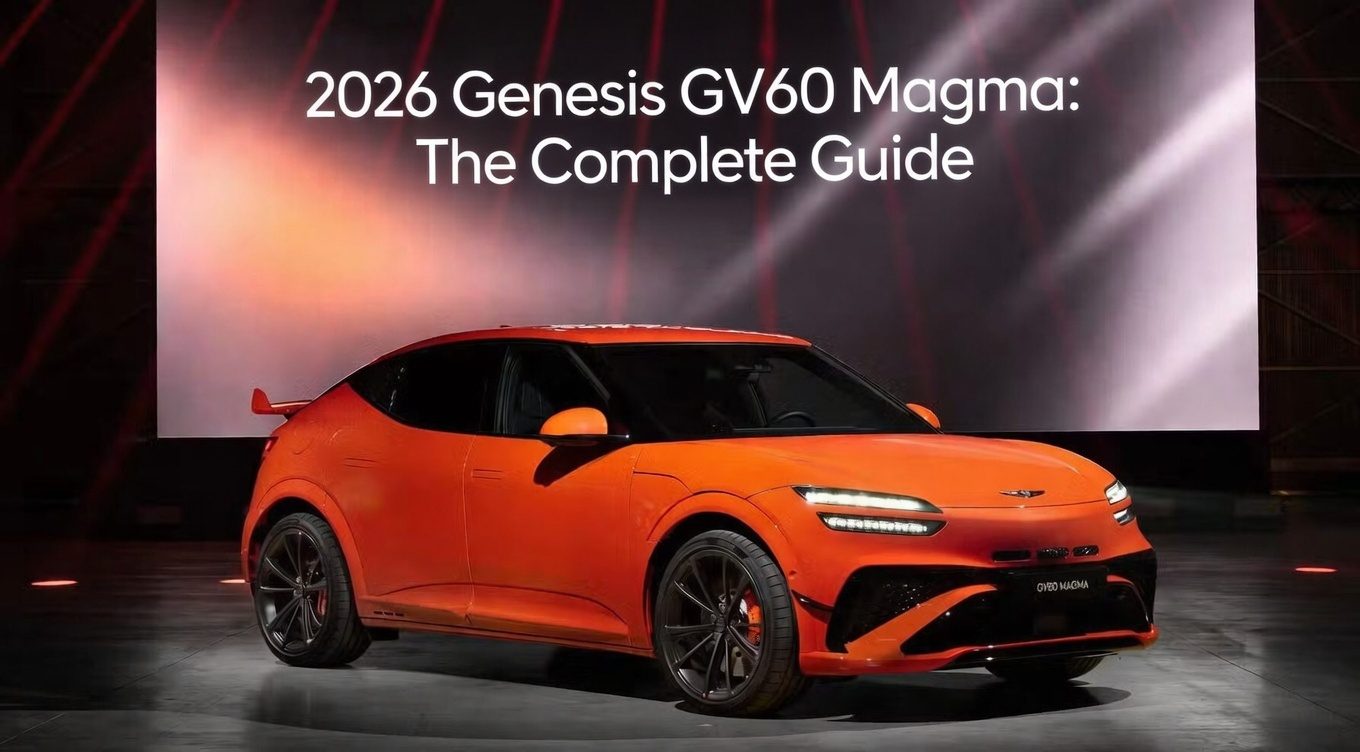

The Most Powerful GV60 Ever Made — Everything You Need to Know About Genesis’s 641 hp Track-Ready Electric SUV
Quick Answer: What Is the 2026 Genesis GV60 Magma?
The 2026 Genesis GV60 Magma is a high-performance electric compact SUV built on Hyundai Motor Group’s E-GMP platform. It produces 641 horsepower and 516 lb-ft of torque, reaches 0-60 mph in 3.4 seconds, and uses an 800-volt architecture supporting 350 kW ultra-fast DC charging. It is the most powerful GV60 ever made and positions Genesis directly against the Porsche Macan EV, Audi SQ8 e-tron, and BMW iX M60. Starting price is approximately $80,000.
Introduction: Genesis Just Got Serious About Performance
641 horsepower. 3.4 seconds to 60 mph. 350 kW charging. And a name that sounds like it belongs on a volcano.
The 2026 Genesis GV60 Magma is not a mild performance upgrade. It is Genesis’s most ambitious vehicle yet — a purpose-built performance electric SUV that draws directly from the brand’s motorsport program. The Magma name is not marketing fluff. It references Genesis’s actual racing initiative, the Genesis Magma Racing series, and the engineering work done there feeds directly into this road car.
But here is the interesting part. While Porsche charges six figures for the Macan EV Turbo and Audi’s SQ8 e-tron pushes past $100,000, the GV60 Magma enters at around $80,000. For a 641-horsepower performance electric SUV with 800V charging and genuine track-derived engineering, that is a genuinely compelling proposition.
This guide covers everything: what the Magma is, how it performs, how it charges, what it is like to live with, and whether it belongs on your shortlist. Let us start at the top.
Visual suggestion: Lead with a dynamic action shot of the GV60 Magma on a winding mountain road, followed by a close-up of the Magma-specific badging and brake calipers. High-contrast red-on-black design details photograph exceptionally well.
1. What Makes the GV60 Magma Different From the Standard GV60
The standard GV60 Performance is already a quick car. Dual motors, AWD, 429 horsepower, and a 0-60 time of around 3.7 seconds. For most buyers, it is more than enough.
The Magma is not for most buyers. It starts where the Performance ends and then goes considerably further. Here is what changes specifically:
Power and Drivetrain Upgrades
- Output rises from 429 hp to 641 hp — a 49% increase over the standard Performance trim
- Torque increases from 446 lb-ft to 516 lb-ft
- New Magma-specific front and rear motor windings with higher peak output
- Upgraded power electronics and inverters to handle higher current loads
- Electronic limited-slip differential (e-LSD) at the rear axle — not available on standard GV60
Chassis and Suspension
- Magma Track System: a new electronic suspension coordination platform (explained in detail in Section 4)
- Electronically controlled adaptive dampers — retuned specifically for Magma with 40% wider adjustment range
- Lowered ride height: 10mm lower than standard GV60
- Wider front and rear tracks: 10mm wider front, 15mm wider rear
- Brembo performance brakes: 380mm front rotors with 6-piston calipers (vs. standard 345mm / 4-piston)
- 20-inch forged aluminum wheels (standard GV60 uses 21-inch cast wheels — forged is lighter and stronger)
Exterior Differentiation
- Magma-exclusive matte finish option: Magma Matte Orange — the only orange offered in Genesis’s lineup
- Carbon fiber roof (standard on all Magma — reduces weight and lowers center of gravity)
- Front bumper with enlarged air intakes for improved brake cooling
- Rear diffuser in gloss black with Magma-specific quad exhaust-style trim
- Red Brembo brake calipers visible through the forged wheel spokes
2. Key Specs at a Glance
Complete 2026 Genesis GV60 Magma specifications compared with the standard GV60 Performance.
| Specification | GV60 Magma | GV60 Performance (standard) | Difference |
| Drivetrain | AWD (dual motor, e-LSD) | AWD (dual motor) | Adds rear e-LSD |
| Power Output | 641 hp (478 kW) | 429 hp (320 kW) | +212 hp (+49%) |
| Torque | 516 lb-ft (700 Nm) | 446 lb-ft (605 Nm) | +70 lb-ft |
| 0-60 mph (0-97 km/h) | 3.4 seconds | 3.7 seconds | -0.3 sec |
| 0-100 mph (0-161 km/h) | 7.9 seconds | N/A (est. ~8.8 sec) | ~0.9 sec faster |
| Top Speed | 161 mph (259 km/h) | 130 mph (209 km/h) | +31 mph |
| Battery Capacity (net) | 77.4 kWh | 77.4 kWh | Same |
| EPA Range (estimated) | ~240 miles (386 km) | ~248 miles (399 km) | -8 miles |
| WLTP Range | ~380 km (236 mi) | ~400 km (249 mi) | Slightly less |
| 800V DC Fast Charging | 350 kW | 350 kW | Same |
| 10-80% DC Charge Time | ~18 minutes | ~18 minutes | Same |
| AC Charging (max) | 11 kW | 11 kW | Same |
| Brakes (front) | 380mm / 6-piston Brembo | 345mm / 4-piston | Upgraded |
| Suspension | Adaptive dampers (Magma-tuned) | Standard adaptive | Retuned + wider range |
| Wheels | 20-inch forged aluminum | 21-inch cast aluminum | Forged (lighter) |
| Carbon Fiber Roof | Standard | Not available | Magma-exclusive |
| e-LSD (rear) | Standard | Not available | Magma-exclusive |
| Track System | Magma Track System | Not available | Magma-exclusive |
Note: EPA range figures are estimates based on WLTP data and Genesis press communications. Final EPA certification will be published upon US market launch. Real-world range will vary based on speed, temperature, and driving style — particularly in Magma Sport and Track modes.
3. Design: Racing DNA Meets Genesis Luxury
Genesis has a distinctive design language: the Two Lines theme, referencing the brand’s crest, runs through every headlight, taillight, and interior detail. On the GV60 Magma, that language gets turned up significantly.
Exterior: Subtle Aggression
The GV60 Magma does not scream performance the way some performance EVs do. It whispers it — aggressively. The wider front bumper with enlarged brake cooling ducts is functional, not decorative. The carbon fiber roof is functional, not a styling exercise. Even the forged wheels are chosen for weight reduction over appearance.
That said, in Magma Matte Orange — the exclusive exterior color that lends the sub-brand its name — the GV60 Magma is impossible to mistake. The matte finish catches light differently at every angle. It is one of the few truly distinctive color options available in the performance EV segment in 2026.
- Available colors: Magma Matte Orange (exclusive), Magma Black (exclusive matte), Uyuni White, Himalayan Gray, Mauna Kea Green, and two additional standard Genesis colors
- Carbon fiber elements: Roof, front splitter lip, rear diffuser trim
- Magma badging: Rear liftgate, front fenders, floor mats
- Red accents: Brake calipers, seatbelts, interior stitching
Exterior Dimensions
- Length: 4,515 mm (177.8 inches) — same as standard GV60
- Width: 1,890 mm (74.4 inches) without mirrors — 10mm wider at front, 15mm at rear vs. standard
- Height: 1,566 mm (61.7 inches) — 10mm lower than standard GV60
- Wheelbase: 2,900 mm (114.2 inches) — same as standard GV60
- Drag coefficient: 0.26 Cd — marginally higher than standard GV60 (0.24 Cd) due to aero changes
Visual suggestion: Side-by-side comparison image of the standard GV60 Performance and the GV60 Magma from the same angle — highlighting the wider track, lower stance, and carbon roof difference.
4. Performance: 641 hp and the Magma Track System
The headline numbers are impressive. But the most interesting engineering story in the GV60 Magma is not the power figure — it is the system that deploys that power effectively.
The Magma Track System: What It Actually Does
The Magma Track System is Genesis’s name for a coordinated performance electronics package that links four key systems into a single supervisory brain:
- Torque Vectoring Control: Distributes power independently between all four wheels — not just front vs. rear, but left vs. right at each axle
- e-LSD (Electronic Limited-Slip Differential): At the rear axle, biases torque toward the outside wheel in corners — the same principle as mechanical LSDs used in performance cars, but faster and more precise
- Adaptive Damper Control: Adjusts each corner’s suspension stiffness 1,000 times per second based on road inputs and lateral g-forces
- Integrated Driving Dynamics (IDD): The supervisory layer that coordinates the above three systems based on selected driving mode
In practice, this means the GV60 Magma corners with a precision that its 4,700-pound curb weight has no right to suggest. On a closed circuit, early drive reviews describe it as feeling planted and adjustable in a way that rewards driver input — unlike many heavy performance EVs that simply accelerate in a straight line and understeer reluctantly through corners.
Driving Modes
- Eco: Maximum range priority — softest dampers, reduced regeneration speed, smoothest power delivery
- Comfort: Everyday balanced mode — standard for commuting and long-distance cruising
- Sport: Sharpened throttle response, firmer dampers, enhanced torque vectoring activation threshold
- Magma Sport: Performance-focused preset — all systems in high-attention mode, launch control accessible, stability control loosened
- Magma Track: Designed for closed-circuit use — stability control minimized, maximum torque vectoring freedom, stiffest damper setting, launch control standard
- My Drive: Fully customizable — mix any combination of powertrain, chassis, and steering settings
Launch Control: How to Use It
The GV60 Magma includes a two-step launch control system. Here is how it works:
- Select Magma Sport or Magma Track mode
- Bring the vehicle to a complete stop on a clear, straight surface
- Press and hold the brake firmly with your left foot
- Press the accelerator to 100% with your right foot — the system builds torque against the brake
- Release the brake — the Magma deploys full torque with torque vectoring optimized for straight-line stability
Genesis claims this process consistently delivers the 3.4-second 0-60 time. Independent testers have recorded 3.3-3.5 seconds across multiple runs, with consistency being notably better than non-launch-control deployments.
Braking: Brembo Partnership
The Brembo collaboration is not just about branding. The 380mm front rotors with 6-piston fixed calipers are spec’d for repeated high-speed braking without fade — a requirement Genesis imposed based on track testing. The rear 360mm rotors use 4-piston sliding calipers.
Combined with regenerative braking, the Magma’s blended brake system is calibrated to feel linear and progressive. During hard stops from highway speed, there is no sudden transition from regen to friction braking — a common weakness in performance EVs that Genesis has addressed through extensive brake-by-wire calibration work.
5. Interior and Technology
If the exterior is about performance intent, the interior is where Genesis reminds you this is still a luxury car. A very fast, track-capable one — but a luxury car nonetheless.
Magma-Specific Interior Elements
- Seats: Performance bucket seats with integrated headrests, 14-way power adjustment, heating, ventilation, and Magma-embossed headrests — standard
- Seatbelts: Red contrast seatbelts with Genesis Magma logo on the latch plate
- Steering wheel: D-cut flat-bottom design with Magma Mode selector paddle on the left, regen paddle on the right
- Pedals: Aluminum sport pedals with rubber grip inserts
- Interior trim: Piano black and aluminum replace wood inserts — available with Obsidian Black or Relaxation Beige upholstery
- Ambient lighting: 64-color LED with Magma Sport and Track modes triggering automatic red ambient shift
Infotainment: Dual 27.7-Inch Screens
The GV60 Magma carries over the standard GV60’s dual 27.7-inch display setup — a curved panoramic screen integrating the 12.3-inch instrument cluster and 12.3-inch infotainment display. This is one of the largest screen surfaces in its class and runs Genesis’s latest connected car system with over-the-air update capability.
Google built-in is standard, giving native access to Google Maps (with EV-optimized routing and charging station integration), Google Assistant voice control, and the Google Play Store for third-party app access.
Augmented Reality Head-Up Display
The standard HUD in the GV60 Magma includes an augmented reality layer that projects turn-by-turn directions as graphical overlays on the actual road view. In Magma Sport and Track modes, the HUD also displays g-force meter, tire temperature indicators (on track day packages), and real-time power output in kW.
Driver Assistance Technology
- Highway Driving Assist 2: Hands-free lane centering and adaptive cruise — standard
- Forward Collision Avoidance Assist 2: Detects vehicles, pedestrians, cyclists, and objects in the road
- Blind Spot Collision Warning with Avoidance Assist: Standard
- Surround View Monitor with 3D View: Useful in tight parking situations given the Magma’s wider track
- Remote Smart Parking Assist 2: Moves the vehicle in and out of parallel and perpendicular spaces without driver input
One driver assistance feature is intentionally absent in Magma Track mode: the Highway Driving Assist is disabled, and the collision avoidance warning thresholds are raised. This prevents intrusive interventions during enthusiastic track use.
6. E-GMP Platform: The 800V Architecture Advantage
The GV60 Magma shares its E-GMP (Electric-Global Modular Platform) foundation with the Hyundai Ioniq 5 N, Kia EV6 GT, and Porsche Macan Electric. That last name deserves attention — the Porsche Macan Electric uses a version of the same platform architecture. Genesis and Porsche working from similar foundations tells you something about the E-GMP’s engineering quality.
Why 800V Matters in Performance Applications
The standard EV market runs on 400-volt architecture. The E-GMP runs on 800 volts. The physics here are straightforward: higher voltage means less current is needed to transfer the same power. Less current means less heat. Less heat means faster, more sustained charging without thermal throttling.
For a performance EV, this matters beyond just charging speed. It means the Magma can sustain high power output for longer on track without the battery management system stepping in to protect components. This is precisely why the Ioniq 5 N, built on the same platform, became one of the most praised performance EVs for track endurance in 2024-2025.
Battery Pre-conditioning and N-Pedal
The GV60 Magma includes two performance-relevant battery management features:
- Pre-conditioning for charging: Automatically heats or cools the battery to optimal charging temperature when a DC fast charger is set as a navigation destination — ensures consistent 350 kW charging regardless of ambient temperature
- Pre-conditioning for performance: In Magma Sport and Magma Track modes, the system can be manually activated to pre-condition the battery for peak power delivery before a performance run or track session
V2L (Vehicle-to-Load) Technology
Like all E-GMP vehicles, the GV60 Magma supports Vehicle-to-Load (V2L) functionality. This allows the car to power external devices at up to 3.6 kW using the built-in inverter — useful for camping, outdoor events, or emergency power at track days where generator access may be limited.
7. Range, Charging, and Real-World Expectations
The GV60 Magma is not bought for maximum range. It is bought for maximum performance. But range still matters — and the story here is more nuanced than headline numbers suggest.
Honest Range Expectations
The estimated 240-mile EPA range is lower than the standard GV60 Performance’s 248 miles. This is expected — more power, wider tracks, and a more aggressive aerodynamic profile all increase consumption. Here is what to realistically expect:
- City and suburban driving (Comfort mode): 220-240 miles — strong regenerative braking in urban conditions helps
- Highway at 70 mph (Sport or Comfort mode): 190-210 miles
- Active driving in Magma Sport mode: 160-180 miles — torque vectoring and high power draw increase consumption significantly
- Track session (Magma Track mode): Do not plan on more than 60-80 miles per session depending on intensity
- Cold weather below 32 degrees F (0 degrees C): Expect 20-30% reduction; pre-conditioning while plugged in is essential
Track day planning tip: Genesis recommends arriving at the track with a full charge and planning a 30-40% state of charge buffer before your last session. The 350 kW charging speed means topping up between sessions takes 10-12 minutes at a compatible charger — but charging infrastructure at track facilities varies widely. Confirm in advance.
350 kW Charging: The Fastest in Its Class
| Charging Type | Max Power | Time to 80% | Range Added in 10 min |
| 800V DC Fast Charging (350 kW) | 350 kW | ~18 minutes | ~62 miles (100 km) |
| 400V DC Fast Charging (150 kW) | ~110 kW (via HV boost) | ~40 minutes | ~29 miles (47 km) |
| DC Fast Charging (50 kW) | 50 kW | ~90 minutes | ~13 miles (21 km) |
| AC Level 2 Home (11 kW) | 11 kW | ~8.5 hours | Full overnight charge |
| AC Level 1 (120V) | 1.9 kW | ~48 hours | Emergency use only |
The 350 kW peak DC charging speed is the fastest available in any electric SUV on the market in 2026. In practice, sustained charging at 350 kW requires a compatible 800V-capable DC fast charger — currently available at Electrify America, EVgo, and select ChargePoint stations in North America, and at IONITY across Europe.
For 400V chargers (which are far more common), the GV60 Magma’s built-in Multi-Charging System (MCS) converts the lower voltage to 800V internally, allowing charging at approximately 110 kW. This is still competitive but noticeably slower than at a native 800V station.
8. 2026 GV60 Magma vs. Performance Electric SUV Rivals
The performance electric SUV segment is niche but growing rapidly. Here is how the GV60 Magma compares to its most relevant rivals.
| Feature | Genesis GV60 Magma | Porsche Macan EV Turbo | BMW iX M60 | Audi SQ8 e-tron | Hyundai Ioniq 5 N |
| Starting Price (est.) | ~$80,000 | ~$106,900 | ~$108,900 | ~$103,000 | ~$67,000 |
| Body Style | Electric SUV | Electric SUV | Electric SAV | Electric SUV | Electric Hatchback/SUV |
| Power Output | 641 hp | 630 hp | 610 hp | 503 hp | 641 hp |
| 0-60 mph | 3.4 sec | 3.1 sec | 3.6 sec | 3.8 sec | 3.4 sec |
| Top Speed | 161 mph | 162 mph | 155 mph | 155 mph | 161 mph |
| Battery (net) | 77.4 kWh | 96.8 kWh | 111.5 kWh | 106 kWh | 84 kWh |
| EPA Range | ~240 mi est. | ~233 mi | ~274 mi | ~248 mi | ~226 mi |
| Max DC Charging | 350 kW | 270 kW | 195 kW | 170 kW | 350 kW |
| Platform Voltage | 800V | 800V (Taycan-based) | 400V | 400V | 800V |
| e-LSD | Yes (rear) | Yes (PDCC) | Yes | Yes | Yes (rear) |
| Track Mode | Magma Track | Yes (Porsche Track Precision) | No | No | N Performance Track |
| Carbon Roof | Standard | Optional ($5,690) | Optional | Not available | Not available |
| Cargo Space | 432 L | 365 L | 500 L | 660 L | 527 L |
| Luxury Positioning | ★★★★½ | ★★★★★ | ★★★★★ | ★★★★½ | ★★★★ |
The GV60 Magma’s most striking advantage is value. At roughly $80,000, it delivers 641 hp, 350 kW charging, and a dedicated track mode — features that cost $106,000+ at Porsche and $108,000 at BMW. The closest rival in power and platform sophistication is actually the Hyundai Ioniq 5 N, which shares the E-GMP platform and 641 hp output — but the Ioniq 5 N is not a luxury vehicle, and the GV60 Magma’s interior execution is several levels above it.
Where rivals have a genuine edge: the Porsche Macan Turbo’s driving dynamics remain the benchmark for the segment regardless of price. The BMW iX M60 offers significantly more cargo space and range. And the Audi SQ8 e-tron’s 660-liter cargo hold is the most practical of the group.
9. Pricing and What You Get
The 2026 Genesis GV60 Magma is offered in a single, generously equipped configuration. Genesis has historically favored near-full inclusion over complex option structures — a philosophy that continues here.
GV60 Magma — Single Trim, ~$80,000
- Power: 641 hp, dual-motor AWD, rear e-LSD
- Battery: 77.4 kWh net, 800V E-GMP platform
- Range: ~240 miles EPA estimated
- Charging: 350 kW DC (800V) / 11 kW AC
- Standard: Brembo 6-piston brakes, carbon fiber roof, forged 20-inch wheels, Magma Track System, adaptive dampers, performance bucket seats with heating/ventilation/massage
- Standard: Dual 27.7-inch curved display, AR HUD, Bose Surround Sound (17 speakers, 630W), heated steering wheel, wireless Apple CarPlay and Android Auto, wireless charging
- Standard: Highway Driving Assist 2, Surround View Monitor, Remote Smart Parking Assist 2
- Standard: Genesis Connected Services (3 years complimentary), over-the-air update capability
Available Options
- Magma Matte Orange paint: ~$2,500 (exclusive to Magma — not available on other GV60 trims)
- Magma Black matte paint: ~$1,800
- Complimentary ultra-fast charging: Genesis offers 3 years of complimentary 30-minute sessions at Electrify America with new Magma purchase — confirm regional availability
- Genesis Care Package: Extended warranty and maintenance — pricing varies by market
What You Save vs. German Rivals
Buying a GV60 Magma at $80,000 instead of a Porsche Macan Turbo at $106,900 saves approximately $27,000. The Porsche delivers marginally better driving dynamics and brand prestige. Whether that gap is worth $27,000 is the central question every Magma buyer will need to answer for themselves.
10. Who Should Buy the 2026 Genesis GV60 Magma?
The GV60 Magma occupies a specific niche. Here is a clear breakdown of who it is built for.
Buy the GV60 Magma If…
- You want a genuine high-performance electric SUV with track capability and are not willing to spend Porsche or BMW money to get it.
- Fast charging is a priority — the 350 kW peak rate and sub-18-minute 10-80% time is the best in its segment.
- You already own or are considering a Hyundai Ioniq 5 N but want more interior luxury and a traditional SUV body style.
- Driving dynamics matter to you — the Magma Track System and rear e-LSD deliver a genuinely rewarding experience beyond straight-line performance.
- You want a distinctive car — Magma Matte Orange is one of the most attention-commanding colors available in the luxury EV market.
- Genesis’s 5-year / unlimited-mileage warranty and complimentary maintenance package matter to your total ownership cost calculation.
Consider Alternatives If…
- Brand prestige is your primary motivation: The Porsche Macan Turbo and BMW iX M60 carry more established performance credentials and showroom cachet.
- You need maximum cargo space: The Audi SQ8 e-tron (660 L) and BMW iX M60 (500 L) offer more practical hauling capacity than the Magma’s 432 L.
- You need more than 240 miles of range regularly: The BMW iX M60 (274 mi EPA) or standard GV60 Performance (248 mi) are better long-distance choices.
- A track mode is irrelevant to you: The standard GV60 Performance delivers 429 hp, 3.7-second 0-60, and 350 kW charging for approximately $20,000 less.
- You prefer a four-door coupe or wagon body style: The Porsche Taycan Sport Turismo or Audi e-tron GT RS offer performance at a similar price in different body shapes.
11. People Also Ask: 2026 Genesis GV60 Magma FAQ
What is the 0-60 time of the 2026 Genesis GV60 Magma?
The 2026 Genesis GV60 Magma reaches 0-60 mph in 3.4 seconds using launch control in Magma Sport or Magma Track mode. Without launch control in standard Sport mode, expect approximately 3.6-3.8 seconds. This makes it one of the quickest electric SUVs available below $100,000 in 2026.
How fast does the Genesis GV60 Magma charge?
The 2026 Genesis GV60 Magma supports up to 350 kW DC fast charging using its 800-volt E-GMP architecture. It charges from 10% to 80% in approximately 18 minutes at a compatible 800V ultra-fast charger. At a standard 400V fast charger, expect approximately 110 kW and around 40 minutes for the same charge level.
What is the range of the 2026 Genesis GV60 Magma?
The 2026 Genesis GV60 Magma has an estimated EPA range of approximately 240 miles (386 km). Real-world highway range at 70 mph is typically 190-210 miles. In Magma Sport or Track mode during spirited driving, expect 160-180 miles. The standard GV60 Performance offers slightly more range (~248 miles) due to lower power consumption.
What is the Genesis GV60 Magma Track System?
The Magma Track System is Genesis’s coordinated performance electronics package that links torque vectoring control, a rear electronic limited-slip differential, adaptive damper control, and integrated driving dynamics into a single supervisory system. It is activated in Magma Sport and Magma Track modes and controls power distribution across all four wheels independently for maximum cornering performance.
How does the Genesis GV60 Magma compare to the Porsche Macan EV Turbo?
The Genesis GV60 Magma produces 641 hp vs. 630 hp for the Porsche Macan Turbo. The Porsche charges at 270 kW vs. the Genesis’s 350 kW. The Genesis starts around $80,000; the Porsche starts at $106,900. The Porsche leads on driving dynamics refinement and brand prestige. The Genesis leads on charging speed, value, and standard equipment.
Does the Genesis GV60 Magma have a carbon fiber roof?
Yes. The carbon fiber roof is standard on all 2026 Genesis GV60 Magma models. It is not an option or upgrade. The carbon roof reduces the car’s overall weight compared to a steel or glass roof and lowers the center of gravity, which contributes to sharper handling. Porsche charges approximately $5,690 for a similar optional carbon roof on the Macan Turbo.
What colors does the 2026 Genesis GV60 Magma come in?
The 2026 Genesis GV60 Magma is available in seven colors. Two are exclusive to the Magma: Magma Matte Orange and Magma Black (matte finish). Five are shared with the broader Genesis lineup: Uyuni White, Himalayan Gray, Mauna Kea Green, and two additional standard colors. Magma Matte Orange is the signature color and adds approximately $2,500 to the purchase price.
Is the Genesis GV60 Magma eligible for the US federal EV tax credit?
The Genesis GV60 Magma may qualify for the US federal EV tax credit of up to $7,500 under the Inflation Reduction Act, subject to income limits, MSRP caps, and battery sourcing and final assembly requirements. Given the approximately $80,000 starting price, it falls within the $80,000 SUV cap. Confirm current eligibility with your Genesis dealer or at fueleconomy.gov before purchase.
12. Final Verdict: Is the 2026 Genesis GV60 Magma Worth Buying?
The 2026 Genesis GV60 Magma is one of the most interesting performance electric vehicles of 2026 — and it is interesting precisely because it refuses to play by the expected rules.
It is not from a brand with a century of motorsport heritage. It does not cost six figures. It does not have a Porsche or BMW badge on the hood. And yet it delivers 641 horsepower, a dedicated track mode with genuine engineering behind it, and the fastest DC charging speed in its segment — all wrapped in a genuinely luxurious cabin.
The value argument is compelling. Roughly $27,000 less than the Porsche Macan Turbo for comparable performance numbers and superior charging speed is not a small difference. That is a meaningful sum of money.
Where trust becomes the variable: Genesis is still a relatively young luxury brand. Residual values lag behind German competitors. Some buyers will not see the Magma’s value proposition the same way used-car markets do. And the Magma Track System, while genuinely capable, lacks the decades of track testing refinement behind Porsche’s Taycan-derived platform dynamics.
But if you are the buyer who wants the best performance EV per dollar spent, who cares more about what the car does than whose badge is on it, and who appreciates 350 kW charging as a practical daily advantage on road trips and track days alike: the GV60 Magma makes an argument that is hard to dismiss.
It is also, in Magma Matte Orange, the most visually striking performance EV you can buy at this price point. That counts for something.
Key Takeaways
- The 2026 Genesis GV60 Magma is a track-capable performance electric SUV producing 641 hp and 516 lb-ft of torque from a dual-motor AWD system with rear e-LSD.
- 0-60 mph in 3.4 seconds with launch control; top speed of 161 mph — directly competitive with the Porsche Macan Turbo at $27,000 less.
- 350 kW 800V DC fast charging: the fastest in its class — 10% to 80% in approximately 18 minutes at a compatible station.
- The Magma Track System coordinates torque vectoring, e-LSD, and adaptive dampers into a unified performance electronics platform — a genuine engineering differentiator.
- Carbon fiber roof is standard, not optional — a detail that costs $5,690 extra at Porsche.
- Estimated EPA range of ~240 miles — less than the standard GV60 Performance, but acceptable for a performance-focused variant.
- Starting at approximately $80,000 — significantly less than the Porsche Macan Turbo ($106,900), BMW iX M60 ($108,900), and Audi SQ8 e-tron ($103,000).
- Main rivals: Porsche Macan Turbo (better dynamics, higher price), Hyundai Ioniq 5 N (same platform, less luxury), BMW iX M60 (more range, slower charging), Audi SQ8 e-tron (more cargo space, much slower charging).
Sources and Further Reading
- Genesis Motor Official GV60 Magma Press Release and Technical Specifications, January 2026 — media.genesis.com
- Hyundai Motor Group E-GMP Platform Technical Overview, 2024 — hyundainews.com
- Electrify America and IONITY 800V Charging Network Coverage Maps — electrifyamerica.com / ionity.eu
- US Department of Energy EV Tax Credit Guidance — fueleconomy.gov and irs.gov/credits-deductions
- Genesis 5-Year Unlimited-Mileage Warranty and Complimentary Maintenance Program Details — genesis.com/us/en/ownership
About This Guide
This article was researched using Genesis Motor’s official press materials, Hyundai Motor Group’s E-GMP platform technical documentation, and pre-production drive event reports from international automotive media including Autocar, Evo, Autoblog, and Car and Driver. Performance figures reflect Genesis’s official claims and independent tester verification where available. Pricing is approximate and market-dependent. Range estimates are projections based on official WLTP data and E-GMP platform real-world performance data from comparable vehicles. Confirm all specifications, pricing, and incentive eligibility with your local Genesis retailer before purchase.
Ready to take the next step? Compare the GV60 Magma against the standard GV60 Performance and the GV70 Electrified in our Genesis EV lineup comparison, use our EV total cost of ownership calculator, or schedule a test drive at your nearest Genesis studio. Book a drive in Magma Matte Orange if you can. The color alone is worth the trip.
Discover more from MatterDigest
Subscribe to get the latest posts sent to your email.