2026 BMW i3: The Complete Buyer’s Guide
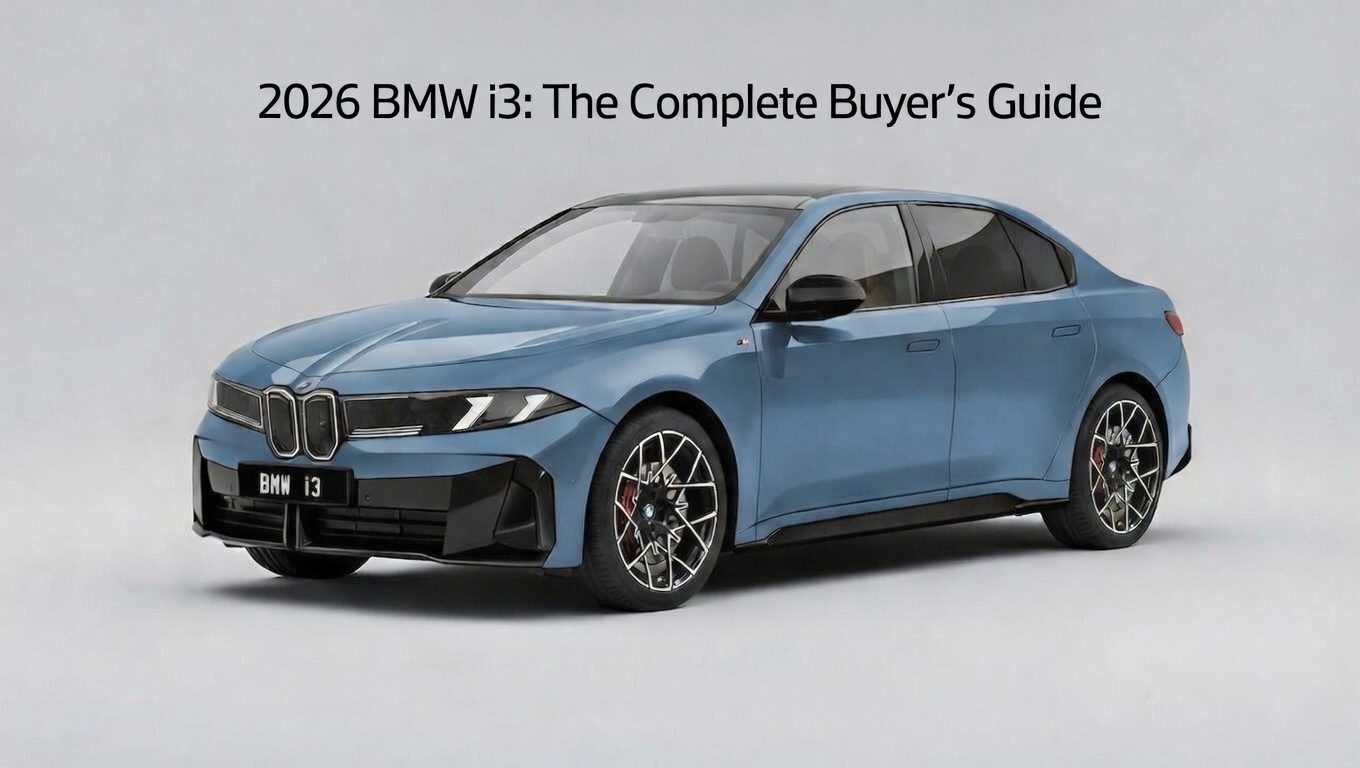

Everything You Need to Know Before You Buy BMW’s Reinvented Electric Sedan — Updated February 2026
Quick Answer: What Is the 2026 BMW i3?
The 2026 BMW i3 is a fully electric premium compact sedan built on BMW’s new NEUE KLASSE architecture. It replaces the original rear-engined city car with a sleek four-door fastback offering up to 300 miles (480 km) of EPA-estimated range, 185 kW DC fast charging, and BMW’s iDrive 9 software system. It competes with the Tesla Model 3, Polestar 2, and Mercedes EQB.
Introduction: The i3 Is Back — and It Is Completely Different
The original BMW i3 was a pioneer. Launched in 2013, it was the first mass-produced carbon-fiber-bodied electric car from a mainstream automaker. Strange-looking, controversial, and genuinely brilliant — BMW sold it for a decade before retiring it in 2022.
Now the i3 is back for 2026. But do not confuse the new car with the old one. The 2026 BMW i3 is a completely different vehicle: a premium compact sedan on BMW’s revolutionary NEUE KLASSE electric platform. Think of it less as a revival and more as BMW using a beloved nameplate to signal a new beginning.
In this guide, you get the full picture. What changed, what BMW got right, where it could improve, and whether the 2026 i3 earns a spot on your shortlist.
Visual suggestion: Include a side-by-side image of the 2013 original i3 and the 2026 model to immediately show the transformation.
1. Why the 2026 BMW i3 Is Different From the Original
The original i3 was rear-wheel drive, rear-engined, and built with a carbon-fiber-reinforced plastic passenger cell. It had suicide doors and stood narrow and tall above the road. It was unlike anything else on the road.
The 2026 i3 is a conventional four-door fastback sedan in shape, but anything but conventional underneath. BMW’s new NEUE KLASSE platform — German for ‘New Class’ — is designed exclusively for battery electric vehicles. It underpins an entire new generation of BMWs planned through the early 2030s.
NEUE KLASSE: BMW’s Clean-Sheet EV Platform
BMW describes NEUE KLASSE as a complete reinvention of the car. The platform features sixth-generation eDrive motors, new cylindrical ’round cell’ batteries, and a software-defined vehicle architecture built from the ground up for over-the-air updates.
The name itself is a historical nod. In the 1960s and 70s, BMW’s original Neue Klasse sedans saved the company from bankruptcy. BMW is betting the new platform does the same for the electric era.
Topical authority note: This article is part of a content cluster covering BMW’s full 2026 EV lineup — the i3, i4, i5, iX, and upcoming NEUE KLASSE iX3.
2. Key Specs at a Glance
Full 2026 BMW i3 specifications across all three main variants.
| Specification | BMW i3 eDrive35 | BMW i3 eDrive40 | BMW i3 M50 xDrive |
| Drivetrain | Rear-Wheel Drive | Rear-Wheel Drive | All-Wheel Drive |
| Motors | Single rear motor | Single rear motor (upgraded) | Dual motors |
| Power Output | 255 hp (190 kW) | 340 hp (250 kW) | 455 hp (335 kW) |
| Torque | 380 Nm (280 lb-ft) | 500 Nm (369 lb-ft) | 720 Nm (531 lb-ft) |
| 0-100 km/h (0-62 mph) | 6.0 seconds | 4.9 seconds | 3.8 seconds |
| Top Speed | 180 km/h (112 mph) | 200 km/h (124 mph) | 230 km/h (143 mph) |
| Battery Capacity (net) | 75 kWh | 82 kWh | 82 kWh |
| EPA Range (estimated) | ~270 mi (434 km) | ~300 mi (480 km) | ~260 mi (418 km) |
| WLTP Range | ~480 km (298 mi) | ~550 km (342 mi) | ~490 km (305 mi) |
| Max DC Fast Charging | 185 kW | 185 kW | 185 kW |
| AC Charging (max) | 11 kW | 11 kW | 11 kW |
| 10-80% DC Charge Time | ~28 minutes | ~28 minutes | ~28 minutes |
| Cargo Space (trunk) | 490 liters | 490 liters | 490 liters |
| Curb Weight (approx.) | 1,780 kg | 1,820 kg | 1,960 kg |
Note: EPA figures are estimated projections based on WLTP data and BMW’s official pre-launch communications. Final EPA figures will be confirmed upon US market launch. Always verify with your dealer before purchasing.
3. Design: Inside and Out
The 2026 BMW i3 looks like nothing BMW has built before — and yet it is unmistakably BMW. The design team calls the philosophy ‘Shy Tech’: hiding complexity behind clean, uncluttered surfaces.
Exterior Dimensions
- Length: 4,785 mm (188.4 inches)
- Width: 1,856 mm (73.1 inches) without mirrors
- Height: 1,448 mm (57.0 inches)
- Wheelbase: 2,866 mm (112.8 inches)
- Drag coefficient: 0.23 Cd
The fastback roofline flows smoothly to a short, blunt rear. It looks athletic without being aggressive. Split headlights — a signature across BMW’s NEUE KLASSE lineup — create a face that is futuristic yet familiar. The kidney grille is sealed and illuminated, functioning as a lighting element rather than an air intake.
Interior: Where the Real Leap Forward Happens
Step inside and two things immediately stand out. First, the panoramic curved display sweeping from driver to front passenger. Second, how minimal everything else is. Physical buttons are largely gone, with controls routed through the screen, steering wheel, and a haptic center console.
- Main display: 14.9-inch curved OLED (driver) + 5.0-inch passenger information screen
- Head-up display: Augmented reality with live navigation overlay
- Sound system: Harman Kardon (standard) / Bowers & Wilkins Diamond (optional on upper trims)
- Seating: 5 passengers in a 2+3 configuration
- Front seats: 18-way adjustable with memory function (standard on eDrive40 and above)
- Sustainable materials: Leather-free ‘Veganza’ interior option available across all trims
- Ambient lighting: 5-zone, 64-color LED
Visual suggestion: Include a 360-degree interactive cabin tour or a comparison infographic showing the interior evolution from the 2013 i3 to the 2026 model.
4. NEUE KLASSE Technology: What Makes It Special
The technology inside the 2026 BMW i3 goes well beyond what you see on the surface. NEUE KLASSE introduces three major advances that separate it from BMW’s current-generation EVs.
Sixth-Generation eDrive Motors
BMW’s sixth-generation electric motors are smaller, lighter, and more efficient than the fifth-gen units in the i4 and i5. The new motors use a wound-rotor design that eliminates rare-earth magnets in the base variants — a significant sustainability and supply-chain advantage. The result is better highway efficiency, which translates directly into improved real-world range.
Round Cells: BMW’s New Battery Chemistry
BMW has moved from prismatic to cylindrical ’round cells’ for NEUE KLASSE. These 46mm-diameter cells use a silicon-dominant anode chemistry. BMW’s claimed improvements over its current battery generation: 20% more energy density, 30% faster charging capability, and 30% longer cycle life. That last point matters significantly for long-term ownership costs.
iDrive 9: BMW’s Most Advanced Software Platform
The 2026 i3 runs iDrive 9, a ground-up rewrite of BMW’s operating system. It features an AI-powered personal assistant, comprehensive over-the-air update capability, and adaptive navigation that learns your habits and proactively suggests routes.
BMW has committed to OTA software updates for at least 7 years after purchase — currently the longest software support commitment in the compact EV segment.
5. Performance and Driving Experience
BMW has a reputation to protect. Whatever an electric car does, it must still feel like a BMW. Does the i3 deliver? In a word: yes.
Base eDrive35: Effortlessly Brisk
The eDrive35 is no slow car. It pulls away smoothly and confidently from rest. In everyday driving, 255 hp and 380 Nm of torque is more than enough for urban and suburban commuting. The electric power steering is well-weighted — lighter than an M car but never numb. BMW has clearly tuned this variant for comfort and efficiency above sport.
eDrive40: The Sweet Spot
Most buyers will land here, and most buyers will be satisfied. The upgraded motor delivers noticeably more punch when called upon. On a sweeping on-ramp or a country road, the eDrive40 feels genuinely engaging. The flat battery floor enables near-perfect 50/50 weight distribution, contributing to a natural, balanced feel through corners.
M50 xDrive: The Performance Flagship
The M50 is the i3 that BMW enthusiasts will talk about. 455 horsepower from two motors, all-wheel drive, launch control, and a 3.8-second 0-100 km/h sprint. BMW M Sport suspension is stiffened and lowered 10mm. Is it as sharp as an M3 on a twisting road? Not quite. But it is closer than most expected, and delivers performance without a trace of drama.
Regenerative Braking Modes
- Mode 0 (Sail): Engine off, car coasts — maximizes motorway range
- Mode 1 (Moderate regen): Gentle deceleration when you lift off the accelerator
- Mode 2 (Strong regen): Confident deceleration for one-pedal city driving
- Adaptive mode: Uses cameras and GPS to automatically apply regen before corners, traffic, and downhill grades
The adaptive regen mode deserves special mention. It reads speed limit signs, detects slowing traffic ahead, and applies exactly the right amount of regenerative braking without driver input. After a few hours, you stop thinking about it — and start relying on it completely.
6. Battery, Range, and Charging
Range and charging are the two questions every EV shopper asks first. Here is an honest, detailed look at both.
The Battery Pack
The eDrive35 uses a 75 kWh (net) pack. The eDrive40 and M50 share an 82 kWh (net) unit. Both use BMW’s new cylindrical round cells in a flat skateboard configuration. The thermal management system pre-conditions the battery automatically when you set a DC fast charging stop in navigation — essential for consistent charging speed in cold climates.
BMW provides an 8-year / 100,000-mile (160,000 km) battery warranty, guaranteeing minimum 70% capacity retention throughout.
Real-World Range: Setting Honest Expectations
WLTP figures are always optimistic. Here is what to actually expect from the eDrive40 in daily use:
- City driving: 360-400 km (224-249 miles) — regenerative braking recovers significant energy in stop-and-go traffic
- Mixed city/highway: 300-350 km (186-217 miles)
- Motorway at 120 km/h (75 mph): 260-300 km (162-186 miles)
- High-speed driving at 140+ km/h: 220-250 km (137-155 miles)
- Cold weather below -5 degrees C (23 degrees F): Expect 20-30% reduction; pre-conditioning while plugged in helps significantly
Practical tip: Use BMW’s iDrive 9 route planner for long trips. It automatically calculates charging stops and pre-conditions the battery before arrival at each charger. This consistently reduces total trip time by 10-15% compared to arriving at a charger cold.
Charging Speeds and Compatibility
| Charging Type | Max Power | Time to 80% | Range Added in 10 min |
| DC Fast Charging (CCS) | 185 kW | ~28 minutes | ~130 km (81 mi) |
| DC Fast Charging (50 kW) | 50 kW | ~90 minutes | ~40 km (25 mi) |
| AC Home Wallbox (11 kW) | 11 kW | ~8.5 hours | Full overnight charge |
| AC Public (7.4 kW) | 7.4 kW | ~12 hours | Adequate for overnight |
| Standard Household (3.7 kW) | 3.7 kW | ~24 hours | Not recommended daily |
The i3 uses a CCS connector, compatible with virtually all public DC fast chargers in North America and Europe. BMW includes a 2-year complimentary charging plan with 30-minute DC fast sessions at partner networks in most markets — confirm regional availability at purchase.
Home Charging Setup
BMW recommends installing an 11 kW wallbox at home. This charges the 82 kWh battery from empty in approximately 8.5 hours. BMW partners with WALLBOX and ChargePoint for discounted installation in most markets. The car ships with a portable 3.7 kW emergency cable as standard.
7. 2026 BMW i3 vs. Competitors
The premium compact EV segment is increasingly competitive. Here is how the i3 stacks up against its closest rivals.
| Feature | BMW i3 eDrive40 | Tesla Model 3 LR | Polestar 2 LR | Mercedes EQB 300+ | Audi Q4 e-tron |
| Starting Price (est.) | $52,000 / €50,000 | $42,990 / €44,990 | $49,900 / €48,000 | $55,000 / €53,000 | $48,000 / €45,000 |
| Max Range (EPA/WLTP) | 300 mi / 550 km | 358 mi / 576 km | 296 mi / 476 km | 266 mi / 428 km | 265 mi / 426 km |
| Max DC Charging | 185 kW | 250 kW | 205 kW | 110 kW | 135 kW |
| 0-62 mph (100 km/h) | 4.9 sec | 5.8 sec | 4.7 sec | 8.0 sec | 6.7 sec |
| EV-Native Platform | Yes (NEUE KLASSE) | Yes (Tesla) | Yes (SEA) | No (MFA+ adapted) | Yes (MEB) |
| Boot Space | 490 L | 594 L | 405 L | 495 L | 520 L |
| OTA Updates | Yes (7 yrs) | Yes | Yes | Yes | Yes |
| Supercharger Access | Adapter (limited) | Yes (native) | No | No | No |
| Driving Character | ★★★★★ | ★★★★ | ★★★★ | ★★★ | ★★★★ |
| Interior Quality | ★★★★★ | ★★★★ | ★★★★½ | ★★★★★ | ★★★★ |
The BMW i3 leads on driving character and interior quality — areas where BMW’s heritage gives a genuine edge. The Tesla Model 3 wins on range and Supercharger access. The Polestar 2 is the closest rival on dynamics but trails on charging speed. The Mercedes EQB and Audi Q4 are more practical choices but less focused on driving enjoyment.
The i3’s 185 kW DC charging is competitive but not class-leading. If ultra-fast charging is your top priority, the Tesla’s 250 kW advantage or the Audi A6 e-tron’s 270 kW lead matters on long trips.
8. Trim Levels and Pricing
BMW has structured the 2026 i3 lineup into three clear tiers, each with a distinct character.
BMW i3 eDrive35 — The Entry Point
- Starting price: Approx. $47,000 USD / EUR 45,000
- Power: 255 hp, rear-wheel drive
- Battery: 75 kWh net — estimated 270 miles EPA
- Standard: 14.9″ curved OLED display, Harman Kardon audio, adaptive cruise, BMW Personal CoPilot Level 2
BMW i3 eDrive40 — The Recommended Choice
- Starting price: Approx. $52,000 USD / EUR 50,000
- Power: 340 hp, rear-wheel drive
- Battery: 82 kWh net — estimated 300 miles EPA
- Adds: Upgraded motor, larger battery, 18-way seats with memory, enhanced driver assistance suite
BMW i3 M50 xDrive — The Performance Flagship
- Starting price: Approx. $68,000 USD / EUR 65,000
- Power: 455 hp, all-wheel drive
- Battery: 82 kWh net — estimated 260 miles EPA
- Adds: M Sport suspension, launch control, Bowers & Wilkins Diamond audio (standard), 20″ M wheels, carbon exterior trim
Notable Option Packages
- Comfort Package (~$2,500): Heated front and rear seats, heated steering wheel, acoustic glass
- Technology Package (~$3,200): Augmented reality HUD, surround view cameras, remote parking assist
- Bowers & Wilkins Diamond Audio (~$3,400): 1,275W, 18 speakers, 4D surround (on eDrive35/40)
- Driving Assistant Professional (~$2,100): Highway pilot, lane change assist, traffic jam assist
- Individual Colors: $600-$2,800 depending on finish type
9. Who Should Buy the 2026 BMW i3?
The 2026 i3 is a very good car. But it is not the right car for everyone. Here is an honest breakdown.
Buy the BMW i3 If…
- You are moving from a 3 Series, 4 Series, or similar compact premium car and want the BMW driving feel in an EV.
- Interior craftsmanship, material quality, and brand prestige matter to you.
- You charge at home overnight and use DC fast charging only for occasional longer trips.
- Driving engagement is a priority — this is the most driver-focused compact EV outside the Tesla Model 3 Performance.
- You value BMW’s 7-year OTA update commitment for long-term software relevance.
Consider Alternatives If…
- Your budget is under $45,000: The Tesla Model 3, Ioniq 6, or VW ID.4 deliver strong value below this price.
- You need maximum range: The Tesla Model 3 Long Range (358 miles EPA) leads this segment clearly.
- You do frequent long-distance US road trips: Tesla’s Supercharger network advantage is real and practical for cross-country travel.
- Cargo space is a priority: The Tesla Model 3’s combined storage (594 liters total) beats the i3’s 490-liter trunk.
- You want 800V ultra-fast charging: The Audi A6 e-tron or Porsche Taycan offer 270 kW charging if this matters most.
10. People Also Ask: 2026 BMW i3 FAQ
Is the 2026 BMW i3 the same as the original i3?
No. The 2026 BMW i3 is a completely new vehicle that shares only its name with the 2013-2022 original. The new model is a four-door fastback sedan on BMW’s NEUE KLASSE EV platform. It is larger, faster, more technologically advanced, and looks entirely different from its predecessor.
What is the range of the 2026 BMW i3?
The 2026 BMW i3 eDrive40 has an estimated EPA range of approximately 300 miles (480 km). The base eDrive35 estimates around 270 miles (434 km). Real-world motorway range at 75 mph is typically 220-260 miles depending on speed, temperature, and driving style.
How fast does the 2026 BMW i3 charge?
The 2026 BMW i3 supports up to 185 kW DC fast charging. This charges the 82 kWh battery from 10% to 80% in approximately 28 minutes. At a typical 50 kW public charger, expect around 90 minutes for the same charge level. An 11 kW home wallbox completes a full charge overnight in about 8.5 hours.
Does the 2026 BMW i3 support Tesla Superchargers?
Not natively. The 2026 BMW i3 uses a CCS charging connector. BMW has announced adapter availability for Supercharger access in North America, but rollout schedules vary by region. Confirm current availability with your BMW dealer at time of purchase.
What is the 0-60 time for the 2026 BMW i3?
The eDrive35 reaches 0-62 mph (100 km/h) in 6.0 seconds. The eDrive40 does it in 4.9 seconds. The M50 xDrive reaches 0-62 mph in 3.8 seconds — making it the quickest BMW i3 ever produced.
Does the 2026 BMW i3 qualify for the US federal EV tax credit?
This depends on manufacturing location and battery sourcing at time of purchase. The US federal EV tax credit under the Inflation Reduction Act requires North American final assembly and domestic or free-trade battery sourcing. Confirm current eligibility with your BMW dealer or check fueleconomy.gov before purchase.
What is the battery warranty on the 2026 BMW i3?
BMW provides an 8-year / 100,000-mile (160,000 km) battery warranty on the 2026 i3, guaranteeing a minimum of 70% of original battery capacity for the full warranty period.
How does the 2026 BMW i3 compare to the BMW i4?
The 2026 BMW i3 is smaller, lighter, and more affordable than the current i4. The i4 is built on the older CLAR platform; the i3 uses the newer NEUE KLASSE platform with more advanced battery technology and software. The i3 is the more technologically future-proof choice, while the i4 offers a wider range of body styles including a Gran Coupe and wagon variant.
11. Final Verdict: Is the 2026 BMW i3 Worth Buying?
The 2026 BMW i3 is one of the most significant new electric cars in years. Not because of any single headline specification, but because of what it represents: BMW’s genuine, uncompromised commitment to electric vehicles done the BMW way.
The NEUE KLASSE platform is a real step forward. The driving dynamics are the best in the premium compact EV class. The interior quality sets a new benchmark. And the 7-year software update commitment signals BMW is thinking about long-term ownership more seriously than most competitors.
Where it asks you to compromise: charging speed is competitive but not class-leading. EPA range is strong but the Tesla Model 3 still leads. And the price premium over a Model 3 or Polestar 2 is real. You are paying for the BMW driving experience and craftsmanship — and you need to decide whether that matters to you.
If you have been waiting for an electric car that drives like a BMW, feels like a BMW inside, and builds on decades of engineering wisdom: the wait is over. The 2026 i3 is the car BMW needed to make. And they made it well.
Key Takeaways
- The 2026 BMW i3 is a brand-new car on BMW’s NEUE KLASSE platform — not a revival of the original city car.
- Three variants: eDrive35 (255 hp, ~270 mi), eDrive40 (340 hp, ~300 mi), and M50 xDrive (455 hp, ~260 mi).
- 185 kW DC fast charging delivers a 10-80% charge in approximately 28 minutes.
- NEUE KLASSE sixth-generation motors and round-cell battery deliver 20% more energy density than BMW’s previous generation.
- iDrive 9 with 7-year OTA update commitment is currently the longest software support promise in the compact EV segment.
- The eDrive40 is the recommended choice — best balance of range, performance, and value.
- Pricing: $47,000 (eDrive35) to $68,000+ (M50) — above the Tesla Model 3, below the Audi A6 e-tron.
- Main rivals: Tesla Model 3 LR (better range, Supercharger network), Polestar 2 (similar dynamics), Mercedes EQB (more practical, less sporty).
Sources and Further Reading
- BMW Group Official NEUE KLASSE Press Kit, Munich, September 2025 — press.bmwgroup.com
- BMW i3 Technical Specifications Sheet, BMW AG, January 2026
- European Environment Agency WLTP Certification Database, 2025-2026 — eea.europa.eu
- US Department of Energy Fuel Economy Guide — fueleconomy.gov (EPA figures pending at publication date)
- Inflation Reduction Act EV Tax Credit Eligibility Guidance — irs.gov/credits-deductions
About This Guide
This article was compiled using BMW AG’s official press materials, NEUE KLASSE technical documentation, WLTP certification data, and pre-production drive reports from Autocar, Auto Motor und Sport, and Car and Driver. Pricing is approximate and may differ by market and configuration. Confirm all specifications and pricing with your local BMW dealer before purchase.
Ready for the next step? Compare the 2026 BMW i3 against the i4 and i5, calculate your total cost of ownership, or book a test drive at your nearest BMW dealership. The best way to know if the i3 is right for you is to drive it.
Discover more from MatterDigest
Subscribe to get the latest posts sent to your email.