2-Week Iran Ceasefire Took Effect, Here’s Where Things Stand

Quick Answer: What Happened?
On April 7–8, 2026, the United States and Iran agreed to a tentative two-week ceasefire, pausing active hostilities in an ongoing war that had started on February 28, 2026. Pakistan mediated the deal. The ceasefire was contingent on Iran immediately reopening the Strait of Hormuz. Both sides accepted it, but major differences remain — and the agreement is fragile.
Fake News Check: Separating Fact from Fiction
This story is real — but it contains several details that have been exaggerated or misrepresented on social media. Let us break them down clearly.
What Is True
- A two-week ceasefire between the US, Israel, and Iran was announced on April 7–8, 2026.
- Pakistan’s Prime Minister Shehbaz Sharif mediated the agreement.
- Iran’s Supreme National Security Council formally accepted the ceasefire.
- President Trump announced the deal on Truth Social.
- Iran’s Foreign Minister Abbas Araghchi confirmed Iran’s acceptance.
- The Strait of Hormuz — shut since the war began — was set to reopen.
- Iran presented a 10-point peace plan that Trump called ‘a workable basis to negotiate.’
What Is Disputed or Unclear
- Trump said the US would work with Iran to ‘dig up and remove’ all enriched uranium. Iran has NOT confirmed this.
- Pakistan’s PM Sharif announced the ceasefire covers ‘Lebanon and elsewhere.’ Israel and the US have contradicted this, saying Lebanon is NOT included.
- Trump suggested ‘regime change’ has occurred in Iran. This is misleading — Iran’s political and religious structure remains intact.
- Iran claims it ‘won’ by forcing the US to accept its 10-point plan. The US has not conceded anything formally.
What Is Completely False (Circulating on Social Media)
- FALSE: Iran’s Supreme Leader Ayatollah Ali Khamenei survived the war. He was killed on the first day — February 28, 2026 — along with other top officials.
- FALSE: The ceasefire applies to Yemen and Gaza. It does not — Hamas still controls roughly half of Gaza, and Houthi activity in Yemen is separate.
- FALSE: Iran has agreed to dismantle its nuclear program. Iran explicitly rejected this in its 10-point proposal.
Background: How Did We Get Here?
The 2026 Iran war began on February 28, 2026, making the April 8 ceasefire the 39th day of active conflict. To understand why this ceasefire matters — and why it may not hold — you need to understand the chain of events that led to it.
The Timeline: February to April 2026
| Feb 28, 2026 | War begins. US and Israeli strikes kill Supreme Leader Ayatollah Ali Khamenei (age 86) along with several top military leaders and officials. |
| March 2026 | Iran launches massive retaliatory strikes. By ceasefire day, Iran had fired over 5,000 drones, 2,100+ ballistic missiles, and 50+ cruise missiles. |
| March 25, 2026 | Pakistani officials deliver a US-led 15-point ceasefire proposal to Iran. Iran rejects it. |
| April 5, 2026 | Pakistan introduces the ‘Islamabad Accord’ — a 45-day two-phased ceasefire framework. Both the US and Iran reject it. |
| April 7, 2026 | Trump issues an ultimatum: ‘A whole civilization will die tonight’ if Iran does not agree to a deal by midnight GMT. |
| April 7–8, 2026 | Trump accepts Pakistan’s revised proposal for a 2-week ceasefire. Iran’s Abbas Araghchi confirms Iran’s agreement. |
| April 8, 2026 | Ceasefire takes effect. Iran immediately accuses the US of violating it amid continued Gulf drone attacks. |
What’s at Stake: The Big Unresolved Issues
A two-week pause is not a peace deal. Both sides know this. Here are the four biggest fault lines that make a permanent agreement difficult.
1. Iran’s Nuclear Program
This is the core of the dispute. The US and Israel have demanded Iran completely dismantle its nuclear program. Iran flatly rejected that in its 10-point peace proposal. All of Iran’s highly enriched uranium remains inside the country — likely entombed inside enrichment sites that were bombed by the US during what became known as a 12-day war last June 2025. Iran stopped enriching uranium after those strikes but insists it retains the legal right to enrich for peaceful purposes. Trump said on April 8 that the US would ‘dig up and remove’ the enriched uranium. Iran has not confirmed this.
2. Iran’s New Leadership
Trump suggested ‘regime change’ has occurred. This is an oversimplification. Khamenei’s son, Mojtaba Khamenei, succeeded his father as Supreme Leader. Mojtaba is considered even more hostile toward the United States than his father. He is believed to have been wounded in the same strike that killed his father and has not been seen or spoken publicly since the war began. The religious and political class that runs Iran’s Shiite theocracy remains largely intact.
3. Iran’s Proxy Groups — Hezbollah, Hamas, and the Houthis
Israel has demanded Iran end its support for armed groups across the region. Iran refused this in its peace proposal entirely — it was not even mentioned. Lebanon’s Hezbollah is actively fighting Israel and both Trump and Netanyahu say the ceasefire does NOT cover Lebanon. Hamas still controls roughly half of Gaza under a previous US-brokered ceasefire. Yemen’s Houthi rebels fired on Israel only a handful of times during the war and largely left Red Sea shipping alone during this period.
4. The Strait of Hormuz and Energy Markets
One of the ceasefire’s key conditions is the immediate reopening of the Strait of Hormuz. Since the war began, Iran had been reportedly charging ships as much as $2 million per vessel to allow passage through the strait — which sits in the territorial waters of both Iran and Oman. The disruption shook global energy markets and sent fuel prices soaring. As jet fuel costs rose, US airlines including Delta moved to raise checked baggage fees. Trump said the US would help ‘with the traffic buildup’ as the strait reopens.
Where Does Israel Stand?
Israel’s position is more complicated than it might appear. Prime Minister Benjamin Netanyahu welcomed the halt to strikes on Iran but was swift to clarify that the ceasefire does not apply to the war in Lebanon. This directly contradicts what Pakistan’s PM Sharif announced.
Israel has received assurances from the US that Iran’s nuclear and missile programs will be addressed in negotiations. But many Israelis are expected to be frustrated by another inconclusive conflict — a political problem for Netanyahu, who faces elections later in 2026. Israel mauled Iran’s allied militant groups across the region in a series of wars that began with Hamas’ October 7, 2023 attack out of Gaza.
Key Players in the Ceasefire
| Donald Trump | US President. Issued the midnight ultimatum. Accepted Pakistan’s 2-week proposal. Says Iran must agree to full nuclear disarmament in final deal. |
| Mojtaba Khamenei | Iran’s new Supreme Leader. Son of the late Ayatollah Ali Khamenei. Believed wounded. Not seen publicly since the war began. |
| Abbas Araghchi | Iran’s Foreign Minister. Officially confirmed Iran’s acceptance of the ceasefire on behalf of Tehran. |
| Shehbaz Sharif | Pakistan’s Prime Minister. The key mediator. Announced the ceasefire publicly and called on Trump to extend his deadline. |
| JD Vance | US Vice President. Reported by CBS News to serve as the US interlocutor in the ceasefire negotiations. |
| Benjamin Netanyahu | Israeli PM. Welcomed the ceasefire for Iran — but insisted Lebanon is excluded. Faces domestic political pressure. |
| Karoline Leavitt | White House Press Secretary. Confirmed Trump was ‘made aware’ of Pakistan’s proposal. |
What Could Happen Next? Three Scenarios
Scenario 1: Ceasefire Holds and Negotiations Progress
If both sides show goodwill over the two-week window, formal negotiations could begin on a permanent deal. This would likely involve extended discussions over the nuclear program, sanctions relief, and proxy group activity. The two-week window is tight — but it creates space for diplomacy that did not exist while bombs were falling.
Scenario 2: The Ceasefire Breaks Down
This is the most likely short-term risk. Iran already accused the US of violating the ceasefire on April 8 — the very first day it took effect. Gulf states including Kuwait, the UAE, Bahrain, Iraq, and Saudi Arabia reported intercepting Iranian drones throughout that day. A fire broke out at Abu Dhabi’s Habshan gas complex and a Saudi pipeline was reportedly struck by a drone. Qatar confirmed intercepting seven missiles and drones. Iran’s state television said those strikes were retaliation for previous attacks on Iranian oil facilities.
Scenario 3: A Frozen Conflict
The ceasefire holds in letter but not in spirit. Low-level attacks by Iranian proxy groups continue. Negotiations drag on without a final deal. The Strait of Hormuz stays nominally open but tensions remain high. Energy markets stay volatile. This is arguably the most historically common outcome of such arrangements in the Middle East.
Regional and Global Impact
Energy Markets
The war has caused a sharp rise in global fuel prices and disrupted trade passing through the Strait of Hormuz — one of the world’s most critical energy chokepoints. The reopening of the strait, a condition of the ceasefire, is expected to bring some relief. However, if the ceasefire collapses, prices could spike again almost immediately.
Gulf States
Kuwait, the UAE, Bahrain, Saudi Arabia, Iraq, and Qatar all reported intercepting Iranian missiles and drones on April 8 alone — the first day of the supposed ceasefire. A fire broke out at Abu Dhabi’s Habshan gas complex. These countries are caught between their relationship with the US and the direct threat from Iranian forces and allied groups operating in the region.
The Iranian Public
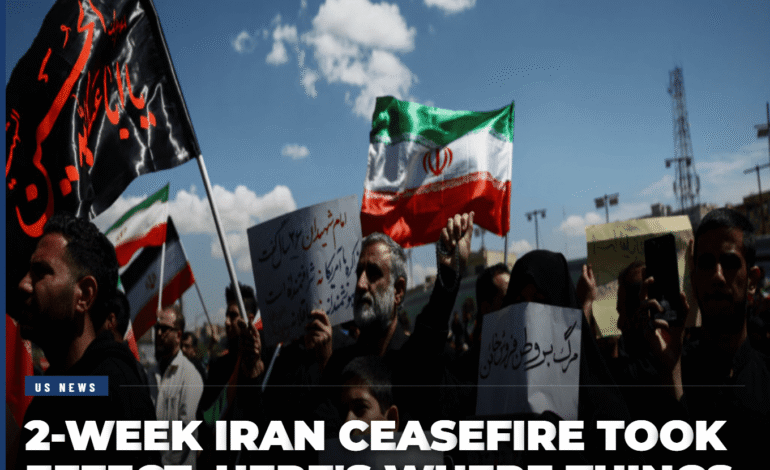
Many ordinary Iranians are angry at their own government. Pro-government demonstrations were held in Tehran following the ceasefire announcement — with crowds holding posters of new Supreme Leader Mojtaba Khamenei. But there has been no popular uprising. Authorities crushed mass protests in January 2026, before the war began, and the state security apparatus remains firmly in control.
Frequently Asked Questions
Q: Is the Iran ceasefire real or fake news?
The ceasefire is real and verified. It was confirmed by multiple major news organizations including the Associated Press, CBS News, NBC News, CNN, Fox News, and PBS NewsHour, as well as official statements from both the US and Iranian governments.
Q: Did Iran’s Supreme Leader survive the war?
No. Ayatollah Ali Khamenei was killed on the very first day of the war — February 28, 2026. He was succeeded by his son, Mojtaba Khamenei, who is believed to have been wounded in the same strike and has not appeared publicly since.
Q: Does the ceasefire include Lebanon?
This is disputed. Pakistan’s PM Sharif said it covers ‘Lebanon and elsewhere.’ Both Trump and Netanyahu contradicted this, saying Lebanon is explicitly NOT included, and fighting with Hezbollah will continue.
Q: Has Iran agreed to give up its nuclear program?
No. Iran explicitly rejected calls for full dismantlement of its nuclear program in its 10-point peace proposal. Iran maintains it has the right to enrich uranium for peaceful purposes and denies seeking nuclear weapons.
Q: Who brokered the ceasefire?
Pakistan’s Prime Minister Shehbaz Sharif played the central mediating role. He proposed the two-week framework after Iran rejected the US’s 15-point proposal and Pakistan’s own 45-day ‘Islamabad Accord.’
Key Takeaways
- The two-week Iran ceasefire is REAL — confirmed by the US, Iran, Pakistan, and major global newsrooms.
- The ceasefire is tentative and fragile. Iran accused the US of violating it on Day 1.
- Iran’s political system is intact. Reports of ‘regime change’ are misleading.
- The nuclear question remains the biggest obstacle to any permanent peace deal.
- Lebanon and Gaza are NOT included in the ceasefire.
- The Strait of Hormuz is expected to reopen — a major economic development.
- JD Vance will serve as the US’s key negotiator in the upcoming talks.
Sources & Further Reading
- Associated Press / PBS NewsHour — ‘Where things stand after a tentative, 2-week Iran ceasefire took effect’ (April 8, 2026)
- The Washington Times — ‘Here’s where things stand after a tentative, 2-week Iran ceasefire took effect’ (April 8, 2026)
- CBS News — ‘U.S. and Iran reach 2-week ceasefire ahead of Trump’s deadline’ (April 8, 2026)
- NBC News — ‘Iran war ceasefire begins, though some new attacks hit Gulf’ (April 8, 2026)
- CNN — ‘Day 39 of Middle East conflict — US, Israel, Iran agree to ceasefire before Trump’s deadline’ (April 7, 2026)
| About This Article This news analysis was compiled by the Claude AI News Desk on April 9, 2026, drawing on verified reporting from the Associated Press, CBS News, NBC News, CNN, Fox News, PBS NewsHour, and The Washington Times. All facts have been cross-referenced against multiple major news sources. Disputed or unconfirmed claims are clearly labeled as such. This article is intended for informational purposes and does not represent an editorial position. |
Discover more from MatterDigest
Subscribe to get the latest posts sent to your email.